
NAZARENI. — Sect of Wesleyan origin, arising at the beginning of the twentieth century (Church of the Nazarene).
It was widely held among Protestants that after Wesley’s death (1791) the idea of «perfect sanctification» had no longer been emphasized, and that it had almost disappeared during the eighteenth century because of the enormous development of Wesley’s other doctrine concerning «conversion». Groups of «holiness» and Pentecostal groups arose here and there, claiming to revive in Christians the idea of perfect holiness, manifested through the charisms bestowed by the Holy Spirit at Pentecost.
From three of these groups, which united in 1907, arose the Pentecostal Church of the Nazarene. From three other groups that had united in 1904 the Holiness Church of Christ had been formed; in 1915 it merged with the Pentecostal Church of the Nazarene. In 1919, at the General Assembly in Kansas City (Missouri), it was decided to omit the name «Pentecostal», retaining the name Church of the Nazarene. The reason for this change was that, in the meantime, many Pentecostal Churches had developed that regarded the «gift of tongues» as a manifestation of the Baptism of the Holy Spirit; the General Assembly of Kansas City therefore wished to make it known that it rejected this doctrine.
The Church of the Nazarene, constituted Methodism (v.) and Pentecostalism, acknowledges the necessity of repentance, followed by justification and regeneration. Entire sanctification is the act of God by which regenerated man, freed from sin, is made perfect through the Baptism of the Holy Spirit. This perfection is also called «Perfect Love; Baptism of the Holy Spirit; fullness of blessings; Christian holiness» and enables the Christian who possesses it to avoid, and in fact to avoid, all sins (a doctrine directly opposed to the Council of Trent, sess. VI, can. 23). The ecclesiastical organization is similar to that of the Methodists. The n. have missions in Africa, Asia, and Latin America, especially in Guatemala, and work toward the formation of national ministers. They number fewer than 100,000, but are well organized.
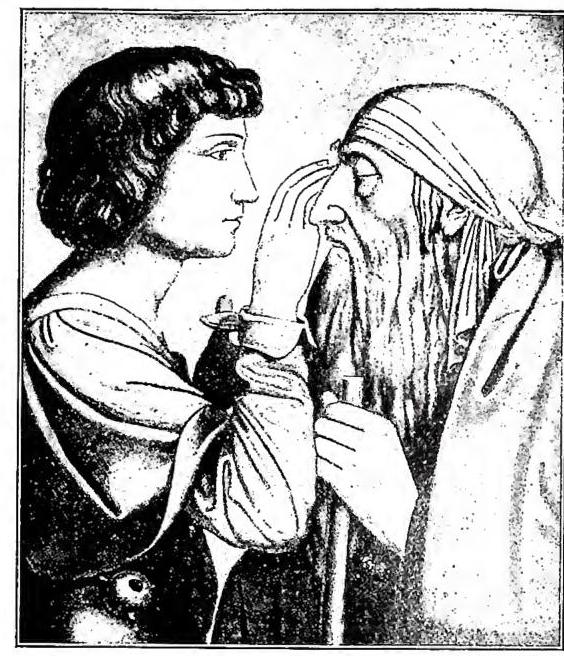
For the N., art was understood as a means of religious propaganda; they therefore despised the cult of formal and corporeal beauty exalted by the Neoclassicists. Their theories, in any event, must also be connected with those of the Italian «purists» and of those in other countries who, with varying emphases, represented an intermediate moment between Neoclassical manifestations and the more explicitly Romantic ones that preceded the emergence of Realism. The principal painters who belonged to the N. group were, besides the already mentioned Overbeck, P. Cornelius, Ph. Veit, W. von Schadow, Schnorr von Carolsfeld and J. Führich.
Their principal works, programmatic in character and executed collaboratively, were painted in Rome. They are the frescoes of the Bartholdy house (1816), detached as early as the last century and transported to Berlin, to the Frederick Museum, and those of Villa Massimo Lancellotti (1821) near S. Giovanni. Later, in 1843, when the N. group had already in practice dissolved, Overbeck signed with T. Minardi and P. Tenerani the manifesto of «purism», drafted by the painter and man of letters Antonio Bianchini. - Vedi tav. CXII.