
RELIGION OF THE GERMANS. - On the religious beliefs of the ancient Germanic peoples prior to their contact with the Roman world, that is, up to the methodical conquest under Augustus, virtually no reliable information of any importance is available. The reports from direct sources for the later period — that is, the period extending up to their conversion to Christianity — are likewise extremely scanty, since, as is well known, it was only with that conversion that the use of writing for literary purposes began among those peoples, and their prehistory may therefore be said to come to an end.
The fact that the conversion itself was not accomplished simultaneously among the various families of the Germanic stock, but dragged on for about eight centuries — from the mid-4th century, when the Visigoths of Moesia were converted to Arianism, to beyond the 11th, when the ecclesiastical provinces of Scandinavia were organized — as well as the circumstance that in certain regions the conversion itself took place peacefully and gradually as a result of a propaganda conducted with the greatest prudence and tolerance, even allowing pagan customs and rites to survive here and there, as among the Anglo-Saxons and Scandinavians, while in others, on the contrary, where it was also and above all a political matter, as among the Frisians and Saxons in the time of Charlemagne, it was imposed with the rigor of laws and at times with the violent destruction of everything that recalled the ancient faith — explain not only how the picture of paganism that can be reconstructed today is notably different among the various families, but also how the sources from which it is possible to draw flow in such varied ways. For the territories of Germany proper it may be said that there is nothing but indirect information — apart from a few archaeological finds of doubtful interpretation and a few literary fragments that are likewise controversial — that is, the works of ancient writers, especially Tacitus, which, however, give isolated and often superficial information, several medieval historians of the Germanic families, Jordanes for the Goths, Gregory of Tours for the Franks, Paul the Deacon for the Lombards, Widukind for the Saxons, and the biographies of the missionaries who evangelized the Germanic peoples, St. Columban, St. Gall, St. Boniface, both of which categories often lack precision or, especially the latter, are understandably not sufficiently objective. For the regions of Northern Europe, on the other hand, where, as was said, paganism survived until beyond the year 1000, there is an incomparable wealth of direct sources, that is, a substantial national literature (v. EDDA) in which not only is a complex divine saga organically developed, but a complete cosmogonic and eschatological doctrine is also fixed. Such a mythology, so-called Nordic, cannot however be taken except very cautiously as the basis for the reconstruction of the common paganism, since it is sometimes not only the result of independent developments, but has most often undergone notable foreign and especially Christian influences, and therefore does not represent a complex of popular beliefs, but rather an artistic and aristocratic epic, a learned poetry.
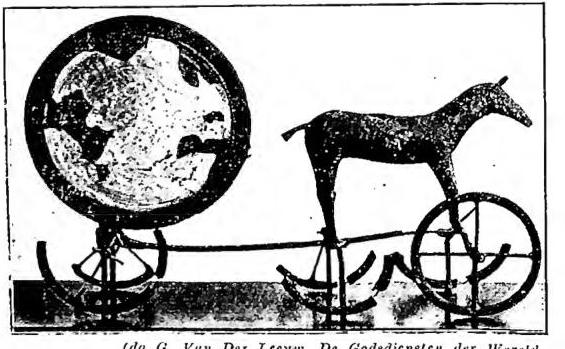
At the time of their entry into history the Germanic populations venerated certain anthropomorphic divinities, already modeled with particular ethical characteristics and with very simple but no longer rudimentary forms of worship, in rough wooden temples, which originally seem to have lacked a roof, the shade of sacred forests sufficing for this purpose, consecrated trees and idols of wood or stone to which sacrifices of fruit, of animals and often of human victims were offered: priests not constituted in a special caste and whose dignity was perhaps a prerogative of the elders and of the most prominent families, indeed sometimes of the princes themselves. The collective name of the gods was Asi. Their number varies according to regions and epochs: while the Norse poets sometimes fixed it at 9, at other times at 12 and even at 14, Tacitus speaks of three principal divinities, and numerous other testimonies agree with him, among them the famous Saxon "formula of abjuration" of the 8th century in which are cited the names of the gods to which the neophytes had to renounce upon receiving Baptism, namely Donar, Wodan and Ziu, whom the Romans identified with Jupiter, Mercury and Mars, and who in the North had respectively the names of Thor, Odin and Tyr. Supremacy over the others and over the entire celestial consortium was held now by one, now by the other of the first two. In any case, this is a decided polytheism: the hypotheses of certain scholars who discern indications of monotheism either at the beginning of the Germanic religious conception, or as the final tendency of its development, or as a latent character, are untenable. Specific, on the other hand, is the fact that all three are, more or less, divinities of war and that their principal attributes relate to this: a quality perhaps not original, but acquired through the stormy vicissitudes and the centuries-old conflicts of the migrations, which exalted to the highest degree the warlike instincts of those peoples and impressed a dark and bellicose character upon their divine saga just as they offered the motive of the tragic fatality that fills their national epic.
Of these three divinities the oldest is certainly Ziu, who represents the original celestial god of Aryan antiquity, common, by etymological concordance, to all the peoples. Among the G. of the historical era, however, he had already assumed the character and attributes of a god of war, for which reason Tacitus, who speaks of his cult among certain populations and relates that the victors consecrated to him all the men of the defeated army, identified him with Mars. Similarly, when the G. of the Rhenish region in the 3rd and 4th centuries felt the need to translate the Latin days of the week into German, replacing the names of the Roman deities, from which the five then-known planets took their names, with the names of the corresponding Germanic deities, Ziu took the place of Mars to render dies martis: Ziostac and, in the north, Tysdagr. Whether to Ziu, under the name of Irmino, as progenitor of the Erminones, the enigmatic Irminul or columna universalis should be understood as consecrated, that is a gigantic tree trunk, venerated especially among the Saxons, but also elsewhere, one of which was destroyed by Charlemagne in 772 near Eresburg, or whether the word Irmin confers on compounds a superlative sense without any relation to some particular deity, is nevertheless doubtful.
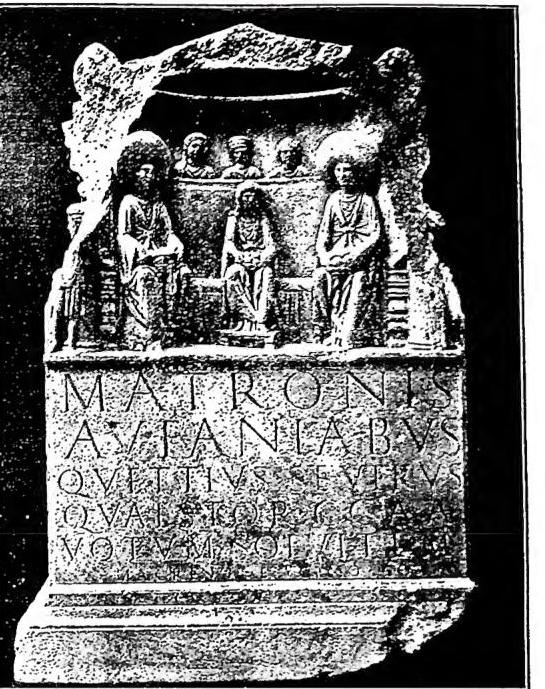
Donar enjoyed general worship, who in the north bore the name of Thor. A god of thunder, as his name indicates, he was first erroneously identified by Tacitus with Hercules and then correctly with Jupiter, although only later and only in Scandinavia did he hold the first place among all the gods; in the other regions he seems always to have had a position inferior to Ziu, then to Wodan. He was considered the strongest and most valiant of the gods and was invoked by combatants before battle. Animal sacrifices were offered to him and trees were consecrated to him, such as the oak of Geismar, felled by St. Boniface, who with its wood had an oratory built to St. Peter. In the north he is the god of the common people, protector of the home, of property and of the nation. A personification of natural force used in defense of the weak, he appears as the invincible vanquisher of the hostile giants, the avenger and protector of the divine consortium. Represented as a handsome man, tall and robust with a long red beard, armed with a formidable short-handled hammer, he may be called the most Germanic of all the gods, the one who even in Norse literature attained the greatest idealization without foreign elements. His name took the place of Jupiter in the formation of the word corresponding to Thursday in all the Germanic languages.
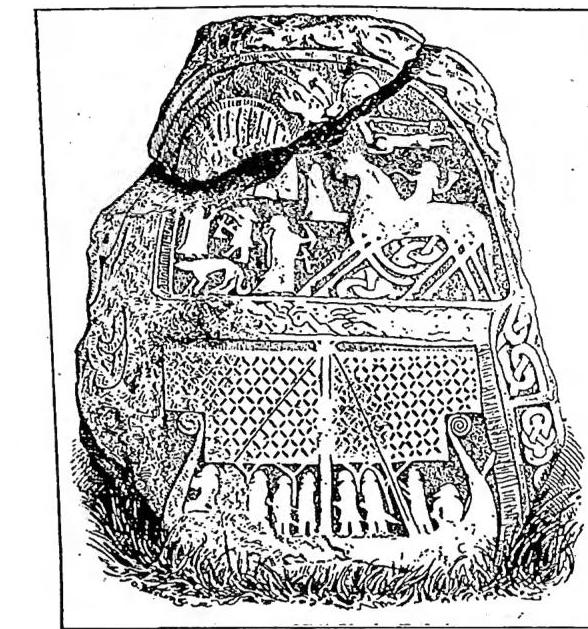
In the western and northern territories of Germany proper, the first place among the gods seems always to have been held by Wodan, whom the Romans identified with Mercury. Originally of a demonic character, a leader, on stormy nights, of the wild hunt, that is of the host of souls whom he then leads back into the bosom of the mountains, he later lost this character and assumed the attributes of a celestial god, lord of war and victory, but also of spiritual life and civilization. In the north, where he was at the center of the cult and became the aristocratic god of the courts and the favorite of the Skalds, a rich complex of myths developed around his figure, representing him as universal father and supreme ordainer of the world, sovereign of the magical art and inventor of the "runes" (the first written characters taken from the Latin alphabet and used as mysterious signs for divinatory purposes). As lord of war he enthrones himself in the marvelous Walhall, or "temple of the slain," a kind of aristocratic paradise, where those slain in battle are received, continuing there the occupations most beloved of earthly life, engaging in warlike exercises and sumptuous banquets, gladdened by the Valkyries, a kind of demigoddesses, handmaidens of Odin, who ride in groups through the sky covered with helmets and armed with shield and cuirass, with the task of choosing, as the etymology of their name indicates, those destined to succumb, granting victory to others. In the Edda a creative activity is also attributed to him; together with his brothers Vili and Ve he would have created the first man and the first woman, animating an elm and an ash on the shore of the sea. It is superfluous to note that the Germanic myth knows nothing of a creation in the sense of our Genesis: it presupposes the eternity of matter, and the gods stand not at the beginning of the world, but at the beginning of history. The name of Odin replaced that of Mercury in the designation of Wednesday in all the Germanic languages, except in the southern regions, that is in present-day literary German. This fact may serve as proof that at the time of the introduction of the Latin names, the populations of the territories that later became Upper German did not practice the cult of Wodan.
Beside Odin there is found, from the most ancient testimonies onward, a female divinity, Frija; but if one excepts a Lombard legend handed down by Paul the Deacon, in which she appears under the name of Frea, and a few magical formulas, she is very scantily documented outside the Scandinavian countries, where she took the name of Frigg, and is the goddess of love, of marital happiness and of the home: she corresponds therefore, as companion of the supreme god, better to Venus than to Juno, and indeed she took the place of the former in all the Germanic designations of Friday.
Little, indeed nothing more than the Latinized name, is known of other divinities, probably local, of whom Tacitus speaks: of a Tanfana, venerated by the Marsi, of a Nehalennia, who is found depicted on certain votive stones, of a Badbuenna, to whom a grove near the Frisians was sacred, of a god Requelivahano, mentioned on a tablet of the 11th century, and of others still. Particularly worthy of mention, however, is the goddess Nerthus, whom Tacitus identifies with Mother Earth, venerated among certain peoples of Jutland and whose sanctuary, which was the national temple of the Ingvaeones, stood in the middle of a forest on a lonely island of the Baltic, and in which was kept the cart on which the image of the goddess was carried about with great solemnity to celebrate perhaps the fertility of the earth and the awakening of vegetation. Her cult shows a great concordance with that of the god Njord and of his son Freyr of the Nordic sources, the latter of whom sometimes occupied a pre-eminent place in Sweden alongside Thor and Odin. They did not, however, belong to the divine race of the Aesir, but to that of the Vanir, a race equally powerful, though more barbarous and rougher, who waged war against the Aesir and were later reconciled by the pact that two of them should be received into the council of the Aesir, who gave two of their own in exchange. This war of two divine races is certainly the reflection of a cultural struggle between the followers of an ancient faith and those of a foreign religion, perhaps the immigration of the cult of Odin into Sweden, where the worship of Freyr was already ancient, and the consequent fusion of the two cults. Other divinities too are characteristic of the North and therefore later and independent creations, of whom it suffices here to cite Balder, god of purity and innocence and martyr of a fatal betrayal, whose death will be the sad prelude to the end of the world; Loki, originally a demon of fire, genius of evil and father of a terrible offspring, among whom Hel, goddess of death, that is, the personification of the ancient Germanic concept of an underground place that receives the souls of all the dead and then, when the Nordic imagination had created Walhall for the heroes who died in battle, only of those who died of old age or illness. Finally, even the vague and rudimentary ideas of the ancient Germans on the origins of the gods and of the races had an extraordinary development in Nordic literature, where, through the work partly of the people, partly of the poets, they were organized into a veritable doctrine that embraces the entire divine saga in a great picture that contains the individual myths as individual actions of the frightful universal drama. They have been handed down especially in the first book of the Edda, the Völuspá, which is at the same time the book of origins and the prophecy of the end (v. COSMOGONIA). When the first being, the progenitor of the first Aesir, Odin, was born, and then Vili and Ve, Asgard, or garden of the Aesir, was built by them, where they spent a long time in a life of joy in the golden age. But their destiny is clouded from the day when Loki obtains by his cunning the death of the righteous Balder, and finally plunges toward the catastrophe, toward the "twilight of the gods" in which, in a frightful battle between the Aesir and the opposing powers, all fall, while the world is set on fire and every life disappears. But from the immense ashes a new earth emerges, more beautiful than the old, on which grain germinates without man's hand casting the seed into it; a new sun shines that will travel the same path. Of the ancient gods only Balder and a few others live again; but they have forever lost the ancient sovereignty, which now belongs to a new god, "the almighty who comes from on high to the supreme judgment." In all this it is easy to isolate what may be truly an ancient Germanic or more specifically Nordic conception, from what is an element of importation, that is, taken from the stock of classical motifs, or of Oriental speculations, or of Judeo-Christian ideas about the end of the world, which reached the North at the time of the Viking raids. One must only beware of thinking, on the basis of these and other vague though genuine motifs, of unconscious forebodings, of "prophetic voices," of Germanic antiquity, of relations of affinity between two religious and moral conceptions that are as far from one another as truth from error.
Bibliography9 works
Bruno Vignola