Machine translation of the 1948–1954 Italian original. The original text is authoritative.
SAN GIROLAMO, ABBAZIA di. — It was established in Rome by Pius XI, through the apostolic constitution Inter praecipuas of 15 June 1933.
By virtue of the papal document, the new monastery replaces in its office and purpose the Pontifical Commission for the Revision and Emendation of the Vulgate, established by Pius X in 1907 and reorganized by Benedict XV with the motu proprio Consilium of 23 November 1914. Its purpose is to restore, insofar as possible, the primitive reading of the text of the Vulgate and to prepare a new
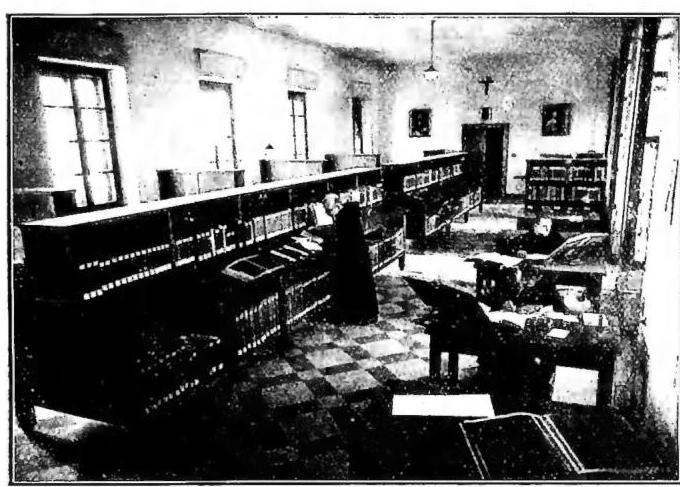
SAN GIROLAMO, ABBAZIA di — The “scriptorium.” (photo Giordani)edition that will meet the demands of the most rigorous criticism, applying to it, in the strictest manner, the principles of the new scientific methodology. At the same time, other no less important ends are achieved, such as providing scholars of biblical matters with new elements for the criticism of the original text, and establishing the stages in the history of the official text of the Bible in the Latin Church. After the research into the manuscripts to be adopted, the study of the method (partly set out in the Mémoire sur l'établissement du texte de la Vulgate, Rome 1922, by H. Quentin), and the determination of the principles adopted for the establishment of the text, the various volumes were published under the title: Biblia Sacra iuxta latinam Vulgatam versionem ad codicum fidem iussu Pii PP. XI. cura et studio Monachorum Abbatiae Pontificae Sancti Hieronymi in Urbe, O. S. B. edita ex interpretatione sancti Hieronymi cum praefationibus et variis capitulorum seriebus (Rome, Poliglotta Vaticana). To date the following have appeared: I: Liber Genesis, 1926; II: Libri Exodi et Levitici, 1929; III: Libri Numerorum et Deuteronomii, 1936; IV: Libri Iosue, Iudicum, Ruth, 1939; V: Liber Samuhelis, 1944; VI: Liber Malachim, 1945; VII: Liber Verborum Dierum, 1948; VIII: Libri Ezrae, Tobiae, Iudith, 1950; IX: Libri Hester et Iob, 1951; X: Psalmi, 1953. Alongside this principal work, the monks of S. G. direct a series of monographs intended to publish texts of the Latin Bible: Collectanea Biblica Latina. The following have appeared: I: A. Amelli, Liber Psalmorum iuxta antiquissimam latinam versionem ex Cusin. cod. 557, 1912; II: H. J. Vogels, Codex Rehdigeranus, 1913; III: card. A. Gasquet, Codex Vercellensis, 1914 (2 vols.); IV: P. Capelle, Le texte du Psautier latin en Afrique, 1913; V: D. De Bruyne, Les fragments de Freising, 1921; VI: H. Quentin, Mémoire sur l'établissement du texte de la Vulgate, part 1: Octateuque, 1922; VII: P. Salmon, Le lectionnaire de Luxeuil, 1944; VIII: V. WEBER, MAX, Les anciennes versions latines du deuxième livre des Paralipomènes, 1945. The following are in press for 1953: IX: Le lectionnaire de Luxeuil, vol. II; X: Psalterium « iuxta Hebraeos » ad codicum fidem; XI: Le Psautier romain et les anciens psautiers latins, édit. critique.
The papal document provides that, in the future, the monks of S. G. may be entrusted with other similar works assigned by the Pontiff. For this reason the abbey is immediately subject to the Holy See, and the monastery of S. Maurizio and S. Mauro of Clervaux, in Luxembourg, has the perpetual task of preparing and supplying persons qualified for these works. By the will of the Supreme Pontiff (motu proprio Monasterium, 25 January 1934), the abbey of S. G., although it belongs to no Benedictine congregation, forms part of the Benedictine confederation. Pietro Salmon
Cite this article
“SAN GIROLAMO, ABBAZIA DI.” Enciclopedia Cattolica, vol. X (1953), p. 1049. Azione Romana digital edition, https://azioneromana.com/article/san-girolamo-abbazia-di.