
TOVAGLIA (Tobalea). — From as early as the sixth century, but more frequently after the tenth, representations of table and altar cloths appear in mosaics and paintings of the period; inventories, too, often contain references to cloths described for the most part as «opus theutonicum» or «de Alemannia».
They seem to have been embroideries in white on white, if not all imported from the north, then certainly imitations of the original German type. According to Fr. Braun, the oldest altar cloth to have come down to us and still preserved is the one found in the reliquary of St. Eribert at Deutz, which predates the exam-
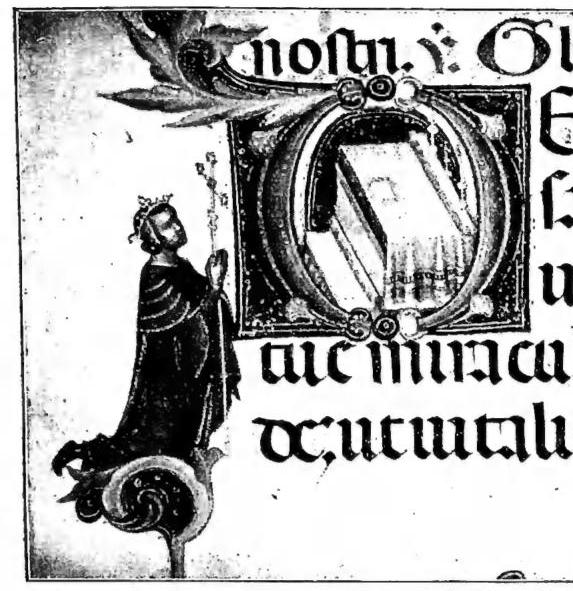
TOVAGLIA — Altar covered with a rich tablecloth. Detail by the “Master of the Codex of S. Giorgio” (mid-fourteenth century). From the Codex of S. Giorgio containing the Vitoria de beati Georgii martirii miraculis by Cardinal Stefaneschi (ca. 1340) — Vatican Library, Arch. cap. di S. Pietro, cod. 129, f. 1067.
…plar of the “Sancta Sanctorum” of the twelfth century, now in the Museo Sacro Vaticano. Another important example is in the Metropolitan Museum of New York, having come from Altenberg. All these tablecloths display a broad design of networked lines, most often in the form of lozenges, with stylized leaves, palmettes, eagles, and motifs indicating varied origins. A fragment, which would appear to be later, is in the Schnütgen Museum in Cologne; and, from the end of the thirteenth century, there is the marvelous needlework known as the work of the Blessed Benvenuta Boiani (1251–92), preserved in the Museum of Cividale. It too is in white on white, but is entirely figurative, with an extraordinary fineness of design worthy of a precious work of painting. Other examples are found in the Museum of Hannover, in the church of S. Maria in Danzig, and in the cathedral of Halberstadt; in the latter, colored silk threads are combined with the white embroidery. A thirteenth-century Egyptian tablecloth in wool woven on linen, in green and purple, is in the Museo Sacro Vaticano and comes from Achmin; although its technique still recalls the Coptic period, the ornament, consisting of a large central cross and four small angular crosses, is distinctly stylized and indicates a date no earlier than the thirteenth century, a technique which Volbach connects with that of a tunic in the Museum of Mainz.
A type of tablecloth was particularly widespread in Italy, extending from the Middle Ages through the entire fourteenth and fifteenth centuries and manufactured according to tradition, especially in Perugia by the Confraternity of the Mercanzia. Extensive documentation of this type is also found in painting (Simone Martini, S. Martino in atto di celebrare la Messa, Assisi, basilica of S. Francesco, reproduced under the entry ELEVAZIONE; Ghirlandaio, Cena, Convent of S. Marco, Florence, etc.). These textiles are white with blue embroidery and depict confronted animals, castles, knights, sirens, centaurs, or inscriptions and sacred figures, such as the tree of life, the cross-bearing lamb, deer, cherubim’s heads, doves, etc. They are considered to derive from older Sienese textiles, and chronologically it is possible to classify them on the basis of the progressive predominance of figures over the earlier stylized geometric forms, the softening of the lines, at first sharp and crude, and the increasing density and refinement of the stitch, which in the most remote examples appears long and irregular.
From the sixteenth century onward, the use of embroidered tablecloths diminished, and was replaced by the practice of decorating them with borders, galloons, lace, or netting, which followed the development and flowering of these precious works in needle and bobbin lace (
V. MERLETTO; STOFFE)
Vedi tav. XLI.Liturgical prescriptions concerning tablecloths — The rubrics of the Missal prescribe that the altar for the celebration of Holy Mass be covered with three tablecloths: two (or one, but folded) to cover the entire sacred table, at least the sacred stone in portable altars; the third, uppermost, to hang down on both sides of the altar as far as the lowest step. In the Middle Ages the third also served to cover the chalice, from which the corporal derives. They must be made of pure linen, in memory of the Sindon in which the body of Jesus Christ was wrapped for burial, and they are blessed. Beneath the three tablecloths, immediately upon the table, a strong waxed cloth called crismale is placed, to protect the tablecloths from dampness; it is prescribed by the Pontificale to protect them from the Oil after the consecration of the altar.
The tablecloth is one of the most ancient vestments, and is appropriate to the altar on account of cleanliness, devotion, and reverence. In the mosaic of S. Vitale in Ravenna, the altar can be seen covered by a broad white tablecloth, edged with fringe and decorated in the center with a rosette and on the sides with embroidered panels (v. illustration under the entry MELCHISEDECH). In ancient times the altar was covered only at the moment of the celebration of Holy Mass, as is still done today for the services of Good Friday. Originally there was a single tablecloth, but from the eighth century onward more began to be used. In Rome, in the time of Burcardo, papal master of ceremonies (d. 1506), three were used.
To protect it from dust or other impurities, before and after sacred services the upper tablecloth is covered with a cloth, called a vesperale or altar-cover, of any material and color. It is not removed during Vespers, not even during pontifical services; it is sufficient to fold it back during incensation (Caer. Episc., II, chap. 1, no. 13).