
MERLETTO. — M. or merlo, trina, pizzo, is a transparent fabric made by hand with a needle, bobbins, a crochet hook, and also with a shuttle, using thread of every kind: linen, cotton, hemp, silk, gold, and silver.
Of this small but precious art, whose first certain examples date from the end of the fifteenth century and which can readily be known through the surviving specimens, the works made with the needle and those made with bobbins are by far the most outstanding. Both have a notable history which extends from the end of the fifteenth century to the present day, with different origins and developments.
Needle lace is now almost unanimously considered to be of Italian, or rather Venetian, origin, and its derivation from the ancient embroideries executed on drawn-thread fabrics can be specified—both on those with « pulled threads », commonly called « reticelli », and on buratto or modano. The true « punto tagliato », descended from the ancient « reticello », appears in the volume by Matthieu Pagan, L'ornamento delle belle et virtuose donne (Venice 1543), and in other booklets, for the most part published in Venice and Bologna, including that of Aurelio Passarotti, from 1560, with very beautiful plates, in which the « punto in aria » is already found. The little volumes become increasingly numerous, from Cesare Vecellio to Isabetta Catanea Parasole and Bartolomeo Danieli, down to around 1630, bearing witness to the richness of the stitches, the variety of the designs, and the spread of this art, which by that period had become supremely refined. From the « punto tagliato » (point coupé) to the « punto in aria », to the foliage stitch made in relief (gros point de Venise), and to the extremely delicate stitch with little roses, the way was opened to the more highly developed and precious laces which, from palaces and convents, their first homes, passed into workshops, undergoing ever greater development in direct relation to the period’s extravagant luxury.
In France, where the art of Venetian lace spread widely, from 1598, when the name dentelles was written for the first time in the Nouveaux pourtraicts de point coupé by Jacques Foillet, to 1665 (Colbert’s edict), the flowering was extraordinarily intense. Under Colbert, important centres for the manufacture of needlework were founded which, while imitating the Italian laces of Venice, Ragusa, Bologna, Milan, or Genoa, took the name point de France. From then on, French names would also be adopted in part in Italy, and in Italy itself Italian names would be Gallicized. Alençon would become the most important centre, followed by Sédan, Argentan, Aurillac, etc., all subject to a perfect state organization, interrupted only by the Revolution, while in Italy and Flanders attempts would be made in the eighteenth century to imitate the exquisite refinements of French art. Thus, in the eighteenth century, Venice created the « punto di Venezia col fondo », with broad foliage and openwork veins, in order to surpass in preciousness the beautiful stitch of Alençon, and the stitch of Burano, another celebrated type of m. with small round meshes and minute motifs, which would enjoy great success and persist even after the nineteenth-century revival (1872)
of this local and popular art, which is still flourishing. Other active centres in Italy are those of Val Sesia, Vallevogna, and above all Bologna, with the Society of the « Aemilia Ars ».
Italy and Flanders still dispute the origin of bobbin lace, but foreign scholars too, such as Seguin (La dentelle, Paris 1875), incline toward Italy. In any case, it also spread rapidly in Flanders, and then in Spain and France, where it was thought to have arrived through Spanish pilgrims. As for the technique, m. made with bobbins, perhaps of very ancient use, are a transformation of the ancient galloons or « passamani » (passements) made with gold and silk or gold and wool fabrics, often studded with gems; worked in the form of ribbons, they were applied to fabrics as decoration. In the course of time, attempts were made to make them of an increasingly open weave, and on one side they were decorated with teeth that were progressively less simple and more delicate, until bobbins were adopted and the fabric support dispensed with. The technique is one and the same: at one end the threads are fastened to a cushion with pins, which are moved progressively as the work advances, while at the other the threads are variously interwoven and knotted with the small bobbins
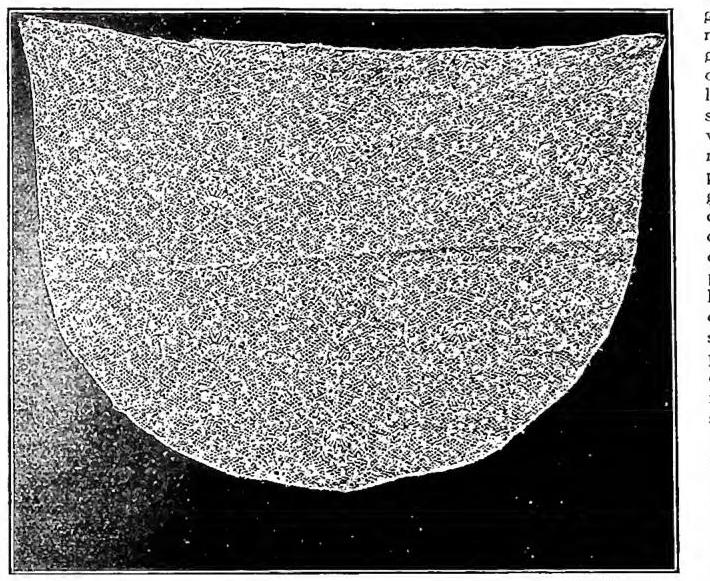
This art, even during its finest period, the first half of the seventeenth century, never attained the richness of needle lace, neither in Genoa, its principal centre—where a somewhat thick point known as les rosaces de Gênes and guipure was used—nor in Portofino, Rapallo, S. Margherita, Chiavari, and Albissola, small lively centres scattered along the two rivieras, nor in Pescocostanzo, L’Aquila, and Naples. There are many varieties of stitches: in Italy, the “punto in trezzola” (Venice), the “punto di Milano,” characterised by a narrow ribbon that traces, without interruption, extremely long volutes in floral designs, especially suitable for liturgical albs, and which produced patterns of great value; outside Italy, Malines and Valenciennes stitch, Brussels, Paris, and Arras stitch, Chantilly, in black silk, Lille, Flemish, Bruges, and English stitch; Irish lace, made with a crochet hook, is also famous. There is also a type of lace made with shuttles, called “frivolità.” As early as the nineteenth century, and especially in modern times, a rich mechanical production developed in Italy and elsewhere, imitating above all bobbin-lace work. — Vedi tavv. XLIV-XLV.
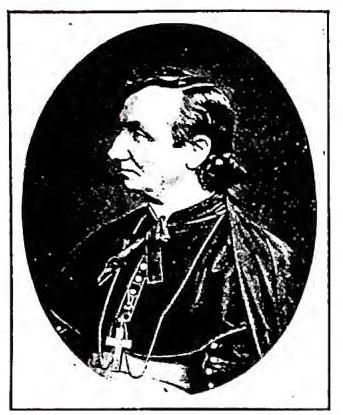
Most zealous and of exceedingly devout life, he is known principally for his devotional books, all published in Cologne in Latin, the best known of which is the Paradisus animae (1650, frequently reprinted until 1898), translated into various languages. Also noteworthy are: Enchiridion Officii divini (1623); Monita sapientiae christianae (1629); Fasciculus myrrhae et thuris (1630); Viaticum quotidianum (1633); Apharismi eucharistici (1638; German trans., Cologne 1828, 1902). M. also edited new editions of the works of St. Bernard (1641, 6 vols.), of Thomas à Kempis (1643), and of other ascetical authors (Septem tubae orbis christiani, 1635).