
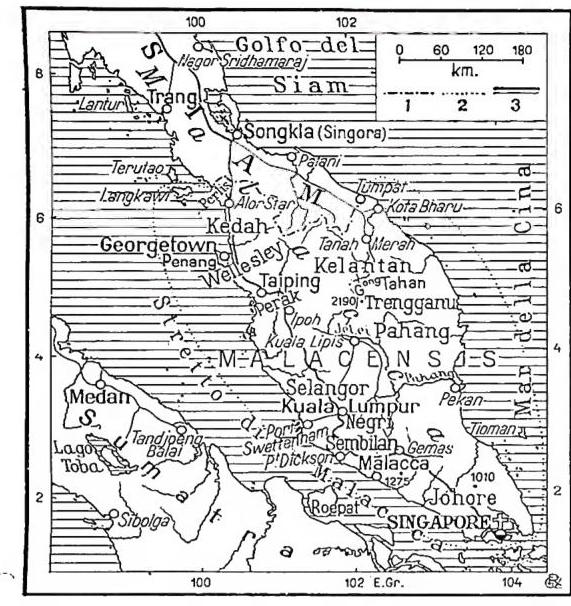
MALAYA, FEDERATION OF. - Since 1 February 1948 it has replaced the Malayan Union, proclaimed on 1 April 1946 and formed from the same British possessions and protectorates of which, before the Second World War, British Malaya consisted, minus Singapore, which was erected into a Colony. The F. M. is now governed by a high commissioner, assisted by two councils, executive and legislative, while each State enjoys a large administrative autonomy.
The population (4.9 inhabitants in 1947) is made up for more than half of Malays, for about 2/5 of Chinese and for the rest of Indians and Europeans.
The economy of the country is based essentially on the production of rubber and on the extraction of tin (respectively 2/5 and 1/3 of world demand in the interwar period), but it can also count on a rich and varied agricultural activity (rice, coconut palm, tobacco, tropical fruit, textile plants) and forestry (reserves still almost intact), while the mining industry also exploits iron, coal, tungsten, phosphates, bauxite, gold, etc. Sea fishing represents another conspicuous
 | States | Area in sq. km. | Absolute population (1941/1000 inhab.) | Density per sq. km. | Capital and relative population in 1000 inhab. |
|---|---|---|---|---|---|
| Penang | 285 | 247 | 868 | Georgetown (165) | |
| Wellesley | 751 | 172 | 228 | Butterworth | |
| Malacca | 1657 | 236 | 142 | Malacca (45) | |
| Perak | 20,670 | 993 | 48 | Kuala Kangas | |
| Selangor | 8180 | 702 | 86 | Kuala Lumpur (138) | |
| Negri Sembilan | 6680 | 296 | 44 | Kuala Pilah | |
| Pahang | 35,790 | 222 | 6 | Kuala Lipis (4) | |
| Johore | 18,980 | 738 | 39 | Johore Bharu (32) | |
| Trengganu | 13,080 | 211 | 16 | Kuala Trengganu (16) | |
| Kelantan | 14,890 | 390 | 26 | Kota Bharu (15) | |
| Kedah | 9430 | 516 | 55 | Alor Star (19) | |
| Perlis | 800 | 58 | 72 | Kangar (2) | |
| F. M. | 131,193 | 4781 | 37 |
reserve. The processing industries (rubber, metallurgy, mechanical, etc.) are in promising development.
The capital of the F. M. is established at Kuala Lumpur, at the center of one of the most active industrial districts.
Bibliography3 works
Giuseppe Caraci
EVANGELIZATION - The city of Malacca, captured in 1511 by Afonso de Albuquerque, had been made by the Portuguese the center of all trade between Europe-India and the Far East, with a fairly important Portuguese colony. The care of souls was exercised by a secular priest. In 1548 the Jesuits, in 1549 the Dominicans, in 1583 the Franciscans founded houses in the city. In 1557 the diocese of Malacca was erected, a suffragan of Goa. The European city soon acquired a Christian appearance with its churches and its convents.
Malacca was the starting point for the missions in the Moluccas, in Cochinchina and in Siam. In Malaya itself the work of the missionaries was limited to the Portuguese and to their slaves, the Muslim Malays showing themselves refractory to the Gospel. The Dutch captured Malacca in 1641, drove out the Portuguese and their missionaries, letting churches and convents fall into ruin. The bishop of the diocese of Malacca, which moreover was for the most part vacant, took up residence in Portuguese Timor. In 1787 Msgr. Garnault, apostolic vicar of Siam, with his small flock fled from Quedah (Siam) to Penang Island, founding a seminary there; in 1807 the Paris missionaries reopened their general College there. In 1830 the same missionaries began a mission in Singapore. The city was taken in 1795 by the English, who then in 1824 took possession of the whole Malay Peninsula, making it a central point of commerce. Msgr. Courvèzy, apostolic vicar of Siam, took up residence there in 1838. The diocese of Malacca was suppressed in 1838 by the brief Multa praeclare and the Malay Peninsula was annexed to the apostolic vicariate of Ava and Pegu, in 1840 to the apostolic vicariate of Siam, and in 1841 it was erected into an independent apostolic vicariate of Western Siam. The missionary work of the Paris missionaries in their stations of Singapore, Malacca and Penang was restricted to the Chinese and the Indians, because the native Malays offered an almost insurmountable resistance to evangelization. In 1888 the diocese of Malacca was re-established as a suffragan of Pondichéry, though no longer under the Portuguese patronage; only one church in Malacca and one in Singapore were annexed to the diocese of Macao. It is true that later the mission was able to establish itself also in the Malay States, but for the most part it is restricted to immigrant Chinese and Indians. The school organization under the Brothers of the Christian Schools and the Ladies of St. Maur is particularly well developed, and is taking on a new impetus now that the Japanese occupation during the Second World War has ended.
Bibliography2 works
Giovanni Rommerskirchen