
PETER OF THE MARSH (Petrus a Palude). - Dominican theologian, b. at Varambon (Ain) ca. 1277, d. at Paris on 31 Jan. 1342. A religious in Lyons, he studied at Paris and became master in theology on 13 June 1314. He was part of the commission for the examination of the commentary on the Sentences of Durandus of St. Porciano and, together with John of Naples, drew up a list of 93 errors and the list of 235 articles contrary to Thomism.
At the general chapter of Pamplona (1317) P. della P. was named vicar general of the Order, and the following year he was charged by John XXI with a delicate mission in Flanders; on his return to Avignon he was entrusted, together with six other theologians, with the examination of the works of Olivi (v.) and of a suspect writing composed in the Catalan language (De statibus Ecclesiae sec. expositionem Apocalypsis). Having returned to Paris, he devoted himself to preaching and study, sustaining a bitter polemic, on confessions made to religious, with John de Pouilly (v.). Named patriarch of Jerusalem in 1329, he set out at once for Palestine, but the critical conditions of the East induced him to return to Europe and to become the herald of a new crusade; but the enterprise failed. On 19 Dec. 1333
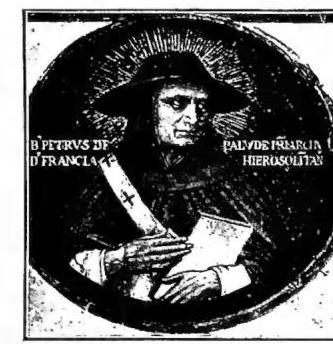
treatises, begun in 1310, of which the first two books remained unpublished (Paris, Bibl. nat., Mazar. 988, 809), while the last two were instead fairly widespread (Book III, Paris 1517; Book IV, Venice 1493, Paris 1518); the author rebuts with learning and warmth the objections raised by Durandus against St. Thomas and is therefore regarded as one of the best interpreters and defenders of Thomism: his doctrine on the Sacraments is highly esteemed.
Numerous biblical commentaries, still unpublished, are attributed to him. Of his Quodlibetales questions, two are known (Toulouse, no. 744; Munich, lat. 26, 309). The De paupertate Christi et Apostolorum against Michael of Cesena, attributed to him, is by Hervaeus of Nedellec (Hervaeus Natalis). The well-known treatise De causa immediata ecclesiasticae potestatis (Paris 1506), published under his name, is probably by the Dominican cardinal Pietro de Godin (v. GODIN), his contemporary. Authentic are the four short works written against Giovanni de Pouilly.