
CASSIAN, JOHN. - G. C., natione Scyta (Gennadius), according to a now fairly common opinion, was born in Dobruja to wealthy parents around 360. Having received a good education in classical studies, while still young he became a monk at Bethlehem; then from about 385 for 7 years he stayed in Egypt to learn there about the monastic life flourishing in that region; after another, very brief stay in the monastery of Bethlehem, he again returned for several years to Egypt among the monks. Around 399 he went to Constantinople, was on account of the Origenist agitations; here he was ordained deacon by St. John Chrysostom, for whose cause we find him active in Rome in 405. From 415 he withdrew to Marseilles, a priest, founder and head of the male monastery of St. Victor, and founder besides of a monastery for nuns in the same region. He died around 435.
The literary output of G. C. is vast:
1) De institutis coenobiorum et de octo principalium vitiorum remediis libri XII, written around 420. Book I deals with the monastic habit, books II and III with the hours of prayer ("canonical") in the monastery, book IV with the novitiate and profession; the remaining books from V to XII are on the principal passions (eight) and the opposing virtues. The work shows C.'s conception of the cenobitic life, whose tasks are presented in a profound manner especially in book IV; the ideas of this book dominate the whole work.
2) Collationes XXIV, in three stages: I-X published around 420, XI-XVII before 426, XVIII-XXIV before 429. The work is devoted essentially to the ideas of the eremitic life.
3) De incarnatione Domini contra Nestorium libri VII. Written before the summer of 430 at the request of the Roman archdeacon, later Pope Leo I. The work is far inferior to C.'s monastic writings.
C. is entirely a monk: only from this point of view are his two principal works to be considered. His monastic doctrine rests on these fundamental concepts: the goal of the monastic life is contemplatio; the condition for contemplation is the actualis life. From these principles, applied to life, two consequences flow for C.: 1) the contemplative life understood as contemplatio relative iugis is possible only in the eremitic life; 2) the actualis life constitutes the essential task of the cenobium, which is therefore considered as a preparatory school for the eremitic life (Coll. XVII and XIX: De tribus generibus monachorum; De fine coenobiotae et heremitae).
Coll. I contains the fundamental lines of the whole doctrine of our author, so that their understanding gives us the key to understanding C. The actualis life consists in the «correctio morum et consummatio vitae perfectae» (De inst., prooenium). And these cannot be effected without struggle, a struggle that is taught in the second part of the De inst. from book V to XII, in Coll. IV-VI, VIII and in other places of the two works (see, for example, the symbolism of the monastic habit in De inst., book II-IV).
The profession, abrenuntiatio, described in the De inst., book IV, obliges the cenobite to a total renunciation in the complete poverty of Christ, in the humility of Christ, in his obedience and patience and in the other virtues (on this see also Coll. III: De tribus abrenuntiationibus and Coll. XXIV: De mortificatione). All these virtues are the fruit of conformity to the life and passion of Christ, and to his cross, in which for C. (as already for Pachomius) the whole life of the cenobite is concentrated. And this conformation also leads to life in Christ (De inst., book IV).
The principal means by which the cenobite can reach his goal are: ieiunia, vigiliae, paupertas, labor, frequens lectio et meditatio scripturorum, decantatio crebra psalmorum, orationum sedulitas. Ascesis is not an end in itself, but offers only the instrumenta. The highest fruit of the actualis life is puritas cordis (C. avoids the apatheia that had become suspect in the Pelagian controversy): cor intactum a cunctis perturbationibus custodire (Coll. I and VI, 3). Puritas cordis is the same as caritas perfecta, apostolica, quae foras mittit fear (on which cf. especially Coll. XI; De perfectione). It constitutes the proper goal of the cenobium, and the monk who has attained it finds himself now at the open door of the contemplative life.
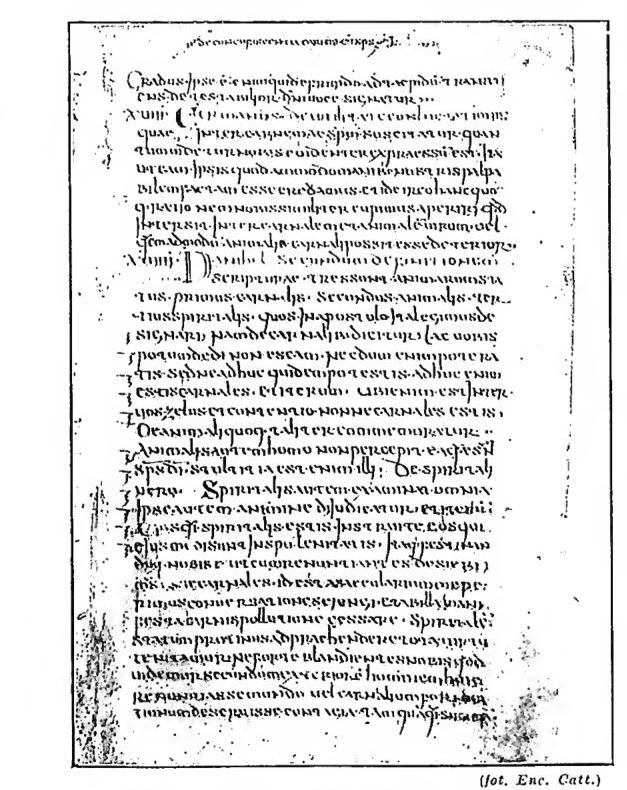
(Ist. Eur. Catt.)
For the realization of the actualis life and of the contemplative (theoretica) life, discretio is of capital importance, for distinguishing what favors the good from what is contrary to it, what comes from God from what comes from man or from the devil (it is treated especially in Coll. II). Man cannot arrive at complete impeccability (Coll. XXIII: De anamarteto). To do good, the Grace of God is incessantly necessary: C. insists on this point with the greatest energy. However, he thinks, in opposition to Augustine, that to safeguard the freedom of the will one must admit in free will a minimum of initiative entirely independent. Thus C. became the representative of semi-Pelagianism: without this error he could have been called a "doctor gratiae."
Common and private prayer constitutes the noblest task of the cenobite. Contemplatio too finds a place in the cenobium; only there it cannot easily be exercised, or at least cannot be iugis, because it is interrupted in so many ways by the duties of the common life. In compensation, however, the cenobite gains the first merit of obedience. In the cenobium the contemplative element is the most effective means for virtue (much as for St. Thomas, Sum. Theol., 1a-2ae, q. 182, a. 4: movet et docet).
Of the essence of the eremitic life, the contemplatio iugis, C. treats at length especially in Coll. IX: the oratio pura, the forms of prayer, the sense of the Pater noster, the oratio ignea, for C. perhaps the highest degree of prayer, the compunctio and the gift of tears, the signs by which we know we are heard, the oratio in cubiculo clauso, the oratio brevis. Coll. X is entirely consecrated to the contemplatio perpetua. C. reveals himself here, as in other points, a follower of Alexandrian spirituality. Coll. XIV: De spirituali scientia treats of the contemplative life from the point of view of gnosis, which is precisely this scientia spiritualis, again in the sense of the Alexandrians. At bottom it is a deeper, "spiritual" understanding of the Holy Scriptures, with application also to the moral life. The condition of this spiritual understanding, whose principal forms are Typology and Allegory, is again the actualis life.
Despite its free forms, especially in the Collationes, the doctrine of C. shows a great completeness and unity: to realize this, after the study of the De Inst. and of the Coll., one should return to Coll. I.
Such completeness and richness of thought, with the greatest warmth and in good language, even if sometimes a little too prolix, have procured for the two principal works that success which still endures.
Sources. - Among the sources of C.'s doctrine, after Holy Scripture, which he cites ca. 1800 times, using it for the most part according to Alexandrian exegesis, are to be remembered Basil, Jerome, Palladius, Rufinus, Athanasius, Chrysostom, and, above all, Evagrius Ponticus. Moreover C. owes much without doubt to his personal experiences.
All these factors were of help to him when he decided, for his friends of the West, to refresh and commit to writing the memories of the conversations he had had with the Eastern monks. He himself notes that this, after so much time, did not come easily to him. This memory, preserved and become operative in his life as monk, teacher and guide of his own, and his own thought, built upon what he had heard and learned, have thus intimately interpenetrated each other. And the historicity of the picture he traces of the conditions of monasticism, after the most recent confirmations, can no longer be called into doubt.