
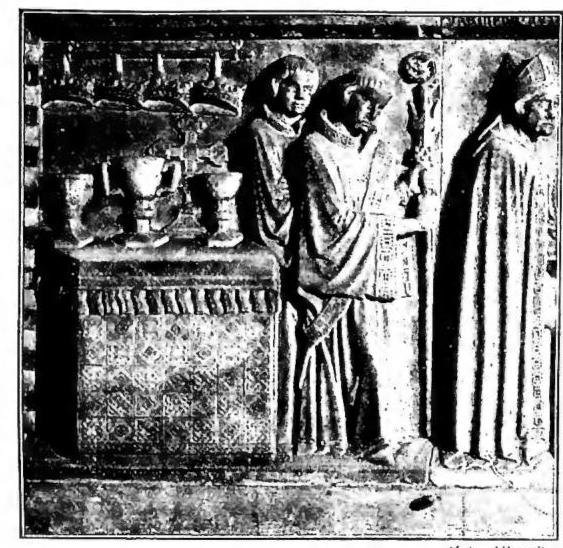
STOLE (More Antiquely Orarium). - It is a liturgical insignia, common to deacons, priests and bishops, but worn differently: by deacons on the left shoulder, crossed over the chest and knotted under the right arm; by priests hanging from the neck and crossed on the breast if worn over the alb, or simply hanging with the two ends parallel; by bishops, who never cross it because they already wear the pectoral cross. It is conferred on the deacon and the priest at ordination.
It is a strip of silk 200-50 cm. long and 8-10 cm. wide; the one worn with the chasuble has a cross in the middle and at the end of each strip (16th century), while the one used over the surplice is often more ornamented and richer. It follows the rules of the liturgical colors.
The stole is found in the East as early as the 4th century as an insignia of the lower-ranking clergy (Council of Laodicea), with the distinction: the deacon wears the stole called "orarion" on the left shoulder, visible (not under the upper garment) and flowing, while the priest wears the one called "epitrachelion" hanging from the neck. The higher ranks wear the pallium. Both insignia are of the same origin, not of ecclesiastical institution, but of imperial privilege; the pallium made of wool, the stole of linen or silk. In the West, outside Rome, in Spain, the stole is proper to bishops, priests and deacons. Deacons wear it on the left shoulder, hanging in front and behind over the dalmatic, always white in linen or wool; from the 12th century worn crossed over the chest and as a scarf, and from the 15th century of the color of the dalmatic and under it.
In the Ambrosian rite it is still worn over the dalmatic today. The priests of Spain wore it around the neck like bishops, but from the Council of Prague of 675 it was crossed on the breast; this manner was introduced everywhere from the 14th century and was prescribed for priests by the missal pianum. In Gaul the stole is found as an insignia of bishops, called "pallium" by pseudo-Germanus; the diaconal stole was worn over the alb; the priestly stole in the 9th century was so proper to priests that they wore it even on journeys. In Rome, on the other hand, it was not a special insignia and was worn even by subdeacons and acolytes under the chasuble; it was called "orarium," and was more than anything a distinctive insignia of the clergy from the laity.
Around the 10th century, when the subdeacon and the acolyte no longer wear the chasuble, the stole becomes the proper insignia of the deacon, the priest and the bishop. And from this time the use and meaning of the stole is uniform in the West.
The origin of the stole and of the name is still obscure. The name orarium (Lat. os = mouth, face) comes from Latin, while the word "stole" derives from Greek. Wilpert derives the word orarium of the deacons from the mappa used in serving at table, carried on the left shoulder; the deacons were ministers at the Eucharistic and agapic table.
The ministers of pagan sacrifices, like those who served at table, were provided with such a mappula. This mappula becomes, by means of contabulatio, a strip or band. The priestly orarium, a true orarium or sudarium to protect the face from the cold in winter and from sweat in summer, likewise passes from the contabulated form to that of a strip. But all these explanations leave its origin obscure, and the derivation of L. Duchesne from an imperial insignia is preferred, as Klauser has recently maintained. The word "stole" comes from the denomination used in Gaul and derived from Greek to designate not a feminine garment, but a distinctive garment in the scriptural sense (Rev. 6:11; 7:9, 14).
Bibliography5 works
Pietro Siffrin