SOLIMENA, FRANCESCO. - Called the abbot Ciccio, painter and architect, b. at Canale di Serino (Avellino) on 4 Oct. 1657, d. at Barra near Naples on 5 Apr. 1747.
Head of the Neapolitan painting academy of the 18th century, he devoted himself entirely to artistic activity and to teaching, and linked his name to an extremely copious output, scattered through the churches and palaces of Naples and Campania and in the principal public and private collections of Europe. His influence on the artistic culture of the 18th century in Italy and in France (Fragonard) was decisive and even reached Venice, where it had consequences even for the pictorial language of a Piazzetta and a Tiepolo.
Besides his father Angelo, a not ignoble painter in the manner of Giordano, S. had as his master Francesco De Maria, an epigone of the Bolognese Academy. But his receptive versatility pointed him rather to an eclecticism as his point of arrival, one in which the breadth of the compositional scheme was sustained by the rigor of chromatic and luministic harmony.
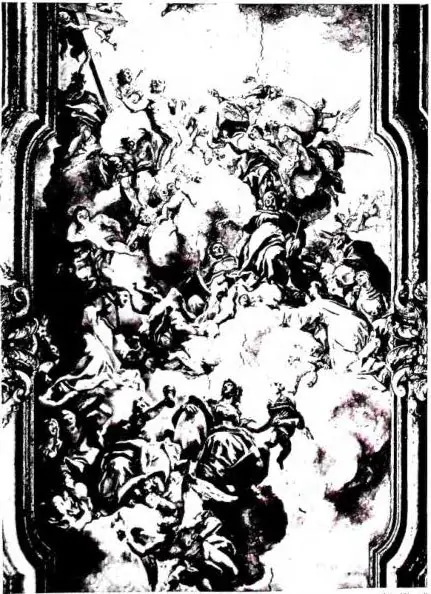
For this reason S. was led to go back to Mattia Preti, not without Cortonesque and Venetian suggestions, mediated by the examples of Luca Giordano's Neapolitan activity. Yet what enabled him to acquire an unmistakable style was an innate architectural wisdom and an extraordinary ease of narrative articulation, which allowed him to satisfy the most disparate iconographic requirements, relying on the intrinsic quality of the brushstroke, always dense and vibrant. Even in moments of lesser inspiration S. in fact reveals a thematic sustainedness that keeps him far from empty repetition and from graphic involution: his technical skill almost never declines into gratuitous artificiality, even when manneristic complacency is most evident. The evolution of his style can be followed without difficulty from the youthful frescoes of S. Giorgio dei Mannesi, of S. Anna at the Gesù Nuovo in Naples and of S. Giorgio at Salerno, up to the concluding cycle of these first experiences in the apse of S. Maria Donna Regina (1680-84). Along this path S. proceeded with ever greater coherence, reaching the summit of his possibilities in the magniloquent complexes of the sacristies of S. Paolo Maggiore and S. Domenico and in the masterly, highly animated Expulsion of Heliodorus from the Temple on the inner wall of the facade of the Gesù Nuovo (1725). Other testimonies to the felicity of narrative of these years remain in the canvas of the abbey of Montecassino with St. Francis and St. Anthony (1681), in the frescoes of S. Patrizia (1682), in those of the vault of S. Nicola alla Carità (1701) and above all in the densely peopled canvas with saints of S. Girolamo delle Monache, which has in the foreground a marvelous still life of scattered flowers (1693), and in the Venetian ones with Rebecca and Eliezer and Rebecca and Jacob at the Well.
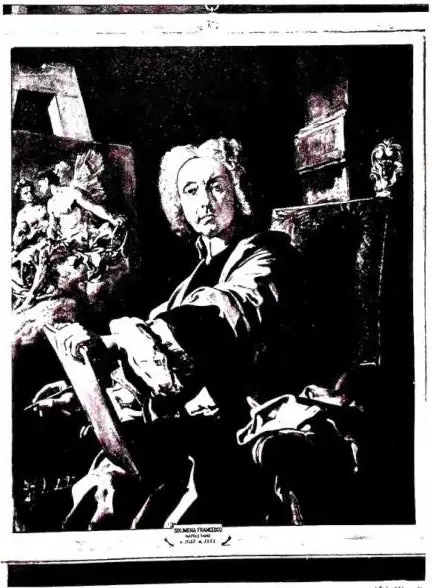
The quality of the lost works is revealed to us by the sketches for the canvases executed for the Council of Genoa (1708-1717), preserved in the Pinacoteca of Naples: scenes crowded with minute figures, in the taste of the presepio. Of the very many portraits, mention should be made of that of the princess Caracciolo, already set upon precious harmonies of light tonalities, and of the self-portrait in the Uffizi, one of the masterpieces of this genre, for its expressionistic effectiveness.
S.'s taste and manner influenced all Neapolitan art, from architecture to the terracotta figurines of the presepio. As a builder he left a lofty example in the harmonious facade of S. Nicola alla Carità. It is in two orders, according to the Baroque module, but vigorously conceived in a balance of projections and recesses that exalt the structures, which are not overwhelmed by the decoration. Other testimonies remain in drawings, preserved in the Archivio di Stato of Naples, and in a great number of altars, portals and sepulchral monuments, scattered through the churches of Naples and its surroundings.
From S.'s school came the architects Domenico Antonio Vaccaro and G. Battista Nauclero; the sculptors F. Celebrano and G. Sammartino, that is to say some of the most fertile and ingenious artists of eighteenth-century Naples; and by his work as a painter the major masters of the Neapolitan school of the 18th century were influenced: De Mura, Bonito, Giaquinto and Diana. - See pl. LXI.