
PETER OF CORTONA (BERRETTINI, PETER OF CORTONA). - Born at Cortona on 1 November 1596, died at Rome on 16 May 1669; he was a painter and architect. He pursued his first studies of painting in Florence and Rome.
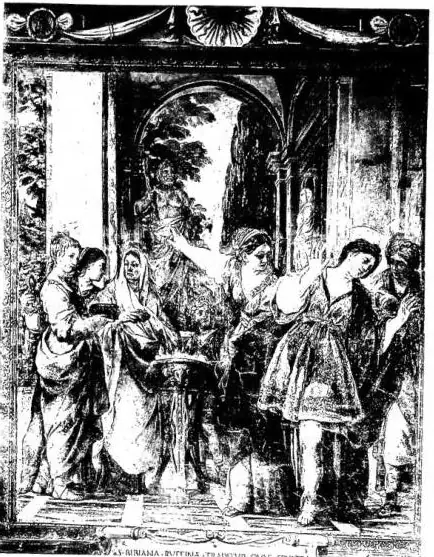
Of great importance in his formation was his proximity to Domenichino and Annibale Carracci, but above all to Poussin. The first Roman sojourn (1612-37) is rich in works: from the Triumph of Bacchus (Capitoline Gallery), to the frescoes and the altarpiece of S. Bibiana (1624-25), to the frescoes of Castel Fusano and Palazzo Mattei, to the Sacrifice of Polyxena, the Rape of the Sabines and Darius Defeated by Alexander (1623-30) in the Capitoline Gallery, to the Adoration of the Shepherds in S. Salvatore in Lauro. From 1631-36 is the altarpiece in S. Maria della Concezione with St. Paul and Ananias; from 1632-33 the frescoes of the chapel of Palazzo Barberini with stories of the New Testament and the feigned stuccoes of a room with figures of Peace, Abundance and stories of the Old Testament, and the mythological scenes of the corridor; somewhat later is the grandiose allegory exalting the Barberini with the Triumph of Divine Providence in the vault of the great gallery (1633-39), a work which, more than any other, reveals his extraordinary skill as a great master of perspective, an airy decorator of spaces, most able in foreshortenings and in "breaking through" walls; for the first time effects of aerial perspective on open skies are achieved. Immense was the fortune of this new manner of his, which influenced all subsequent painting and spread throughout Europe. From the same years is the fresco with the Angels and the Instruments of the Passion in the church of the Vallicella. Important in '37 is the journey to northern Italy, where he became acquainted with Correggio and the Venetians, even before finishing the frescoes of Palazzo Barberini. In 1637 itself he had meanwhile already begun the decoration of Palazzo Pitti (Sala della Stufa) with the Four Ages; in 1641 and 1642 he frescoed there the ceiling of the Sala di Venere in collaboration with Ciro Ferri, in 1642-45 the Sala di Giove, in 1646 that of Mars, in 1647 that of Apollo, the latter finished from his cartoons by Ciro Ferri in 1660. In 1647 the second Roman sojourn begins, which ends with the artist's death. From 1651-54 are the frescoes with scenes from the Aeneid of Palazzo Doria Pamphili in Piazza Navona, the dome and pendentives of S. Maria della Vallicella with the Trinity in Glory and four Prophets; and in the same church, a few years later, the Assumption of the apse and the Vision of St. Philip Neri on the vault of the nave. From the decade 1652-62 are the mosaics of the domes of the bays of the second and third compartments of St. Peter's, commissioned from him by Innocent X; the other mosaics were completed by C. Ferri in 1661.
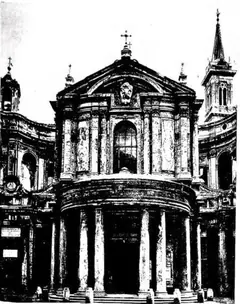
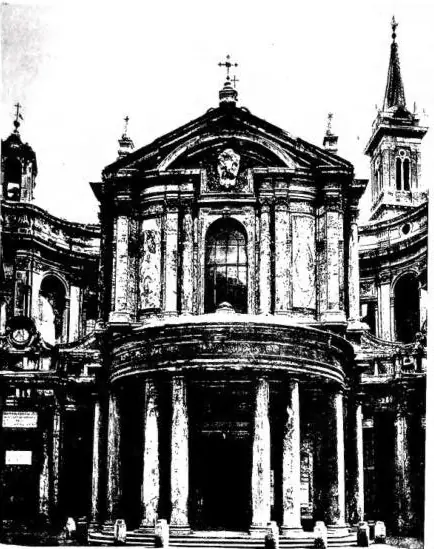
With an interval of almost ten years he begins his career as a simple and sober architect: from the project for the Palazzetto of the villa of Pigneto, to his participation in the completion of Palazzo Barberini, to the church of Sts. Luke and Martin (1640-50), to the Cappella della Concezione in S. Lorenzo in Damaso (1635), to the architectural drawings for Palazzo Pitti, to the tribune and dome of the Chiesa Nuova (1647-56), to the churches of S. Maria della Pace and S. Maria in Via Lata; in all his works he is a singular balancer of the Berninian and Borrominian Baroque with the calm Tuscan manners of Buontalenti and Ammannati, always sober in comparison with the Romans, yet rich in his own most vivid pictorial sensibility, which achieves particular effects of movement and relief especially in the suggestive façades of the church of S. Maria della Pace and S. Maria in Via Lata. To B. is owed moreover a Trattato della pittura e scultura, in collaboration with Fr. Ottonelli (Florence, 1652). - See pl. XCVIII.
Bibliography6 works
Luisa Mortari