
CAVALLERIA. - I. HISTORY. - The origin of this distinctive institution, which permeated so much of medieval life, is not clear. It is found fully constituted at the end of the 11th century, and in the 12th century it was in full flower; but, on the one hand, its earliest origins go back to the Early Middle Ages, while, on the other, it continued, albeit with characteristics by then different, through the Renaissance and beyond. In this constant development, and particularly during its finest period, it is entirely natural that cavalry should present different characteristics from one country to another, above all in France, Germany, and Italy. Once the great and gradual military transformation had been completed, chiefly as a result of the barbarian invasions—a transformation by which the predominant and decisive arm of the army was no longer the infantry but the cavalry—with the establishment of the Carolingian Empire the army came to be composed entirely of horsemen, who were free landowners serving at their own expense: the warrior was still a free man. On the other hand, maintaining a good horse and its equipment, and sometimes one or more attendants and one or more replacement horses, required a certain degree of prosperity, which, in a period when the economy had reverted toward a state of nature, could be provided only, or chiefly, by landownership. But as feudalism prevailed, ownership too tended to become feudal, and the army likewise came to be formed by feudal horsemen; toward the
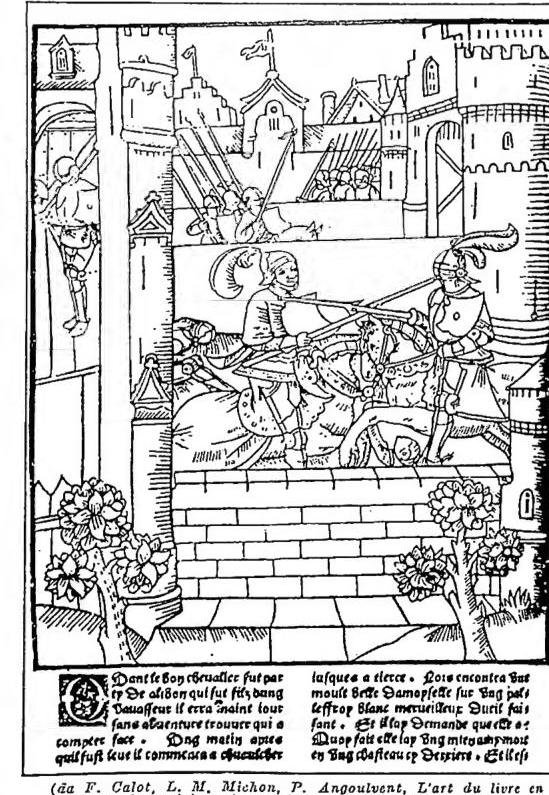
CAVALLERIA — Episode from Lancelot du Lac, Vérard edition, 1494. Paris, Bibliothèque de l’Arsenal.
At the end of the tenth century, the term miles came to mean a mounted warrior bound by oath to his lord. In France, however, where the fief under Frankish law was transmissible only and in its entirety to the firstborn, there arose an increasingly numerous class of younger sons, bound to no lord because they owned no property and thus excluded from the ranks of strictly feudal life; they were granted only enough to equip themselves and a horse.
Throughout the tenth century these knights appear in the sources and chansons de geste as particularly turbulent and adventure-seeking elements: through their activity feudal anarchy seems to have reached its climax. But as early as the beginning of the eleventh century the Church began its providential action to restrain and tame them, and to direct so many exuberant and disorderly energies toward pious and generous actions; and the State, which was once again consolidating itself and recovering strength and authority, supported the Church’s work. On the other hand, these wretched and restless knights shared common needs and aspirations; hence the possibility of creating a common spiritual bond and a common order on the basis of an association among equals: equals above all in courage and in their shared scorn of danger, and then, under the influence of the Church’s action, in a series of increasingly lofty moral obligations, such as the protection of churches, widows, orphans, and all those who found neither defense nor protection under the existing regime. Thus, as Pivano argued perceptively, chivalry could establish itself as an institution with characteristics of its own, born in the feudal world but not itself properly feudal; chivalry was open to all nobles, and every knight could make another knight; it filled the period from the beginning of the Crusades to the end of the twelfth century with its presence, its deeds, and its exploits; and it gave rise to an entire chivalric literature, in verse and prose, spreading its ideals and customs throughout Roman-Germanic Europe and causing them to prevail in the feudal world, thereby truly creating a single chivalry. In Germany, the principal nucleus of this institution must perhaps at a certain point be sought, as Delbrück maintains, above all among the ministeriales, that is, in the new category of warriors whom the State had created alongside the free feudal lords, selecting them from among both free and unfree men and ennobling them by granting them sufficient lands for their own maintenance and that of their horse, together with the appropriate equipment: milites par excellence, placed under the direct authority of the king or of dukes and counts, or else dispersed in small courts, in the feudal manner. And throughout Italy, where the Lombard fief predominated, with its patrimonial character and hence its divisibility among all the sons, chivalry became identified with the myriad of petty feudal lords who played so great a part in the formation of our Communes.
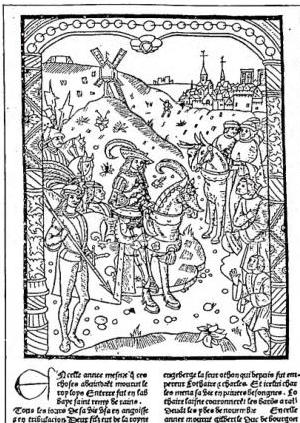
(from F. Catot, L. M. Michon, P. Angoulc, L'art du livre en France des origines à nos jours, Parigi 1831, p. 24)
CAVALLERIA - « Chroniques de France » (1493).
Parigi, library of the Arsenal.
within the aristocracy. But precisely now its flourishing comes to an end: with the death of Luigi IX in France, and with the end of the Hohenstaufen in Germany. It seems to become more rigid and austere, rejecting unsuitable bourgeois elements; but in this way it no longer admits even many non-noble elements who are morally most worthy and physically suited; and that noble competition among equals, through which the most worthy could truly rise, disappears. Monarchical power increasingly tends to bridle it and make it an instrument directly at its service; and sovereigns create chivalric orders, emphasizing in them above all the duties of loyalty and faithful subjection, alongside the warrior and Christian virtues. In Italy more than ever, where chivalry had taken less firm and deep-rooted hold, it deteriorates into a formalism ever emptier in proportion as it becomes more pompous, while continuing, on the contrary, to admit unsuitable elements, although those vigorous companies of mercenaries still arose from the feudal and chivalric stock which, toward the end of the 14th century, would free Italy from the scourge of the transalpine companies. But everywhere, in reality, the great ideals in whose name, and also, at least in part, for whose benefit, it had at first fought and triumphed have disappeared. - Vedi Tav. LXIX.
Kriegskunst, III, Berlino 1923; A. Abram, Chivalry, in The Cambridge Medieval History, VI, Cambridge 1929, p. 799 ff. Piero Pieri
II. CHIVALRIC EDUCATION
It holds a significant and distinctive place in the history of pedagogy because of the multiple aims toward which it was directed (“my soul to God, my life to the king, my heart to the lady, honour for myself”) and because of the consequent development of elements of the spiritual life, which helped to shape a personality both free and disciplined, adventurous and yet faithful.The position, in fact, of chivalry vis-à-vis the State and the Church required a special education, and the knight had first and foremost to learn to conquer himself, to overcome his inclinations and caprices, so as then to be fit to defend and make truth and justice triumph. The principal virtues, therefore, were moderation and self-mastery; these were followed by love of God, delicate and respectful love for the lady, fearless love of arms and danger, a lofty sense of honour and duty, fidelity to one’s pledged word, truthfulness, the pleasantness—while remaining firm and detached—of conversation and manners, gentleness and mercy. Outwardly: decorum, dignity, nobility; in a word: courtesy.
Until the age of 7, the future knight remained under the care of his mother and the noblewomen, who instilled in him the first principles of Christian education; games occupied most of his time. At 7, the boy became a page, and generally went to the court of a prince or castellan, for whom it was an honour and a source of pride to show his guests a numerous group of pages, and where his principal occupation was to learn to serve his lady or castellan, and also his lord, accompanying him on hunts or journeys. Religious instruction was not neglected, but was entrusted to the chaplain. He spent the rest of his time practising in order to acquire the knight’s seven “probitates”: swimming, horsemanship, shooting the arrow, duelling or fencing, hunting, playing chess, and the art of rhyming. On long winter evenings, the page could listen to the chaplain recounting the events of the Old and New Testaments and the legends of the saints; or sometimes hear the singer who, having arrived at the castle, entertained him by playing the viol and accompanying it with accounts of the deeds of the knights of old.
At 14, the page or “domicellus” (= donzello) became a squire, receiving from the priest, at the foot of the altar, the sword and the scarf, which he girded on after they had been blessed; meanwhile, the attendants, promising love and loyalty in his name, fastened silver spurs to his feet. From that moment arms became his principal occupation; and his office consisted in accompanying his lord in war, carrying his weapons for him, or on the hunt, taking an active part in II.
At about 21, the squire was armed knight. Even before this, however, he had set out to accomplish some feat, with a ring on his arm or leg as a sign of a vow. The ceremony was imposing and rich in symbolism. On the evening of the vigil, the candidate took a bath, then received and put on a black surcoat (symbol of death), a white tunic (symbol of purity), and a crimson mantle (symbol of the blood he must be ready to shed for the faith); then, fasting, he went to the chapel and kept vigil over his arms; in the morning, after Confession, Mass, Communion, and the blessing of the sword, he knelt and listened to the reading of the duties that would be his. The sponsors then put a shirt on him and over it the coat of mail, girded his iron greaves and sword on him. Then came the solemn oath to remain brave and faithful. Finally, his lord, striking him three times flatwise with the sword, said: “In the name of God, of s. Michael, and of Our Lady, I make you a knight.”
In practice, as in all human affairs, not all knights proved faithful to their ideal; nor did the institution always prove equal to the nobility and loftiness of its task; this is shown in part by the ironies of novella literature and heroic-comic epic; nevertheless, it remains true that chivalry made an effective contribution to the revival of justice and gentility in an age of easy and widespread abuses of power and oppression.