
GRANDE CHARTREUSE, THE. - I. HISTORY. - In 1084, St. Bruno, together with six companions, among them Landuin, at the suggestion of St. Robert of Molesme and also, it seems, of Seguin of Escotay, abbot of La Chaise-Dieu, went to Bishop Hugh of Grenoble, who led them to one of his deserted lands on the Chartreuse massif, ceding its ownership to Bruno and his companions; there they built, at first, simple huts arranged around an oratory; later, with the help of the bishop of Grenoble, the first monastery was built, which then served as a model. Joined to the church was a small cloister that led to the refectory, the chapter room and the guesthouse; then a larger cloister which gave access to the monks' cells, separated from one another and consisting of three small rooms for the eremitical life.
This life was dedicated to contemplation, study and the transcription of manuscripts, according to the testimony of the Benedictine abbots Guibert of Nogent and Peter the Venerable, who journeyed as far as the G. C. to visit the anchorites.
In 1090 St. Bruno was summoned to Rome by Urban II, and at the G. C. Landuin remained with those monks who had not followed Bruno. In 1099 Landuin visited St. Bruno, who had withdrawn to Calabria at the "Torre," and obtained from him a letter for the hermits who had remained at the G. C., a letter which, under the name of the testament of St. Bruno, constitutes the first nucleus of the Carthusian legislation.
Later, in 1127, the "consuetudines" were drawn up, approved by Innocent II in 1133. In 1142 the first General Chapter was held at the G. C., and it was established that the prior of the G. C. should be the General of the whole Order; the first was St. Anselm, seventh prior of the G. C. In 1259 the Chapter approved the "Statuta antiqua" dictated by Father Riffier; in 1368 came the "Nova statuta" of de Raynald; in 1508 the "third compilation" drawn up by du Puy. A new collection of the statutes, edited by Father Carasse, was approved by the Chapter in 1581; it was reprinted in 1679 by Father Le Masson. But all these modifications never touched the essence of the norms established by St. Bruno, whence the saying: Cartusia numquam reformata quia numquam deformata. The monastery having been suppressed with the French Revolution in 1790, the monks returned there in 1816. Expelled again in 1904, they moved to Farneta near Lucca; recently they have returned to the G. C.
Two kilometers from the monastery, in the midst of a wood, is the chapel of Notre-Dame de Casalibus (1440) and, a little farther on, beneath a rock, the chapel of St. Bruno, rebuilt in 1640 and restored in 1820; it is believed to occupy the site of the primitive hermitage.
Today in the library of Grenoble there are 36 volumes from the dispersed library of the G. C.; they form four complete Bibles: one of which is from the time of St. Bruno. In one of these Bibles are contained copies of the first donations received for the enlargement of the G. C.
Bibliography
Enrico Josi
II. ART
Of the original building there remain the church, today the Chapter, and a part of the cloister built in the 12th century by St. Anselm. A general reconstruction of the Convent, destroyed by fires, was undertaken during the 1550s by the 50th General of the Order, Innocent Le Masson.
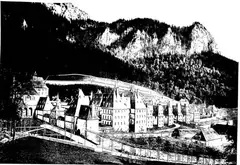
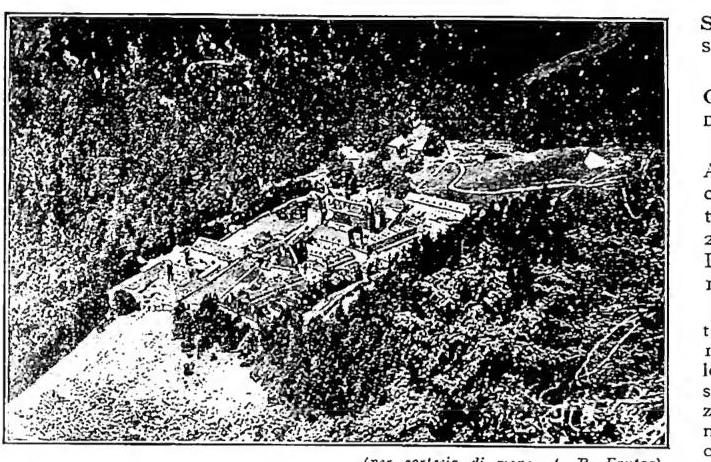
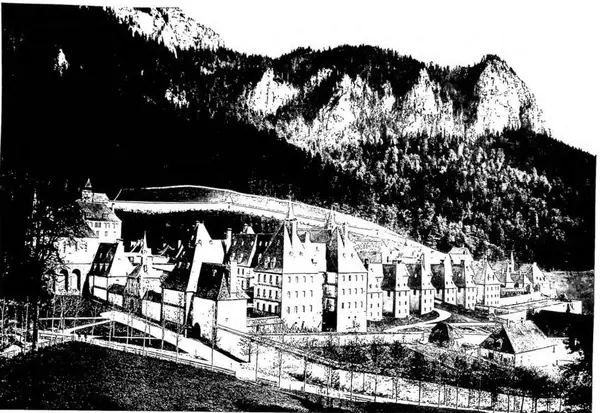
The Convent consists essentially of two building blocks arranged at the sides of the church and is dominated by ten bell towers of varying heights. To the left of the entrance door is a building that serves to house poor visitors; women are not admitted within the enclosure of the Convent and are received in a separate building, called the infirmary. A quadrangular courtyard opens in front of the entrance door; in it are two basins fed by the spring that takes its name from St. Bruno. Beyond the courtyard one comes to a corridor 130 m long, with which all the galleries that connect the various parts of the Convent communicate. To the right and left of the corridor there are also large halls for receiving foreign visitors. Beyond are the domestic chapel, the church, the refectory, the kitchen, the pantry, some cells, as well as the quarters of the Father General and the library, rich in more than 6000 volumes. The church, rebuilt after the fire of 1474, has simple and elegant lines and a vaulted roof that is very high and slender in its lines. Below the library is a chapel with an altar decorated with a curious mosaic composed of fragments of roots of various trees. In the chapter hall are the portraits of the first fifty Generals of the Order and 22 paintings depicting the life of St. Bruno, whose originals, painted by Le Soeur, are in the Louvre.
The great rectangular cloister is supported by 130 arches which in their arrangement follow the irregularities of the terrain and are of various periods. The oldest are pointed, the most recent, round-arched, date back to the 17th century. In the middle of the cloister is the cemetery and nearby the Chapel of the Dead founded in 1382; opposite is another chapel dedicated to St. Louis built by King Louis XIII. The Convent houses 40 fathers and 20 brothers who live in 60 cells that open onto two corridors each fully 220 m long. - See plate LXXVI.
Bibliography4 works
Emilio Lavagnino