
GAMBERA, PIETRO ANDREA (Gambarus, Gammarus, de Gamberinis). — Celebrated canonist, b. at Casal Filumane, near Bologna, around 1480, d. at Fano or Viterbo in September 1528. He studied at Bologna, where he had J. Campoglio as his teacher of civil law and A. M. Sala as his teacher of canon law; utriutrique iuris doctor (1505–1507), he taught canon law for some time, until he was chosen by Cardinal Giulio de' Medici, archbishop of Florence (later Clement VII), as his vicar general (14 June 1515).
Appointed an auditor of the Rota by Leo X, he took up his post under Adrian VI (22 May 1522), who sent him as legate to Hungary (June 1523–January 1524). Clement VII appointed him auditor of the Sacred Apostolic Palace and his vicar (1527), and the following year promoted him to bishop of Faenza (7 August 1528). He died while traveling to take possession of his diocese, and is said to have been buried at Viterbo.
He collected the decrees of the provincial Council of Florence (1517–18), published at Florence (1564), and wrote a commentary on the Extravagantes of Julius II, De electione simoniaca Romani Pontificis (Rome 1528), taking the position that the election itself was null, but, fearing that the new constitution might have sown the seed of a possible schism, he proposed its abrogation.
He also wrote Legalis dialectica (Bologna 1514); De veritate et excellentia scientiae (Basel 1543), almost a commentary on Aristotle’s Topics; another commentary, In rubricum de rerum permutatione et in caput licet eodem titulo (published in Repetitiones in universas fore iuris canonici partes, V, Venice 1587, fols. 103–70); a treatise De officiis et auctoritate legati a latere; another Tractatus de beneficiorum permutatione; and a third, De extensionibus, all three published in the collection Tractatus iuris universi (XIII, I, Venice 1585, fol. 150 ff.; XV, I, fol. 208 ff.; XVIII, fol. 247).
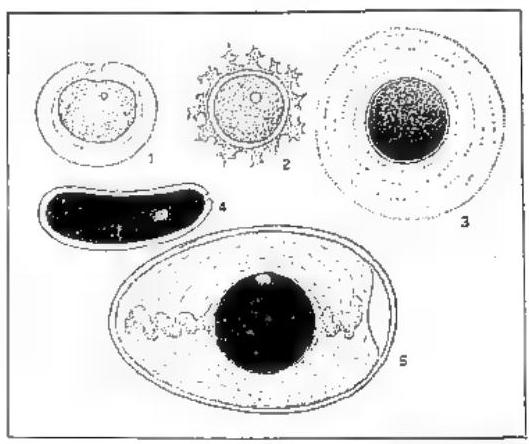
(propr. Enc. Catt.)
GAMETI ■ GAMETOGENESI — Fig. 1. Eggs: 1) oligolecithal egg of an echinoderm (arbacia); 2) oligolecithal egg of a mammal (human); 3) telolecithal egg of an amphibian (tana); 4) telolecithal egg of an insect (moaca); 5) telolecithal egg of a bird (hen).
(The yolk is indicated in black.)