
INCUNABULUM. — From the Latin incunabula, “infant’s swaddling clothes,” a noun indicating every book printed from 1455 to 1500, the conventional date after which a printed book is no longer called an i. but a “sixteenth-century book.”
The first i. is the Bible known as the 42-Bible (v.), named after the printer who is believed to have printed it in Mainz.
From Germany, proto-printing spread to the other European countries, so that by the end of the fifteenth century a very large number of stationary or itinerant printers were practising the art in Italy, France, Holland, Belgium, and Spain. The i. displays certain special characteristics: the almost total absence of a title page, replaced in most cases by a half-title; the absence of page numbering; the presence of signatures; the printer’s notes at the end of the text; the presence of the register; and the quality of the paper, thick and durable, with various designs in the watermarks. The illustration of the i. consists of woodcuts (v. INCISIONE), or engravings in wood; crude in Germany, rich in liveliness and often in comedy in France, and in Italy magnificent in its grace, especially in the books printed in Venice and Florence. Particularly noteworthy among all these are the Sogno di Polifilo, printed in Venice by Aldo Manuzio in 1499, the Fasciculus medicinae, likewise printed in Venice in 1495, and the Morgante Maggiore, printed in Florence in 1500.
From the eighteenth century onward, with the progress of culture, proto-printed books began to be held in high esteem and to become objects of study and purposes of collecting.
Before the Second World War, the most substantial collection was represented by the State Library of
That I can well say is mine.
Finis.
Dono: et gloria omni operanti bonum.
Mantue feliciter die xv Junij.
• M. cccc-lxxxvi.
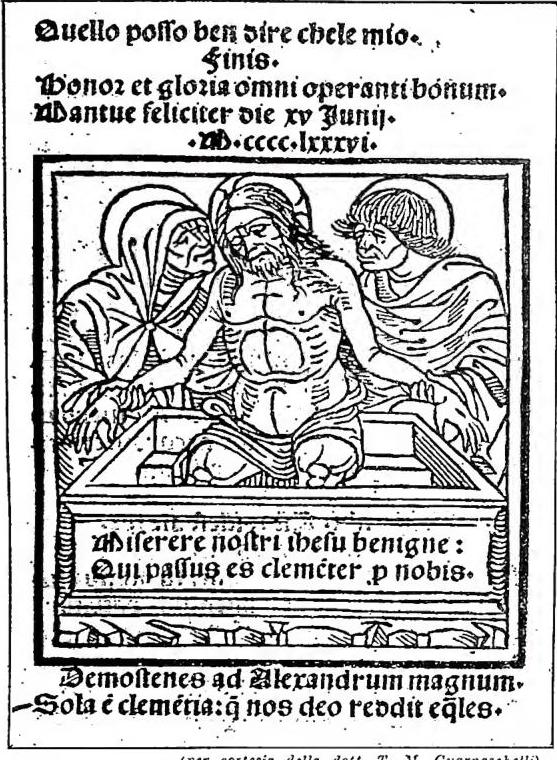
INCUNABULO — Auctoritates ad misericordiam inducentes, completed
printing at Mantua on 15 June 1486, photograph of the verso of the last
leaf — Venice, Biblioteca Marciana.
Monaco (16,000 items), which seems to have remained intact; followed by that of the British Museum (11,000 items), the Biblioteca Vaticana (7,000 items), the Pierpont Morgan Library, and the Huntington Library in America. In Italy, the largest collection of fifteenth-century books is held by the Biblioteca nazionale centrale di Firenze, but the libraries possessing the rarest items are the Ambrosiana and the Civica di Milano, the latter considerably enriched by the acquisition of the Trivulzio collection.
A central catalogue of the fifteenth-century editions held by all Italian libraries open to the public (excluding the Vaticana) was begun in 1932 by Giuliano Bonazzi, then director of the Biblioteca nazionale di Roma; after the compilation, it was possible to establish that the items held by Italian libraries number approximately 100,000. — Vedi tav. CXI.