
MOROCCO. - I. GEOGRAPHY. - Morocco embraces the northwestern extremity of the African continent, between the Mediterranean, the Atlantic and the Sahara, and is the only one among the countries of lesser Africa (Maghrib) that enjoys the benefit of a double sea front, although, while the Atlantic one is almost entirely controlled by France, the Mediterranean one is entirely contained within the borders of Spanish Morocco.
The incomparably larger part of Morocco (398,600 sq km with 9 million inhabitants) is represented by the Sultanate of Morocco, a French protectorate since 1912 and since 1947 included as an associated State in the French Union. Capital Fez (201,000 inhabitants). In addition to a notable and varied agricultural production (barley, wheat, maize and, more recently, fruit, early produce, grapes and olives), and a rich livestock heritage, the Sultanate can point to promising achievements in the mining sector (phosphates, manganese, cobalt, lead, zinc, antimony, molybdenum), while the deficiency of raw materials for motive power (coal, petroleum) is being made up for by the hydroelectric possibilities of the Atlas.
Spanish Morocco too is a protectorate, under the control of a high commissioner. The territory is essentially identified with the Rif region (22,000 sq km), inhabited by industrious agricultural populations (1.1 million souls), and notable, from the economic point of view, for the presence of rich deposits of iron minerals, as well as antimony, lead and zinc, all concentrated in the hinterland of Melilla. Alongside the capital, Tetuan, which has 73,000 inhabitants, the two ports of Melilla (62,000 inhabitants) and Ceuta (50,000 inhabitants) retain their importance; together with the Alhucemas Islands, the Chafarinas and the Peñon de Velez de la Gomera, these are detached from the protectorate proper, constituting the so-called Presidios. For the geographical map v. AFRICA (I, coll. 707-708).
Bibliography6 works
Giuseppe Caraci
II. CIVIL HISTORY
Present-day M., bounded on the east by the Muluya River, constituted in the Roman imperial age the province of Mauretania Tingitana, established around 45 A.D. by the emperor Claudius. Previously there existed in this territory various Berber kingdoms, of uncertain extent and constitution, which, having come into contact with Rome following the destruction of Carthage, generally maintained relations of good neighborliness with the Roman Republic. With with the reorganization of Diocletian, Mauretania Tingitana passed around 297 under the dependence of Spanish Baetica. The expansion of Christianity was slow, because of the difficulties posed by the indigenous populations and the changing historical events. After Mauretania was conquered in 429 by Genseric, king of the Vandals, he introduced Arianism there.
The domination of the Vandals lasted almost a century until in 533 Belisarius subjected Mauretania to the Byzantine Empire. After less than a hundred years present-day M. changed master again. The Visigoths of Spain, taking advantage of the struggles of Byzantium with the Persians, occupied Mauretania and remained there until the Arab invasion. The Muslims established themselves there firmly toward the end of the 7th century and, having crossed the Strait of Gibraltar, set out to conquer Spain. The reconquest by the Catholic kings, completed in 1492 with the capture of Granada and the expulsion of the infidels from the Iberian peninsula, aimed to secure also outposts beyond the strait, which would guarantee Spain and Portugal against an immediate offensive return of the Arabs. The consequence was the occupation of Ceuta and Melilla, strongholds steadily maintained against the many sieges of the Muslims. Spain, through various treaties concluded in the 18th century, obtained recognition from the Sharifian Empire of the possession of its strongholds and gained commercial advantages. In the same century France also obtained particular commercial rights, while England, having occupied Gibraltar in 1704, regarded the fortunes of M. with particular attention, strengthening commercial relations with the Sharifian Empire and keeping watch over possible attempts by others to assert their sovereignty over portions of Moroccan territory. M. thus slowly became an object of particular attention on the part of the European chancelleries, and assumed, especially after the French conquest of Algeria, international importance. Facing France, which wanted to continue in M. as well the expansion begun in Algeria, stood the interests of Spain, England, Germany and other powers. With the bilateral Anglo-French and Franco-Spanish agreements of 1904, the zones of influence of Paris and Madrid in M. were delimited. The international Conference of Algeciras (1906), while the sovereignty and independence of the Sultan, the integrity of the Sharifian Empire and economic freedom remained firm, recognized for all the signatory powers the enjoyment of equal economic and commercial rights in M., without compromising the interests and rights of the individual States, as they resulted from the treaties and agreements concluded. On 30 March 1912 France, by signing a convention with the Sultan, asserted its protectorate over M. A subsequent Franco-Spanish agreement of 27 Nov. of the same year delimited the zone of influence of Madrid. Today M. is divided politically into four parts: 1) zone of protectorate administered by France; 2) zone of protectorate administered by Spain; 3) neutralized and internationalized zone of Tangier; 4) direct Spanish possessions: the so-called Presidios (Melilla, Alhucemas Islands, Velez de la Gomera, Ceuta, Chafarinas Islands) and Ifni.
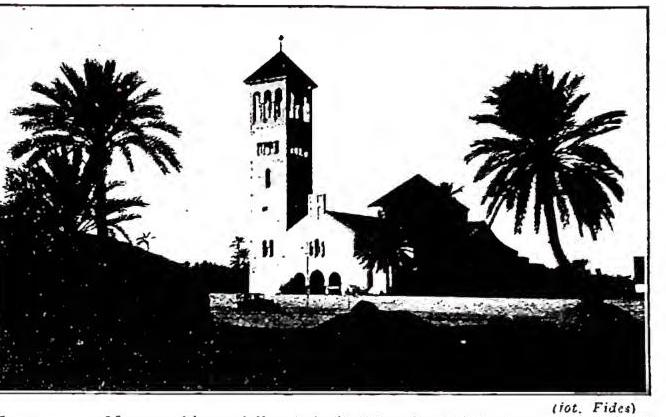
Bibliography4 works
Silvio Furlani
III. EVANGELIZATION
In the time of the Roman and Byzantine Empire, throughout North Africa, and likewise in Morocco, there were flourishing Christian communities with numerous episcopal sees; the Arabs succeeded in completely destroying Christianity in those regions. From the 9th century there is no further mention of a diocese in Morocco. In 1137 mention is made of a bishop Miguel, son of 'Abd al-'Aziz, with the Mozarabic Christians exiled in the 12th century from Granada and settled near Fez and Meknes. It is to be supposed that they were gradually exterminated. However, in 1225 a Dominican, friar Domenico, was consecrated bishop of Baeza (in still Islamic Spain) with destination for Morocco, and by order of Rome, presumably in 1226 or 1227, a Franciscan, Agnello, was ordained for Morocco or Fez. St. Francis of Assisi sent there in 1219 the first missionaries to preach the Gospel to the Saracens. They suffered martyrdom on 16 Jan. 1220 at Marrakech and were the protomartyrs of the Franciscan Order: Berard, Peter, Otto, Accursius and Adjutus.
In 1225 the Pope sent Dominicans and Franciscans to Morocco and thus the reorganization of the Moroccan Church was officially begun. Their activity was limited to the Christians: soldiers in the service of the Sultan, merchants, slaves. The immediate evangelization of the Mohammedans was impossible; whoever had the courage to undertake it paid for his zeal with his life, as did the seven Franciscans at Ceuta in 1227. The see of Fez or Morocco was fixed in 1237 at Marrakech. In the following centuries Franciscans and Dominicans succeeded one another as bishops; but very often they did not take up residence in the country and remained in Spain. Until the beginning of the 14th century the Franciscans exercised their ministry among the Christians with relative freedom. For the following period documents proving the continuity of Franciscan and Dominican work are lacking. It is to be presumed that the wars of the Spaniards and Portuguese with Morocco and the internal wars among the various dynasties made the work of the missionaries impossible. For the 14th and 15th centuries there is information about the ransoming of slaves by the Trinitarians and Mercedarians, some of whom suffered martyrdom. After the capture of Ceuta in 1415 and of Tangier in 1471 both cities were elevated to episcopal sees; in 1570 the two dioceses were united. All this, however, had no influence on the mission in the Moroccan Kingdom. Sporadically missionaries are found there: Franciscans, of whom Andrew of Spoleto was martyred in 1532; Jesuits from 1548 to 1553 and again in 1576 in Tetuan; Capuchins from 1624 to 1635, and other priests who were prisoners exercised the ministry among their companions.
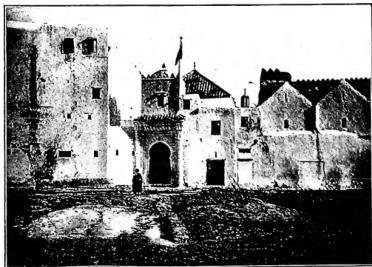
With the appointment as apostolic prefect of the Franciscan Juan de Prado in 1630, the Franciscan mission was re-established. Although he had been martyred in 1631, the Franciscans were subsequently able to found a permanent convent at Meknes and hospices at Fez, Sale, Marrakech and Tetuan until the new expulsion in 1790. In Tangier alone a few missionaries were able to remain, and in the end only one Franciscan. In 1859 the apostolic prefect Sabaté renewed the mission. It is the special merit of Fr. José Lerchundi, apostolic prefect from 1877 to 1896, to have organized the mission by founding stations, schools, hospices, and calling in sisters for the education of young women. Even in this period the activity of the Franciscans had to be restricted to the Christians of the sultanate of Morocco. In 1909 the apostolic vicariate of Morocco was erected. Once the international zone of Tangier was established and the Spanish and French protectorates proclaimed in 1912, the French Franciscans assumed the care of souls in the French protectorate, which was detached in 1923 as the apostolic vicariate of Rabat.
Bibliography3 works
Giovanni Rommerskirchen
IV. THE APOSTOLIC VICARIATE OF MAROCCO
The statistics of the apostolic vicariate of Spanish M. are as follows: area 28,373 sq. km., population approx. 950,000 inhabitants, Catholics 113,164, Protestants 2,500, Jews 60,000, Muslims 700,000. Missionaries 72, of whom 50 are Franciscans, brothers 64, sisters 221. Forane vicariates 3, quasi-parishes 15, primary stations 6, secondary stations 35, churches 23, chapels 25. Elementary schools 19; middle schools 18; higher schools 6; vocational schools 6. The charitable associations and those of Catholic Action are very flourishing.
Bibliography
Saverio Paventi