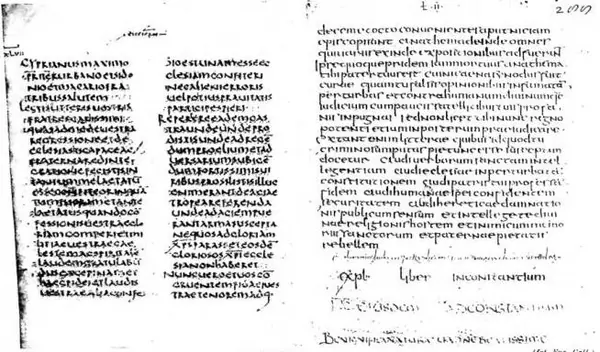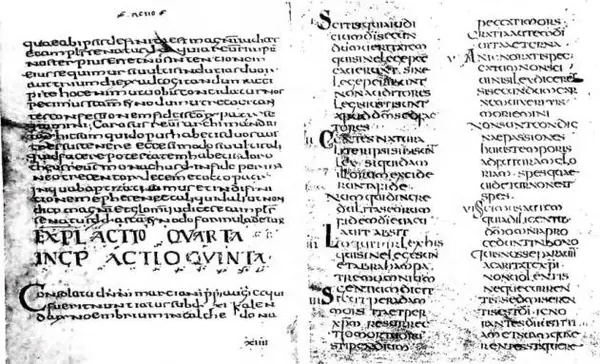
UNCIAL AND SEMI-UNCIAL SCRIPTS. - The term "u." is found used for the first time by St. Jerome (preface to the book of Job: PL 28, 1142), to indicate generically, it seems, large-sized majuscule script. With this meaning it is still encountered in the 9th century, in a letter of Lupus of Ferrières (PL 119, 448), then in an anonymous commentary on Donatus's Ars from the 10th century (cf. H. Hagen, Anecdota Helvetica [Gramm. lat. ex recens. Keilii, Supplement], Leipzig 1870, p. 221 ff.; cf. L. Traube, Vorlesungen und Abhandlungen, III, Munich 1920, p. 116 ff.) and in a passage of the anonymous biography of St. Severus, bishop of Ravenna, from the 11th century (cf. Rostagno [v. bibl.], p. 167).
For the ancients, therefore, it is probable that the word u. did not indicate a script very different from the capital. But on the origin and true meaning of the term the opinions of modern paleographers are not in agreement: some derive it from uncia (the twelfth part of a foot), which would have given the name to the script because of the height of the letters, or because they occupy the twelfth part of a column (Hatch); others from uncus or even from uncinus because of the curved shape of some of them (Allen), or from the shape of the ancient conventional sign of the ounce (Barone); still others affirm that in the formation of the term from uncia the resemblance of the shape of some letters to an uncus may have had an influence (Madan). In reality even the most recent studies have not reached a satisfactory conclusion. In any case, from the work of the Maurists (Nouveau traité de diplomatique, II, Paris 1755) onward the term "u." conventionally indicates a kind of script in which some capital letters have rounded their square forms. One should speak, therefore, more properly of uncial "letters" than of u. "script." It should be borne in mind in any case that the word "u." designates, with respect to Greek paleography, the majuscule script of papyri and parchments as opposed to that of the epigraphic type, and with respect to Latin paleography the majuscule book script (which does not however exclude lapidary examples), with a tendency to round forms, as opposed to the capital.
The term "s.", also consecrated by the Maurists for a script that exists only in Latin paleography, was meant to indicate a dimensional and genetic relationship between this script and the u., and although today the genetic relationship is excluded, the word is traditionally accepted in preference to others, proposed by various scholars, which lend themselves to new misunderstandings.
Bibliography7 works
I. IN GREEK PALAEOGRAPHY
The uncial was born or developed when the transition was made from the materials proper to epigraphy to papyrus and from the chisel to the reed pen; it appears that its centre of formation was principally Alexandria. It is considered separately according to whether it is traced on papyrus or on parchment, because the writing material considerably influences the shape of the letters; papyrus does not permit the strokes to be rounded as well as parchment does; moreover, on papyrus these strokes turn out to be more or less of the same thickness, whereas parchment favours the contrast between thick and thin lines.
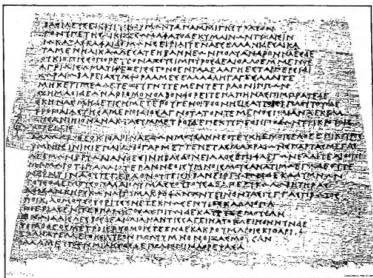
The oldest documents in o. and on papyrus that have come down to us, besides a marriage contract securely dated to 311 B.C., are assigned to the 4th century B.C.: a logos of Timotheus, the Persians; the imprecation of a certain Artemisia against the father of her child who abandoned her, and other fragments of lesser importance. In these documents the shape of the letters is in general that of the epigraphic style, with angles and wedge-shaped strokes; only a few letters begin to assume the typical form of o.: the linear sigma C and the omega that is beginning to become round, ω.
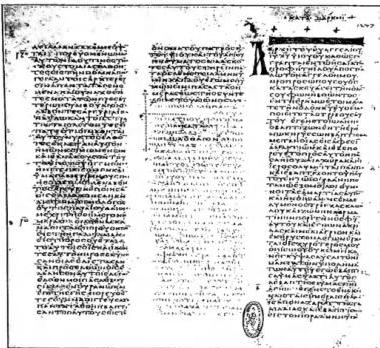
On parchment the oldest manuscript in o. is the Ambrosian Iliad (3rd century A.D.), of which, however, only a little more than fifty fragments remain, written on the reverse of as many miniatures, cut from the original codex by some vandal collector. Immediately following are three manuscripts of the Bible: the Vaticanus, the Sinaiticus, and the Alexandrinus, and one of the Old Testament: the Sarravianus or Colbertinus. The oldest of these seems to be the Vaticanus, to be assigned to the 1st half of the 4th century, then the Sinaiticus, in all probability from the 2nd half of the same century; the Alexandrinus and the Sarravianus are from the 5th century.
In the oldest manuscripts the o. is very pure and regular; almost all the letters can be contained in a circle or in a square, whose side has roughly the same dimension as the diameter of the circle. Later, however, the o. is transformed and deformed: the squares take the shape of rectangles; the circles flatten and shrink or widen out of all proportion; the angles are rounded, the strokes gradually lose their rigidity and some at times extend almost in an attempt at a ligature with the neighboring letter. Contemporaneously with this transformation of the ancient o., the practice of centering the texts begins. Finally in the 9th century, with the introduction of minuscule script (v.) in books, the o. begins to fall out of current use and in the following centuries is employed almost only in liturgical texts: through a return of archaism it then becomes upright again, elegant, stylized, and proceeds with a certain uniformity.
Bibliography6 works
II. IN LATIN PALEOGRAPHY
1. Origin
The lively discussions about the origin of Latin o. cannot yet be said to be concluded. Traube, presenting it as a "Christian script," reduced it to a direct imitation of Greek o., through the first Latin versions of Holy Scripture. Schiaparelli, having established the presence of round forms of a, d, e, m (the "characteristic" letters of Latin o.) in documents of the 3rd century where the alphabet has capital forms alongside cursive forms, denied such a direct derivation and, classifying this mixed script under the name of "archaic s.," identified in it a transitional type which, in the Diocletianic age, a period of the greatest expansion of Latin culture and of the closest contact with the Greek spiritual world, would have given rise to o. and to s. Finally Marichal, summarizing the theses of the latest French palaeographic school regarding the
"primitive minuscule" (that is, the book minuscule that would have been formed from the "degenerate capital" and that practically identifies itself with s.), derives o. from this script, as an artificial product that restores to the "familiar" forms of the minuscule the solemnity of the capital.
In truth none of the theories set out above attains the force of a proof. Schiaparelli's observations exclude the direct derivation of Latin o. from the Greek one: there nonetheless remains the fact of the undeniable contacts between the two scripts and of the clear prevalence of the use of o. for sacred or liturgical texts. On the other hand, the s. archaic, postulated by the Italian scholar, is not supported by sufficient examples, and the doubt persists that the "prescriptive" forms are rather elements of a personal and contingent character. As for the theory of the French school, it must be acknowledged the merit of having undermined many false theories and of having placed the problem on new foundations: nevertheless the transition from the "primitive minuscule" to the o. through the need to create a set script of majuscule character is not persuasive, given that in the same period the capital was at its greatest flourishing. The hypothesis, already put forward by Traube, that the territory of origin of the Latin o. is Proconsular Africa (a bilingual zone), from which come the oldest known inscriptions in o. (3rd century), has a character of greater probability.
2. Characteristics
The o. presents itself as a majuscule script, in which, however, bilinearity is not as rigorous as in the capital. Most of the letters preserve the capital form, with a stroke that is somewhat freer and rounder; a, d, e, m present themselves in the characteristic form recognized by the treatises as proper to the o.; h and q are of minuscule form. The s., on the other hand, is a minuscule script, which preserves some majuscule elements (almost always the n: sometimes the g and the e [in the o form]; rarely the r and the s). The a assumes now the open form, as is already found in the cursive, now the closed one, considered characteristic; the g alongside the characteristic form (derived from the cursive) also presents a majuscule caudate form; the i is sometimes tall; the m has its first two legs straight, the third bent back; the r and the s, when they are not of majuscule form, show a form that recalls that of the cursive; the t has a round descending stroke.
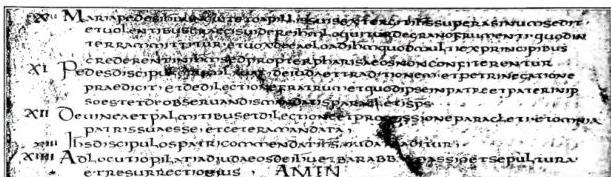
Some paleographers further distinguish, with Schiaparelli, a rustic o. and s. (frequent in the marginal glosses of ancient codices) characterized by the presence of cursive or cursive-like elements. Very vague and problematic is the existence of a "quarter o." script, envisaged by Traube and accepted by other scholars.
3. Dating
The criteria established for the dating of the o. by Chatelain and Lowe, and of the s. by Chatelain, have a relative value, inasmuch as they are based on a rather scanty group of securely dated codices and disregard localization.
For the o. in general the codices of the 4th and 5th centuries present in the letters stems that exceed the lower line but not the upper one; the b has the upper loop barely indicated, the lower one quite pronounced; f, p, t are very narrow (the t has a wavy upper stroke); l has a very small base and without a tail; m, n, u are very wide (the m has the first stem almost straight, the n the oblique stem quite marked); the p has a small and open belly. In the 6th century the f has horizontal strokes of equal length; the l has a base with a small tail; the t has a longer upper stroke, sometimes curved to the left; the n has a small crowning stroke on the right stem; the p and the r have the belly still open, but wider. In the 7th century the crowning strokes develop (h, l, n [also on the left stem]; the base of the l is much developed); the belly of the p is almost always closed; the t curves its upper stroke also to the right. In the 8th century the crowning strokes lengthen; the m has the first leg curved until it closes on the middle stem; this rests on a small horizontal line; the n has the intermediate stroke almost horizontal; the belly of the r descends beyond the middle of the vertical stem.
For the s. in the 5th century the a is of smaller dimensions than the other letters; the e is of uncial form, the n is majuscule and with the first leg somewhat longer; the belly of the q is developed in width more than in height; crowning strokes are lacking; the ligatures li and ci are frequent. In the 6th century the e sometimes has minuscule form; the g and the n majuscule or minuscule form; the t has a round lower stroke; li are not in ligature. In the 7th century the crowning strokes are carried onto the ascending and descending stems; the m always has it on the middle leg, sometimes also on the first; the t is sometimes found in tall form. In the 8th century the tendencies noted in the preceding age develop even more; the lower stem of the r is straight. - See pl. VIII.