
Enciclopedia Cattolica Vol. I, 1948 Art & architecture Artists

Andrea da Firenze

Italian original Cite

Bonaluti, Andrea redirects here.

Also known as: Italian: Andrea Bonaiuti, Andrea di Bonaiuto, Andrea di Buonaiuto

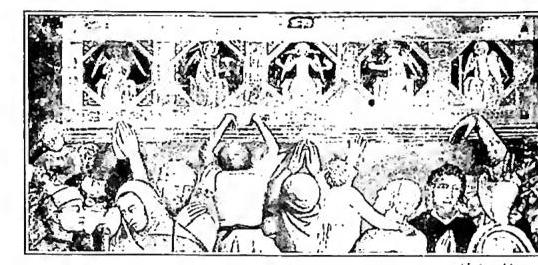
ANDREA DA FIRENZE - Suppliant faithful before the shrine of St. Peter Martyr - Detail of the fresco in the Spanish Chapel - Florence, S. Maria Novella.

ANDREA DA FIRENZE. - Florentine painter, according to Bonaini identical with Andrea Ristori of the parish of S. Pancrazio (1333-92), but identified by Milanesi, Berenson, van Marle and Toesca with Andrea di Buonaiuto or Bonaiuti; who, enrolled as early as 1343 in the guild of physicians and apothecaries, stipulated in 1365 the contract for the frescoes of S. Maria Novella, in 1366 took part in the commission for the construction of the Cathedral, received in 1377 payments for the paintings in the Camposanto of Pisa; his will is dated 2 Nov. 1377.

By Sirén there was attributed to the master, as a youthful work, the panel with St. Mary Magdalene, formerly in the Beckerath collection in Berlin, which criticism, however, does not unanimously recognize as his. The great cycles of A. in the Spanish Chapel at S. Maria Novella in Florence and in the Camposanto of Pisa show how, in the second half of the fourteenth century, A. in particular was sensitive to the Giottoesque heritage under Sienese influence. Nevertheless A. succeeded in creating a style of his own, decorative and pleasing for its liveliness of colour.

Beginning around 1365 the works at S. Maria Novella, A. was certainly a well-known and mature master. The Chapel, simple and square in form, was decorated entirely by A. but probably with the help of pupils, as the poorer parts show. The design is of a unified style; the theme represents the glorification of the Dominican order, and is influenced by the Specchio di vera penitenza of the prior of the convent Jacopo Passavanti (d. 1357), according to the scholastic ideas of St. Thomas and with reminiscences of Dante's Paradiso. The altar wall is decorated with the Journey to Calvary, with the Crucifixion and with the Descent into Limbo. On the entrance wall are scenes from the Story of St. Peter Martyr. On the right wall the Activity and Triumph of the Dominican Order; on the left the Triumph of St. Thomas Aquinas; in the vault of the great chapel, the Resurrection, the Ascension, the Navicella (after Giotto's mosaic in St. Peter's in the Vatican) and the Pentecost.

The three frescoes in the upper register, with the stories of St. Ranieri, in the Camposanto of Pisa - now much damaged - surpass those of the Spanish Chapel from the decorative and colouristic standpoint. The surface becomes even more crowded with people, without any order among the figures. It seems that the artist died after finishing the three scenes, because the pictorial cycle was completed by Antonio Veneziano. - See Pl. CII.
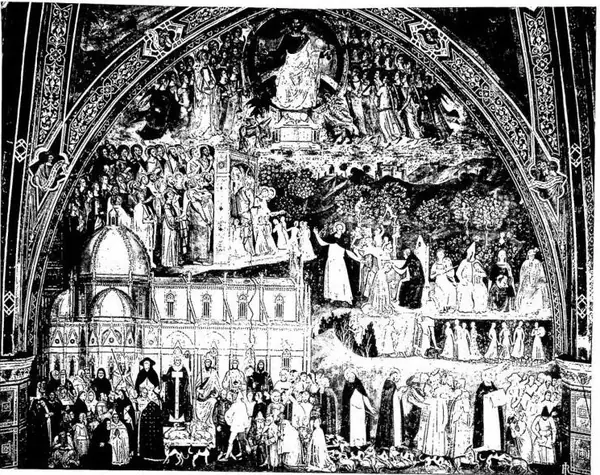
Sp. Bruni THE CHURCH MILITANT AND THE CHURCH TRIUMPHANT Florence, cappellone degli Spagnoli.
Plate CII Sp. Bruni THE CHURCH MILITANT AND THE CHURCH TRIUMPHANT Florence, cappellone degli Spagnoli.
Bibliography7 works
BIBL.: F. Bonaini, Memorie inedite intorno alla vita e ai dipinti di F. Traini, Pisa 1846; G. Vasari, Le Vite, ed. Milanesi, I, Florence 1878, p. 550; O. Sirén, Giotto, Leipzig 1908; P. Taurisano, Il capitolo di S. Maria Novella in Firenze - Andrea di Bonaiuto, in Il Rosario, 33 (1916), p. 217-30; B. Berenson, The Florentine Painters, New York 1909, p. 21; R. van Marle, The Development of the Italian Schools of Painting, III, The Hague 1924, p. 425; P. Toesca, Pittura fiorentina del Trecento, Verona 1929, p. 60.

About this entry

By Volfango Federico Volbach

How we know read from the page scan

Translated from the Enciclopedia Cattolica, vol. I (1948), coll. 1196–1197.

Printed pages Open in the page viewer
Page 732
vol. 1, coll. 1195–1196
Page 733
vol. 1, coll. 1197–1198

More by Volfango Federico Volbach: Acheiropoieta (from Ἀχειροποίητος, literally «Not Made by Hand [Human]», and in proper sense «True Image of Christ») · Textiles · Wulff, Oskar

Cite this article

Chicago

Volbach, Volfango Federico. “Andrea da Firenze.” In Enciclopedia Cattolica, vol. I, coll. 1196–1197. Città del Vaticano: Ente per l’Enciclopedia Cattolica e per il Libro Cattolico, 1948. https://azioneromana.com/article/andrea-da-firenze.

MLA

Volbach, Volfango Federico. “Andrea da Firenze.” Enciclopedia Cattolica, vol. I, Ente per l’Enciclopedia Cattolica e per il Libro Cattolico, 1948, coll. 1196–1197. Azione Romana, https://azioneromana.com/article/andrea-da-firenze.

BibTeX

@incollection{ec1_andrea_da_firenze,
  author    = {Volbach, Volfango Federico},
  title     = {Andrea da Firenze},
  booktitle = {Enciclopedia Cattolica},
  volume    = {I},
  pages     = {1196--1197},
  note      = {Cited by column},
  publisher = {Ente per l’Enciclopedia Cattolica e per il Libro Cattolico},
  address   = {Città del Vaticano},
  year      = {1948},
  url       = {https://azioneromana.com/article/andrea-da-firenze}
}

One of some 20,000 entries brought back from the twelve printed volumes (1948–54). Spotted something? Help us improve it.

Save for later

Enter your email and we will send you a sign-in link. No password. What you save (articles, verses, chapters, documents) follows you to any device.