
Pope Innocent IV

25 June 1243 – 7 December 1254

Enciclopedia Cattolica Vol. VII, 1951 Canon & civil law Jurists

Innocent IV, Pope

INNOCENZO IV, PAPA

Italian original Cite

Fieschi, Sinibaldo redirects here.

Also known as: Italian: Sinibaldo Fieschi, Sinibaldo dei Fieschi; Latin: Innocentius IV

INNOCENT IV, Pope. - Sinibaldo Fieschi, born at the end of the 12th century to the count of Lavagna, of a Genoese family; he studied under the guidance of a paternal uncle who was bishop of Parma, attended in Bologna the famous schools of canon and Roman law, hearing illustrious masters such as Azzo and Accursius, and became himself one of the most renowned canonists of his time (he had, among other things, a great part in the elaboration of the doctrine of juridical persons); in 1226 he moved to Rome, where he held offices in the Curia and carried out legations; on 23 Sept. 1227 Gregory IX, who had known him for some time, raised him to the cardinalate, assigning him the presbyteral title of St. Lawrence in Lucina. On the death of Celestine IV (10 Nov. 1241) there followed a vacancy of fully 18 months, while the Church was in a most grave condition because of the hostility of the emperor Frederick II; at last the few surviving cardinals unanimously elected Fieschi (24 June 1243), who took the name of I.

The new Pope at first showed the intention of conducting negotiations with the Sovereign, but very soon every agreement became impossible because both parties had too many demands; moreover I. felt insecure in Rome, and betook himself to Genoa and from there to Lyons, where he convoked a general Council for June 1245. Despite the defense of Thaddaeus of Sessa, Frederick was solemnly excommunicated for the second time and deposed from the throne; there followed a period of struggles with alternating fortune, closed by the death of the Emperor (17 Dec. 1250). Then I. set out on the return journey, but only on 6 Oct. 1253 did he enter Rome, when new dissensions had already broken out with Frederick's heirs, Conrad and Manfred; a year later I., long ill, died at Naples (7 Dec.).
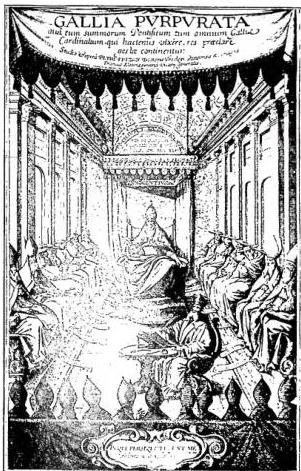
INNOCENT IV, pope - I. IV presides over the First Council of Lyons. Title page of the Gallia Purpurata of P. Frison, Paris 1638. Copy in the Vatican Library.
INNOCENT IV, pope - I. IV presides over the First Council of Lyons. Title page of the Gallia Purpurata of P. Frison, Paris 1638. Copy in the Vatican Library.(from P. Frison, Gallia Purpurata, Paris 1635)

Among his works as a jurist one must remember the Apparatus in quosque libros Decretalium, composed for practical purposes, which had a wide diffusion and enjoyed great authority. Moreover I. promulgated three authentic collections of canons comprising 41 of his Decretals and sent them to the Universities of Bologna and Paris so that they might insert them into the compilation of Gregory IX under the corresponding titles; the principal constitution was the Romana Ecclesia issued at the First Council of Lyons; he also wrote a commentary on his own Decretals.

The juridical writings of I. were commented on by John of God, Peter of Sampson, Bernard of Compostella the younger and the Hostiensis. The Pope's writing entitled Apologeticus, or De iurisdictione imperii et auctoritate Romani Pontificii, stands apart, directed against Pier della Vigna, but which today cannot be identified with certainty.

Bibliography13 works
BIBL.: Nicola da Calvi, Vita Innocentii IV papa, in RIS, III (there also a life by an anonymous author); Matteo Paris, Chronicon, in MGH, Scriptores, XXVIII, pp. 107-389; MGH, Epistolae suec. XIII etc., II; E. Berger, St Louis et Innocent IV, Paris 1887; id., Les registres d'Innocent IV, 4 vols., ibid. 1894; A. Folz, Kaiser Friedrich II. und Papst Innocenz IV., Strasbourg 1905; I. Uminski, Niewozpieczenstwo Tatariskie w Polowie XIII w. i Papież Innocenty IV., Lwowie 1922; B. Sütterlin, Die Politik Kaiser Friedrichs II. und die römischen Kardinäle (1239-50), Heidelberg 1929; P. Brezzi, Roma e l'Impero medievale, Bologna 1947, p. 443 ff. On Innocent IV as jurist, cf. I. F. Schulte, Beiträge zur Literatur über die Decretalen Gregori IX., Innocenz IV. etc., Vienna 1871, pp. 55-127; F. Ruffini, La classificazione delle persone giuridiche in Sinibaldo Fieschi (Innocent IV), etc., in Studi Schapler, II, Turin 1898, p. 313 ff.; B. Kurtscheid-F. A. Wilches, Historia iuris canonici, I, Rome 1943, p. 259; A. van Hove, Prolegomena, 2nd ed., Malines-Rome 1945, pp. 362-63, 453, 477, 480; H. Marc-Bonnet, Le Saint-Siège et Charles d'Anjou sous Innocent IV et Alexandre IV, in Revue historique, 200 (1948), p. 38 ff.

Paolo Brezzi

About this entry

By Paolo Brezzi

How we know signed in print

Translated from the Enciclopedia Cattolica, vol. VII (1951), coll. 12–14.

Printed pages Open in the page viewer
Page 32
vol. 7, coll. 11–12
Page 33
vol. 7, coll. 13–14

More by Paolo Brezzi: Innocent VII, Pope · Innocent VIII, Pope · Innocent IX, Pope · Leo VII, Pope · Leo VIII, Pope

Cite this article

Chicago

Brezzi, Paolo. “Innocenzo IV, papa.” In Enciclopedia Cattolica, vol. VII, coll. 12–14. Città del Vaticano: Ente per l’Enciclopedia Cattolica e per il Libro Cattolico, 1951. https://azioneromana.com/article/innocenzo-iv-papa.

MLA

Brezzi, Paolo. “Innocenzo IV, papa.” Enciclopedia Cattolica, vol. VII, Ente per l’Enciclopedia Cattolica e per il Libro Cattolico, 1951, coll. 12–14. Azione Romana, https://azioneromana.com/article/innocenzo-iv-papa.

BibTeX

@incollection{ec7_innocenzo_iv_papa,
  author    = {Brezzi, Paolo},
  title     = {Innocenzo IV, papa},
  booktitle = {Enciclopedia Cattolica},
  volume    = {VII},
  pages     = {12--14},
  note      = {Cited by column},
  publisher = {Ente per l’Enciclopedia Cattolica e per il Libro Cattolico},
  address   = {Città del Vaticano},
  year      = {1951},
  url       = {https://azioneromana.com/article/innocenzo-iv-papa}
}

One of some 20,000 entries brought back from the twelve printed volumes (1948–54). Spotted something? Help us improve it.

Save for later

Enter your email and we will send you a sign-in link. No password. What you save (articles, verses, chapters, documents) follows you to any device.