
TIARA. - From the Greek τάρα, synonymous with φάγιον (= turban), a head covering proper to the pope, of conical shape adorned with three crowns (= triregnum), surmounted (since the 16th century) by a small cross.
It is not used during liturgical functions
TIARA - T. with three realms, surmounted by the Cross, which is placed on the head of the bronze statue of St. Peter on days of great solemnity. The custom of dressing the statue in sacred vestments dates back to 1736 - St. Peter's Basilica.
turgical functions, and the pope receives it from the hands of the cardinal protodeacon, as in ancient times, outside the Vatican Basilica, on the day of his solemn coronation after celebrating solemn Mass, before the people. He then wore it in the solemn procession with which he went to take possession of the Archbasilica of St. John Lateran, from the time when he established his ordinary residence in the Vatican Palace. Today the pope wears it upon returning from the celebration of or assistance at pontifical Mass.
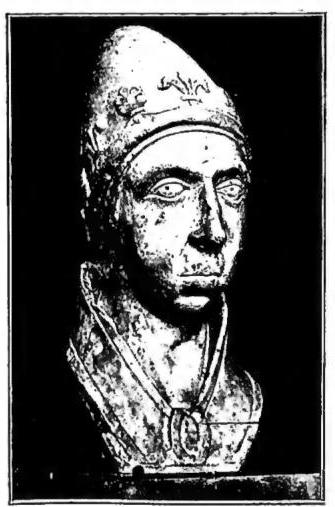
It has a common origin with the mitre, bearing a resemblance to the Phrygian cap used at the Persian court, which later became an insignia of the Byzantine Emperor. It seems to have been used by the popes at least since the 8th-9th century as a sign of their earthly power, perhaps from the time of the Syrian pope Constantine (708-15; cf. Constitutum Constantinum, ed. K. Zeumer [1888], cap. 16). It had the shape of a tall, pointed cone made of white fabric; around the lower brim ran a golden band (cf. the coins of Sergius III [904-11] and Benedict VII [974-83] representing St. Peter with a pointed conical headgear). This headgear is to be distinguished from the camelaucum, which later transformed into the liturgical mitre. Not before the 10th century did the golden band of the Phrygian cap become a crown, notched after 1256, called regnum. At the beginning of the 14th century under Boniface VIII (1294-1303) the shape changed somewhat and a second crown was added (cf. the attempt by Hildebrand the archdeacon in 1059 to add the second crown); the third crown was added under Benedict XI (1303-1304) or Clement V (1305-14); hence the name triregnum. Innocent III indicates the mitre "pro sacerdotio"; the t. "pro regno". The double crown has the same meaning as pontifical and imperial authority, analogous to the double crown of the emperor who wore the "diadema imperii" over the clerical mitre. E. Eichmann explains the three crowns of the t. by analogy with the three crowns of the Emperor: German of Aachen, Lombard of Milan-Monza, Roman of Rome. The formula for the papal coronation in the Roman Pontifical of 1596 instead declares the Pope 1) father of princes and kings, 2) ruler of the world, 3) vicar of Christ. - See pl. V. BIBLICA.: J. Braun, Die liturg. Gesandung im Occident und Orient, Freiburg 1907, pp. 498-508; G. Ladner, Die Statue Bonifaz VIII. in der Lateranbasilika u. die Entstehung der dreifach gebrönden Tiara, in Röm. Quartalschr., 42 (1934), p. 35 ff.; P. E. Schramm, Zur Gestalt der päpstl. Tiara, in Hist. Zeitschr., 152 (1935), pp. 307-12; M. Righetti, Manuale di st. liturg., I, Milan 1950, p. 536; F. Hermanin, Tre ritratti