
PONTORMO, JACOPO CARUCCI (CARRUCCI), Called Il. - Florentine painter, b. 24 May 1494 near Empoli, d. in Florence in 1557. Son of a pupil of the Ghirlandaio, Bartolomeo di Jacopo di Martino Carrucci, of whom no works are known, Jacopo went to Florence ca. 1507 and, according to Vasari, would have been first at the school of Leonardo da Vinci, then with the Albertinelli, Piero di Cosimo and Andrea del Sarto. In reality P. cannot be called a pupil or follower of any one in particular, if one considers the multiplicity of aspects and the discontinuity of development that his works manifest.
Solitary, restless, tormented, dissatisfied, P. can in fact belong to the ranks of the early Mannerists; rather, in his dissatisfied attitude, the psychological motive of "self-criticism" predominates, which his drawings in particular manifest. The definition of pictorial criticism, while it does not explain all the complexity of Pontormo's language, nevertheless appears more convincing than recourse to extraneous concepts, such as Gothic or Romantic, employed by some critics with regard to P. On the other hand, certain frankly naturalistic affirmations of the artist (frescoes of Poggio a Caiano, Supper at Emmaus of the Accademia in Florence, etc.) confirm the complexity of motive in his painting.
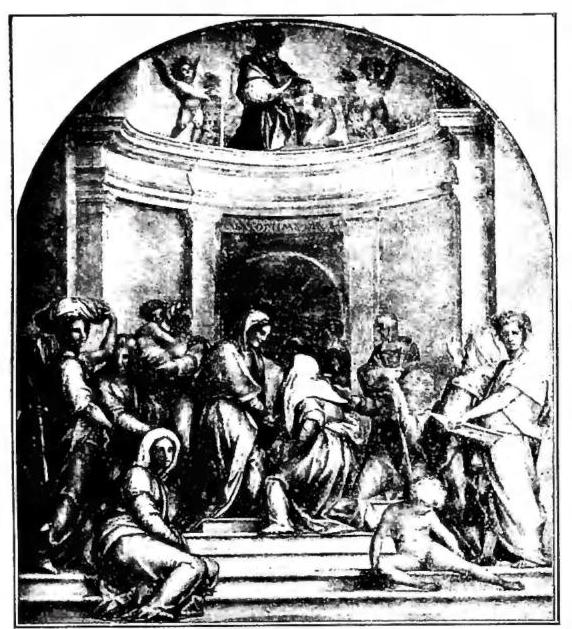
While a small Annunziata by him (1508) has been lost, which reveals him as a child prodigy, praised by Raphael, and a faint memory may be called the coat of arms of Pope Leo X executed on the door of the church of the Annunziata (1513), from about the same year there remain the small monochrome Stories of a St. Monica (Florence, Accademia); where together with recollections of the Albertinelli and of Andrea del Sarto one perceives a restless and incisive sense of the Pontormo vision, even in the strange intensity of the hallucinated gazes. Less significant, with clear recollections of Raphael and Andrea del Sarto, is the fresco (Florence, Santissima Annunziata, chapel of St. Luke; 1513) representing the Madonna and Saints. Important, instead, is the fresco of the Veronica (1515; Florence, convent of Santa Maria Novella), which reflects elements drawn from Andrea del Sarto, Leonardo and Michelangelo, through a strong interpretation, plastic and dynamic at once; of theatrical but rigorous effect.
The chiaroscuro and spatiality of Andrea del Sarto, together with recollections of Raphael and Fra' Bartolomeo, are evoked by the fresco of the Visitation (Florence, Santissima Annunziata; 1516), where the composite classical equilibrium is maintained. The altarpiece of St. Michael Visdomini (Florence 1518) manifests instead the Mannerist crisis of P., that is the search for almost expressionistic modes, both in the elongated proportions of the figures and in the study of the affections and of movement. The frescoes of Poggio a Caiano (1519-20), studied in numerous drawings (and P. was a great draughtsman), document the anxious critical position of the artist, but then the pictorial realization is frank, like an oasis of rare summer serenity. Then the restlessness of P. reasserts itself through new problems of interpretation: as in the frescoes of the Certosa (Galluzzo, Florence: 1523-25) which presuppose the study of Dürer, if not directly, then through his prints, which had been circulating in Italy for some decades.
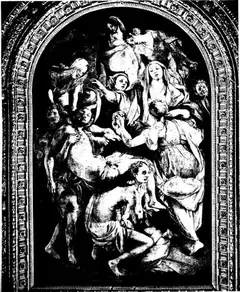
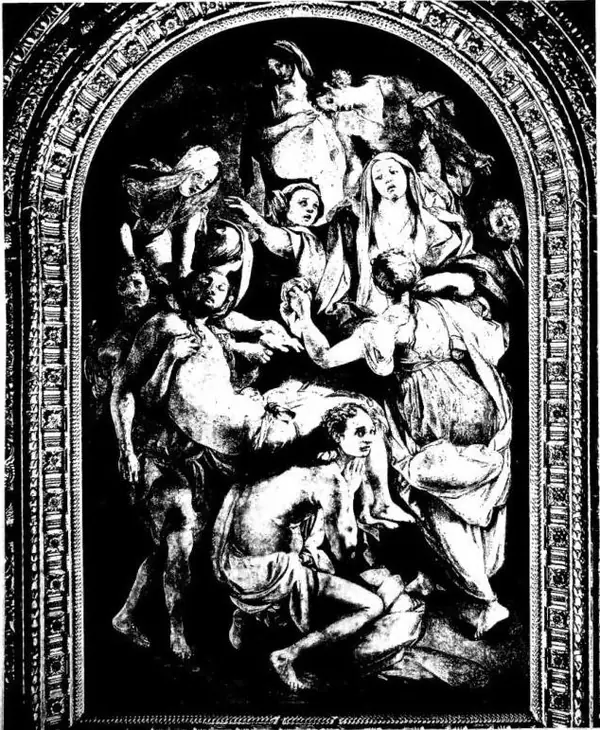
In Dürer P. saw a psychologically and religiously penetrating humanity; and on the side of form, certain chromatic and inventive abstractions that stimulated his anti-classical and intellectualistic tendency but yet clearly draughtsmanly and, in the details, icastic. The Stories of the Passion, at the Certosa, thus evoke a strange, disconcerting world. But, once the immediate contact with German art was overcome, the Dürerian suggestions, resolved into a subtle rhythm woven of linear motifs, precious luminous quantities, refined chromatic relationships, allowed P. to attain very high moments, as in the Annunciation and in the Deposition in S. Felicita (1526-28; Florence), in the Visitation of Carmignano (1528-30), etc. The so-called Halberdier, of the Fogg Museum in Cambridge (U.S.A.), belongs to the Dürerian period. Among the portraits owed to P., always most noble, aristocratic, spiritual, one recalls: that of a student (Milan, Castello Sforzesco: 1522); that of a gentlewoman in Florence (Uffizi); that of Cosimo the Elder (ibid.: ca. 1523); that of a gentlewoman in Frankfurt (Städel Museum: ca. 1540). Numerous drawings, especially important the group in the Uffizi. - See pl. CXVIII.
Bibliography13 works
Luigi Grassi