

GELASIUS I, Pope, Saint. - He deserves the first place in the series of popes of the 5th century, after Leo I. He governed the Church from 492 to 496. African by origin, he had the taste and talent for controversy peculiar to Tertullian as well as the vigorous and expansive reasoning, the liveliness and even the acerbity of the same apologist (cf. L. Duchesne, L'Eglise au VIe siècle, Paris 1925, p. 12 ff.). When he succeeded Felix III (492), he had already for a long time belonged to the Roman clergy and had had occasion to make himself noticed with polemical and historical writings relating to Monophysitism and Pelagianism (v.).
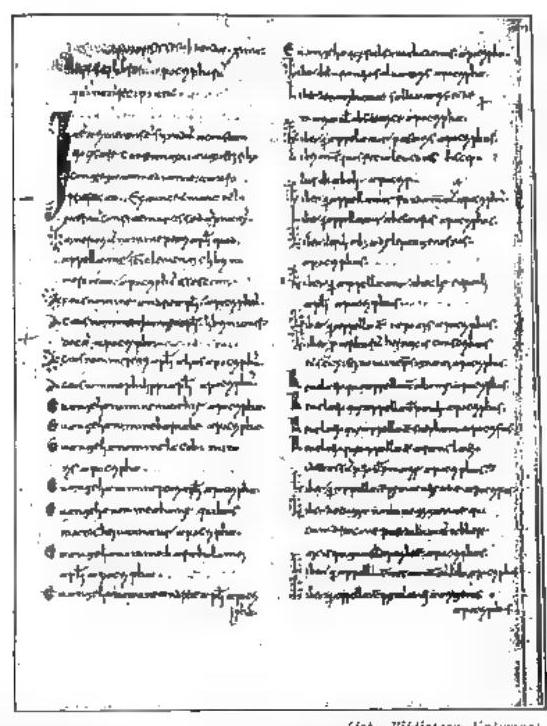
(Int. Vatican Library)
His contemporaries in their enthusiasm acclaimed him "Vicar of Christ and Apostle Peter," and the following generation, in the person of Dionysius Exiguus, wrote his eulogy.
Throughout the duration of his pontificate, relations between the Church of Rome and that of Constantinople remained tense because of the schism of Acacius: G., on the one hand, firm and faithful to the Council of Chalcedon and to the traditional doctrine of the Fathers against the Henotikon, sought on the other hand every occasion to continue or resume correspondence with the emperor Anastasius I. As soon as he was elected pope, he communicated the news to the emperor but received no reply: in a new letter, very respectful, he recalled that if bishops have the duty to submit in civil matters to the prince, the latter must be subject to the bishops in matters of religion, and that a particular respect is owed to the First Bishop and to the Roman Church. G. had the highest conception of his authority and founded the doctrine of the two powers. He wrote to Anastasius I: "There are, august emperor, two powers that principally divide the empire of the world: the sacred authority of the pontiffs and the royal power; and the office of the priests is all the more grave inasmuch as they will have to render account, at the divine judgment, even for the very kings of men... no one can, for any human reason, rise against the privilege of the confession, that is, of the primacy of him whom Christ has set over all things, and whom the venerable Church has always recognized and duly considered as its head" (Epist., XII, 2-3). With this G. became the creator of the papal idea dominant in the Middle Ages.
In Italy G. maintained good relations with Theodoric, king of the Ostrogoths, who, after the victory over Odoacer, acquired dominion over the peninsula.
From the years of peace (494-95) two synods celebrated by G. in Rome are known, the first for a series of disciplinary decrees intended to settle questions among the clergy, the second for having put an end to the last consequences of the Acacian schism within the Church of Rome.
Among the letters of G., which A. Thiel counted at 43 with 49 fragments (subsequently 22 more were found), some, because of the subject matter treated, had a scope wider than the region to which they referred, being true and proper treatises, such as the one on the controversy of Acacius and, particularly, on the patristic tradition.
Among the acts of G. there also figures, probably wrongly, the famous Decretum Gelasianum, in five parts: "De Spiritu Sancto; De Canone Scripturae sacrae; De Sedibus patriarchalibus; De synodis oecumenicis; De libris recipiendis et non recipiendis." This last part, by far the most important, is the first essay of an index of forbidden books (cf. E. von Dobschitz, Das Decretum Gelasianum de libris recipiendis et non recipiendis, Leipzig 1912). The whole was probably compiled in the 6th century with earlier elements going back to Damasus and Hormisdas. Regarding the so-called Sacramentarium Gelasianum, a recension of the Roman Missal, existing only in a Gallican recension, the opinions of authors to this day are divided (v. SACRAMENTARIES). The homilies and hymns of G. have been lost. His feast is noted by the Martyr. Romanum on 21 November.
Bibliography5 works
Lucchesio Späling
THE GELASIAN DECREE
A Latin dogmatic writing, which presents itself as drawn up at a Roman Synod of 494. It is known under the title of that part, De libris recipiendis et non recipiendis, which is of special importance for the history of the biblical canon, contained in ch. 2, where no distinction is made between protocanonical and deuterocanonical books (but the 2nd and 3rd epistles of John are attributed to John the presbyter). It is divided into 5 chapters. In the 1st it speaks of the seven gifts of the Holy Spirit and of the different names of Christ; the 2nd contains the biblical canon; the 3rd speaks of the authority of the Church and of the primacy of the Roman Church; the 4th of the authority of the councils and of the Fathers; the 5th of the books of heretics and schismatics, which the Church rejects.
About 36 manuscripts of the Gelasian Decree are known, which can be distinguished into two classes. The first attributes all or part of it to Pope Damasus (366-84), the second to Pope G. (492-96); some more recent manuscripts to Pope Hormisdas (514-23). According to the testimony of the manuscripts, the Gelasian Decree comprises two independent parts, which are not attested before the 7th century, but which could have existed earlier.
Recent studies authorize, though only as a hypothesis, the following conclusions concerning the origin of the Gelasian Decree: 1) the definitive writing resulted from the conjunction of two documents of different origin and different value; 2) the first document, comprising chs. 1-3, may go back to the end of the 4th century, and in accordance with the title could be the work of the Roman Council of 382 under the pontificate of Damasus I; 3) the second document (chs. 3-5) is the work of a private individual, of the end of the 5th century-beginning of the 6th, who nourished great veneration for St. Jerome, and was most faithful to the doctrines of the Roman Church; 4) the two documents were soon joined together either in northern Italy or in southern France; 5) the Gelasian Decree thus composed remained for some time unknown, nor was it considered an official document. This explains why the testimonies are quite late, that is, of the 7th century (Bardy, col. 389).