
UNIONE UOMINI DI AZIONE CATTOLICA. — This is the organization of adult Action (v.). According to the current Statute (11 Oct. 1946), it consists of
“ married men or men who have reached their 30th year of age.”
The history of the U. U. di A. C. is intertwined with, and to a great extent coincides with, that of the Catholic organizations of the laity in Italy from 1868, the year of the foundation of the Gioventù Cattolica Italiana, to the present day. Already a considerable number of adults were entering or remaining in its ranks, especially as leaders; adults, in any case, constituted the majority of the militant Catholics who held the Catholic Congresses of Venice and Florence in 1874 and 1875, giving rise, the following year, to the Opera CATTOLICITÀ (v.). The Opera soon assumed first-rate importance in the life of the country and in 1891 was divided into five sections, later called groups. A new organization of militant Catholics was established in 1906 by the b. Pio X. Apart from the Società della Gioventù Cattolica and the Federazione Universitaria, the following were created: Unione popolare (v.), the Unione Economico-Sociale (v.), Unione Elettorale Cattolica (v.). Finally, in 1922, a few months after his election to the pontificate, Pio XI gave Italian Catholic Action those structures which it has essentially retained to the present day, emphasizing its bond with the hierarchy and its character as a collaboration in the hierarchy’s apostolate. And since women had joined the young men and university students in 1908, and young women in 1918, the Pope in November 1922 entrusted A. Ciriaci with organizing the adults; this organization officially came into being, by decision of the Central Council of Catholic Action, on 13 December.
The organization took the name Federazione Italiana Uomini Cattolici; its first president was Augusto Ciriaci and its first ecclesiastical assistant was Msgr. Domenico Tardini, currently Pro-Secretary of State of His Holiness. The Federation rapidly established itself, bringing together numerous existing associations of adults, creating others as time went on, defining and deepening its aims, arranging its organizational structures, training its leadership, and acting vigorously in the most varied fields, especially in the dissemination of culture and religious practice, the family, morality, the press, and social action.
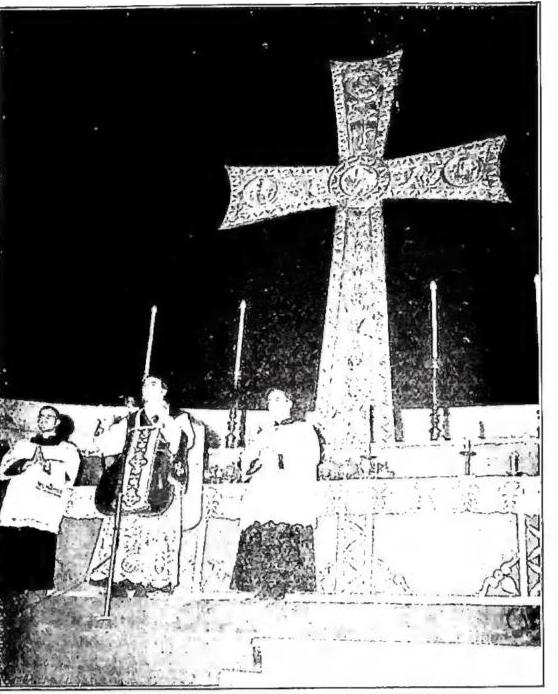
(phot. Giordani)
UNIONE UOMINI DI AZIONE CATTOLICA — Mons. Angelini speaks to the Men of C. A. during the night Mass celebrated in Piazza di Siena on the occasion of the Thirtieth Anniversary of the Men of C. A. (11–12 Oct. 1952) — Rome.
and in an atmosphere of extraordinary enthusiasm, more than 70,000 men of Catholic Action from throughout Italy held in Rome a demonstration which L'osservatore romano did not hesitate to call «the greatest ever recorded in religious history», concluded in St. Peter’s Square by a memorable papal address; the appointment, on 8 Dec. of the same year, of Msgr. Fiorenzo Angelini as central ecclesiastical assistant; the establishment, in Feb. 1948, under the impetus of the presidency of the U. U. of C. A., of the Civic Committees, which, presided over by Luigi Gedda, immediately and subsequently produced valuable fruits for the Christian and civic good of the country; the establishment in Lourdes, on 20 Sept. of the same year, at the initiative of the U. U. of C. A., of the International Federation of Catholic Men; the transfer of Luigi Gedda to organizational leadership (and subsequently to the general presidency of Italian Catholic Action) and, consequently, the appointment of the fourth central president of the U. in the person of Agostino Maltarello, in Oct. 1949; the celebration of the thirtieth anniversary of the organization, which brought 150,000 members to Rome on 12 Oct. 1952; they presented the Pontiff with the parish complex of S. Leone I (church, rectory, hall for associations, cinema-theatre, clinic), built in the Prenestino district in memory of the great date; the solemn close of the thirty-year period in Genoa, on 25 Oct. 1953.
These schematic data evidently provide only a pale idea of the structure and life of the U. U. of C. A.; they need to be supplemented by some information on the organization’s structures and activities. Above all, Articles 63 and 64 of the Statutes of Italian Catholic Action deserve to be reproduced verbatim; Art. 63: «The U. U. of C. A. has as its particular aims: a) the apostolate in public life and in the social environment; b) the defense of the family; c) the Christian education of youth; d) the protection of public morality.» Art. 64: «To this end the U.: a) gives special attention to preparing its members for the exercise of public functions; b) instructs its members and keeps them up to date on the religious, moral
and social problems requiring the attention and action of Catholics; c) together with the Union of Women of C. A., promotes the Family Front; d) devotes its activity in a particular way to the fields of Christian education, public morality, and social life.» These aims and activities correspond almost word for word to what the Italian Federation of Catholic Men had already set itself at the Milan Congress of 1922.
Particular mention should be made of the annual religion courses in all the associations; the countless «religious weeks» organized throughout Italy «for the return of men to God»; the vigorous campaigns conducted in defense of the family, for respect for the feast day, against the vice of blasphemy, for the education of young people, for the salvation of abandoned or needy children, for «the great return» of social-communists to the Church, for a truly Christian way of life, and for the dissemination of the Catholic press, especially the daily press. These activities were always supported by lively and sustained propaganda, carried out through visits by the central ecclesiastical assistants and leaders to local areas, as well as through the publication of volumes, pamphlets, and, above all, the organization’s periodicals: Noi Uomini, a fortnightly sent to all members; Prospettive, a monthly sent to all diocesan centers; Sussidi, a monthly sent to all associations.
The organization has nearly (Oct. 1953) 300,000 members, distributed among more than 12,000 associations and several thousand «nuclei», small groups representing nascent associations. In the last six years, after a certain decline caused by the events of the final period of the war and the early postwar period, the U. U. of C. A. has increased by more than 100,000 members; its activities have multiplied in quantity and effectiveness; its members have become increasingly aware of the importance of their organization and, conscious of their responsibility before God and men, also work in the highest positions of national life with a dedication that offers excellent hopes for the future.
BBL. In addition to the aforementioned periodicals, cf. the speeches of Pius XII in the AAS: L. Civardi, Manuale di Azione Cattolica, 11ª ed., Roma 1984, and the Cronache of the congresses in Civ. Catt. on the dates indicated. Carlo Carbone