
ITALIAN MALE YOUTH OF CATHOLIC ACTION. - The present name (1931) of the male group, whose original name was Italian Catholic Youth (G. C. I.), which was the cradle of Catholic Action in Italy and is today one of the sections within the organizational framework of the A.C.I., namely the male youth section.
The idea of the Society matured in the mind of a young patrician from Viterbo, Mario Fani Giotti, who, on 6 March 1866, after a night of continuous prayer in his church of S. Rosa, raised the cry to the youth of Italy: “We must act!” A few young fellow citizens of his established the “S. Rosa Circle,” the first in the series. While in Bologna in 1867, he met Dr. Giovanni Acquaderni, who would later become the first general president of the Society; he also became acquainted with Fr. Pincelli, a Jesuit and learned writer of ascetical works, and it was then that the Society of the G.C.I. was discussed for the first time, for which Fr. Pincelli drafted the first regulations. The Society’s motto was “prayer - action - sacrifice”; its purpose, determined by the “inescapable necessity of courageous and energetic action,” was to “constitute an association composed principally of young people who, undaunted and frank in deeds and words, would glory in bearing aloft and unstained the glorious banner of religion.”
This programme was launched throughout Italy in the form of an “appeal,” and all Italy responded by applauding the initiative, while a great many young people joined it, founding the first circles in the various regions of the peninsula. On 2 May 1868 the Supreme Pontiff, in response to an address presented to him by the Higher Council of the Society of the G. C. I., officially approved it by the brief “Dum filii Belial” and, in blessing it, encouraged the Society and granted it abundant indulgences. The Society gave life to the whole of Catholic Action (v. I)). The following year the “Circle of S. Pietro” arose in Rome, possessing a fine tradition of fidelity to the pope and works of charity.
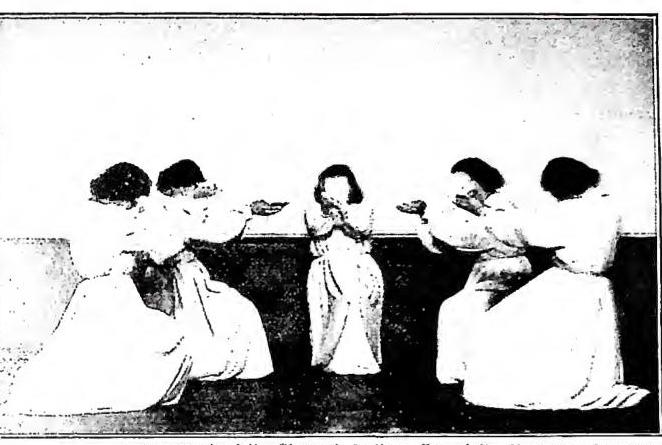
GIOVENTÙ ITALIANA FEMMINILE DI AZIONE CATTOLICA - The spoken chorus “Holy Year Relay” at the folk evening of the International session of the F. J. C., Fribourg, 11–16 Apr. 1950.
GIOVENTÙ ITALIANA MASCHILE DI AZIONE CATTOLICA
Born to defend the Pope, the G.C.I. was concerned from the outset to demonstrate concretely to the Vicar of Christ its fidelity, and already at the first audience on 14 Apr. 1869 Pio IX said: “You are with me and I am with you.” And the union grew ever stronger, so much so that Pio XI would say, many years later: “You are Us and We are you.”
The first pilgrimage of devotion to the Pope followed in 1869; on this occasion the first Peter’s Pence was offered to the Holy Father (v. PIETRO).
The pontifical Jubilee of Pio IX in 1871 served to promote throughout the world a great crusade of prayers and works for the Pope. A Vatican exhibition was also organized at that time, repeated in 1888. Meanwhile, the Opera dei Congressi cattolici was established.
The Superior Council meanwhile approved the transfer of headquarters from Bologna to Rome in 1880, the year in which Filippo Tolli was appointed successor to Giovanni Acquaderni.
Pilgrimages were promoted and, in 1891, Catholic young people from all over the world gathered in Rome for the first time. The G.C.I. assumed a new title: numerous groups for social studies, university circles, etc., were formed. It was the year of Rerum novarum.
The field of action widened: morality unions, sports associations, preparation for political life, etc. Its social organ from its inception was the Eco della G. C. I., which suspended publication in 1879 and resumed it in 1881 with the Bollettino della Società della G. C. I. The direction of the Società della G.C.I. passed in succession to Prof. Filippo Tolli (1880–81), Prof. Augusto Persichetti (1881–86), again Prof. Filippo Tolli (1886–88), lawyer Guglielmo Alliata (1888–93), Marquis Giulio Sacchetti (1893–1900), and then Paolo Pericoli, who was to lead the G.C.I. from 1900 to 1922.
The Pericoli presidency began a work of maturity, promoting the “Works.” It will suffice to recall the Federazione delle associazioni sportive cattoliche italiane (F.A.S.C.I.; v.), founded in 1907, and the Federazione delle associazioni del teatro educativo (F.A.T.E.; v.) in 1912. In 1916 the A.S.C.I. (Associazione scoutistica cattolica italiana) was promoted by the Superior Council of the Società della G.C.I., when it had become evident that it was impossible to live the Scout life within the Corpo nazionale giovani esploratori italiani, too closely bound to Freemasonry and anticlericalism.
In the Great War of 1914–18, the G.C.I. could count 10,000 dead, 17 gold medals, 703 silver, 82 bronze, and 267 war crosses; collections of offerings to provide altars, aid to refugees organized through countless offices, and 13,505,250 propaganda leaflets distributed among soldiers.
At the end of the war, the Employment Secretariat, founded in 1913, which rendered great services to young people, resumed activity; and the Unione nazionale tra i militari cattolici mutilati, invalidi e reduci di guerra was founded, which in 1922, at its third congress, would see more than 20,000 members gathered in Bergamo.
The Pericoli presidency ended with the solemn celebration of the fiftieth anniversary in 1921.
In Sept., on the occasion of the great international pilgrimage of 50,000 young people, the International Secretariat of Catholic Youth came into being.
With the advent of Fascism, the works yielded one by one before the violence of the regime: in 1926 the Unione reduci, and in 1928 the F.A.S.C.I. and the A.S.C.I. In 1931 the Società della G.C.I. itself was actually suppressed; but the Holy Father Pio XI, who in 1929 had signed the Conciliation with the Italian State, reacted vigorously, and the G.C.I. was able to live again under a renewed form. Its name was also changed, becoming “Gioventù italiana di azione cattolica” (2 Sept. 1931), but its programme did not change.
Under the presidency of lawyer Corsanego (1922–28) and lawyer Jervolino (1928–34), the G.C.I. made gigantic strides: the press became ever more effective, the organization more widespread, the specialization of the “aspirants” (that is, boys from 10 to 15 years old) arose, national study weeks for leaders were promoted and held periodically in Rome, and “Gioventù italica” was established, shortly afterwards becoming the A.V.E. (Editrice della gioventù).
In 1934 S. S. Pio XI appointed Prof. Luigi Gedda central president (1934–46). Catholic Action Youth became increasingly a powerful school of for-
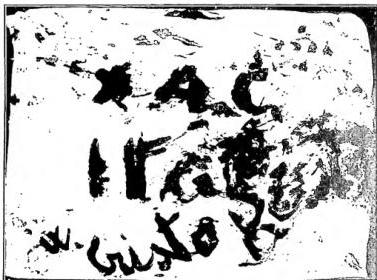
GIOVENTÙ ITALIANA MASCHILE DI AZIONE CATTOLICA - Gino Pistone, one of the many Catholic partisans who fought for freedom, died writing with his own blood on his haversack: “I offer my life for A.C.I. W. Christ the King.”
formation. Its educational method was established on scientific foundations, and its structure became increasingly suited to the requirements of modern times.
Alongside the aspirants arose the iuniores; that is, the character and organized life of young people from 16 to 21 years of age became more clearly defined; the framework was then completed with the seniores movement (21-30 years).
From the mass of young people in the individual parish associations, elites began to emerge, in order to give them a greater commitment and training: the “leaders” for the aspirants, and the “guides” for the iuniores, while all seniores were called to be “militants.”
Moreover, young people were further differentiated into students, workers, and rural youth, in order to establish educational action that was more effective and more suited to the needs of each group, and to reach their respective milieu of life more directly.
Each year the Central Presidency launched a theme called the “annual campaign.”
The Associations received practical aids from the National Centre for organizing the course of study on the proposed theme, in two phases: one internal, longer and more demanding, for the young people of Catholic Action; the other external, in a concise and lively form, for all the young people of the parish. The themes of the 16 annual campaigns were as follows:
1) Sanctification of the feast day. 2) The young person’s parish life. 3) Strong and pure. 4) Living Confirmation. 5) Servite Domino in laetitia. 6) The Holy Mass. 7) Towards life. 8) The priest. 9) God wills II. 10) Christ in the world of work. 11) Christian charity in social life. 12) Let us save the child. 13) Let us form the man. 14) The Christian and the world. 15) The interior life. 16) The Mystical Body. Then came the period of war.
The figures are still provisional, but for the war of liberation alone there have already been 21 gold medals,
14 silver, and 3 bronze, while the members who fell number at present approximately 1,000.
The Works rise again (A.S.C.I., C.S.I. [Italian Sports Centre; formerly F.A.S.C.I.], Student Youth, Working Youth, Rural Youth, Youth Tourist Centre).
Since 1946 the Presidency has been held by Prof. Carlo Carretto. Today the G. C. I. feels itself to be the backbone of Italian youth, and no one any longer ignores the importance it has assumed in national life.
A memorable date bears witness to this: September 1948, the celebration of the 80th anniversary of the G.I.A.C. More than 300,000 young people gathered in Rome. The Holy Father Pio XII, receiving the young people in St. Peter’s Square, blessed the foundation stone of the “DOMUS PACIS” in the presence of representatives of 52 countries. The motto of 1868, “Prayer - action - sacrifice,” signed by Fani and Acquaderni, has not been disproved, but, even with different structures, continues to orient and guide the present 500,000 members gathered in 13,000 parish Associations. - Vedi tav. XLVII.