
FOUCAULD, CHARLES-EUGÈNE de. — Missionary hermit, born on 15 September 1858 at Strasbourg, killed by the Touareg on 4 December 1916 at Tamanrasset (Algerian Sahara).
Having graduated from the military school of St-Cyr in August 1878, he was dismissed from service in 1881 because of his dissolute life; on 3 June 1881 he was reinstated as a lieutenant of hussars in the Army of Africa; six months later he requested his resignation (1883). From 1883 to 1884 he organized, disguised as a Jew, a strategic reconnaissance expedition in Morocco; and after returning to Paris, took part in the expedition to southern Algeria from September 1885 to January 1886.
Converted to a Christian life through the work of Fr.
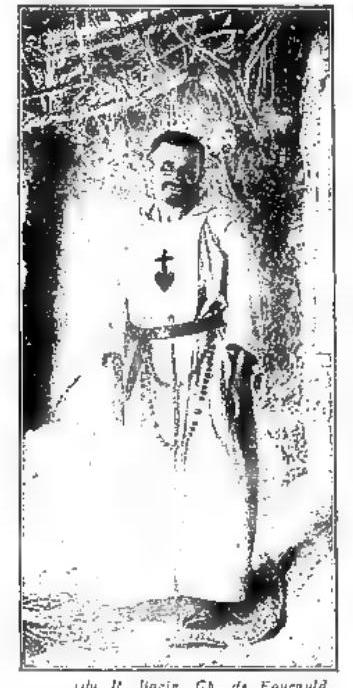
Driven by the desire for penance in the eremitical life and for apostolate among the most abandoned peoples of the Saharan desert, he lived as a nomadic religious in southern Oran and among the Hoggar (Alge-
rian), spending years filled with holiness at Iseken, Amra, Ghardaïa, Beni-Abbès, and Asekrem. In 1905 he settled in the oasis of Tamanrasset in the Hoggar mountains, devoting himself to the religious, moral, and civil assistance of the Muslim tribes of that region and translating some sacred texts into their language, without, however, succeeding in converting them. He was murdered in his hermitage by anti-French Senussi.
He had adopted as his motto: «to sanctify souls by placing myself silently in their midst». At Pentecost in 1897 he had written these words: «your vocation: to preach the Gospel in silence, like Jesus in the hidden life, like Mary to Joseph». In 1920 his heart was placed beside the tomb of the French general Laperrine, his friend, at Tamanrasset; while his exhumed remains were transferred to El-Golea. His cause of beatification has been introduced. In 1946 a commemorative exhibition of F. was held in Paris at the Musée des Invalides. His spiritual writings were published by René Bazin (Paris 1923). He left plans for a highly austere congregation, the «Little Brothers of the Sacred Heart», for the conversion of Muslims. In France, the association «C. de F.» for Catholic missions in the French colonies was founded as early as 1919, as was the «Mission de F.», an association for female apostolate in Muslim lands.