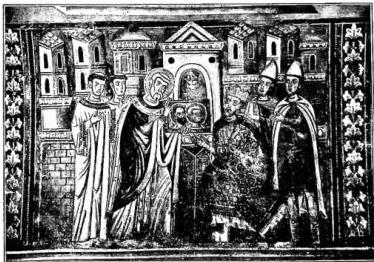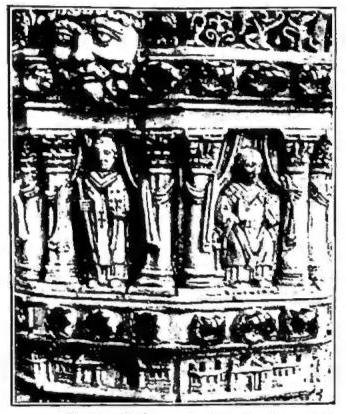
SILVESTER II, Pope. - He reigned from April 2, 999 to May 12, 1003. Probably a native of Auvergne, Gerbert entered as a monk the Benedictine abbey of St-Géraud d'Aurillac (Cantal). Borrel, count of Barcelona, appreciated his learning and took him along to Catalonia around 967. Atton, bishop of Vic, initiated him into the mathematical sciences. The young monk made such progress that his patron presented him as a celebrity at the court of Otto I, who was then in Rome (970). He did not settle in that city and went to Reims, where a school of dialectic flourished (972).
Having become a master in this discipline, he taught and acquired great renown; this procured for him the title of scholasticus and the favor of Archbishop Adalbero. Otto II, who was present at a philosophical discussion with the German Otric of Magdeburg at Ravenna - reported by the monk Richer - rewarded him by giving him the abbey of Bobbio (980). The political events that arose in Italy obliged him to resume teaching at Reims in 983.
Two short works survive on S.'s philosophical doctrines: De rationali et ratione; De Corpore et Sanguine Domini. It is not certain whether he actually adhered to the exaggerated realism suggested by certain texts (cf. De Corp. et Sang. Dom.: PL 139, 189 B.). Besides his teaching of dialectic, Gerbert was known for his knowledge of geometry and astronomy. The construction of a celestial globe allowed him to expound to his hearers the movement of the stars and planets in a new way. The invention of a device that marked the hour during the night caused a stir because until then only the sundial had been used. Gerbert simplified the art of calculation and drafted the first thirteen chapters of a treatise De Geometria (PL 139, 95-152 and the ed. of N. Bubnov, Gerberti opera mathematica, Berlin 1899).
Gerbert also occupies a distinguished place in the art of letter-writing. As secretary of Archbishop Adalbero he maintained an intense diplomatic correspondence with his contemporaries and worked effectively for the advent of Hugh Capet. Julien Havet prepared the critical edition of the correspondence (Paris 1889) and succeeded in dating it and in deciphering the enigmatic tachygraphic notes that abound in it; nevertheless, M. J. Lair (Etudes critiques sur quelques textes des Xᵉ et XIᵉ siècles, 2 vols., Paris 1899) has proposed certain corrections. Thus, as a scientist and as a man of letters, Gerbert exercised a considerable influence in the 10th century. Politics was for him a cause of tribulations. After having contributed to the success of Hugh Capet and to the elimination of Charles of Lorraine, he might have aspired to the see of Reims, following the death of Adalbero (23 Jan. 989), but the Capetian preferred Arnoul, who betrayed him and favored the entry into Reims of Charles of Lorraine. The King wished to punish the traitor and to obtain his deposition. Having obtained no satisfaction from Pope John XV, he convoked a Council at Saint-Basle de Verzy (June 991) where Arnoul, bishop of Orléans, on the basis of arguments furnished to him by Gerbert, upheld a scandalous thesis according to which the Gallican episcopate possessed the qualities necessary to take a decision (v. the minutes drawn up in 995 by Gerbert himself: PL 139, 287-88 and in MGH, Script., III, pp. 658-86). Arnoul having been deposed and degraded, Gerbert was elected archbishop of Reims. John XV did not tolerate the affront brought to his authority. Since two convocations of the Gallican clergy to a council that was to have been held at Aix-la-Chapelle or at Rome had no effect, he announced reprisals. An assembly of the Gallican clergy held at Chelles dared to confirm the sanctions adopted against Arnoul and the election of Gerbert. Nevertheless the latter appeared at the Council of Mouzon-sur-Meuse convoked by the legate Leo and delivered a skillful defense (June 995). Subsequently, before another Council he delivered a speech of which the text is still preserved: PL 139, 345-50. No decision was reached, but Gerbert could no longer reside at Reims; he joined (996) the retinue of Otto III who was visiting Italy, then went again to France where he attended the Synod that opened in March 997 at St-Denis. Having returned to the court of the Emperor, thanks to him he obtained the see of Ravenna. A profound upheaval took place in him: from a supporter of clearly Gallican theories, as he had previously been, he became an ardent defender of the omnipotence of the Holy See. On 2 Apr. 979 the Emperor placed the tiara upon him.
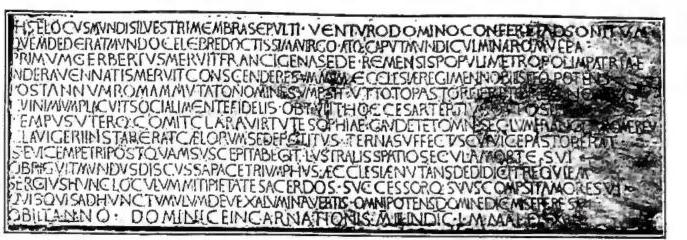
(from A. Silvani, Monumenta epigraphica Arist., I. Rome, Vatican City (M2. tab. 1, 2)
S. II announced himself as an intrepid defender of the pontifical authority and as a reformer of ecclesiastical morals. At first he permitted Arnoul, his adversary of Reims, to carry out the episcopal functions, then he set about combating an evil that unfortunately raged in the Church: simony (PL 139, l. 169, in which appears a Sermo de informatione episcoporum, on the authenticity of which, however, doubts remain). The principal merit of S. II was to have known how to maintain his freedom of action while at Rome the dreamer Otto III aimed to exercise his imperial prerogatives in the most rigorous manner. He had, in particular, the ability to ensure the recognition of the pontifical authority in certain countries evangelized by missionaries of