
Pope St Celestine V

5 July 1294 – 13 December 1294; died 19 May 1296

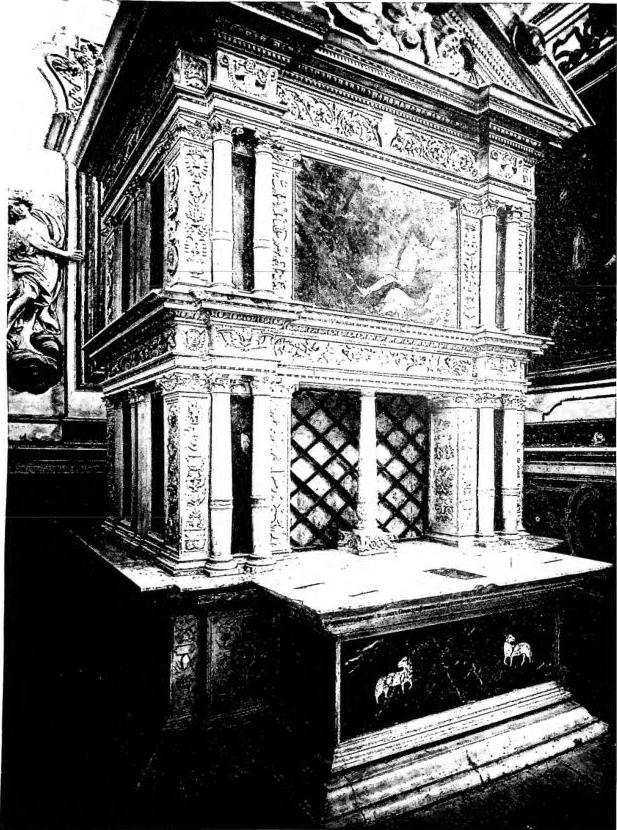
MAUSOLEUM OF CELESTINE V, work by Girolamo da Vicenza (1517) - L'Aquila, church of S. Maria di Collemaggio

Enciclopedia Cattolica Vol. III, 1949 Popes & papal documents Popes

Celestine V, Pope, Saint

CELESTINO V, PAPA, SANTO

Feast day: 21 May

Italian original Cite

Peter of Morrone redirects here.

Also known as: Latin: Petrus de Murrone

CELESTINE V, Pope, Saint. - Pietro di Morrone, b. at Isernia (Campobasso) in 1215, d. at the Castle of Fumone (Frosinone) on 19 May 1296. As a young man he entered the Benedictine abbey of Faifoli (diocese of Benevento), of which he was later (1276-79) abbot. Out of an inclination, evident throughout his life, toward solitude, he withdrew to Mount Palleno, and after three years, having gone to Rome, he was ordained a priest. His subsequent dwellings were on Mount Morrone and on the Maiella, near Sulmona. On the Maiella he gave rise to the monks later called Celestines (v.). At the time of the long vacancy of the Holy See after the death of Nicholas IV, he lived in the hermitage of S. Onofrio on the Morrone, where he received the announcement of his elevation to Supreme Pontiff, which had taken place at Perugia.
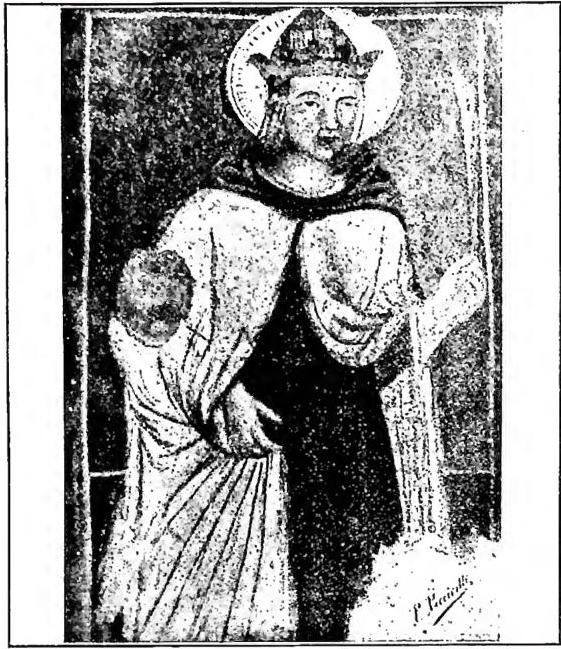
CELESTINE V - 14th-century fresco in the hermitage of C. V on Mount Morrone.

The choice of the poor hermit, after a troubled period due chiefly to the rivalry between the Colonna and the Orsini, both represented in the Sacred College, has always been an enigma for historians. Recent studies have clarified the background: Charles II, king of Naples, with his son Charles Martel, came to Perugia in the spring of 1294 and conferred with the eleven cardinal electors. From there he went on to Sulmona, where he granted privileges to the Celestines and almost certainly also saw the holy hermit, who shortly afterward wrote a letter to the cardinals urging them to give the Church a Pastor at last. Latino Malabranca, cardinal dean, was the first to put forward the name of the pious hermit and gave him his vote; others followed him, and the remaining ones decided to accede. Other circumstances and spiritual currents (the Angelic Pope) may have influenced the election of the inexperienced hermit. He, having accepted the election, went to L'Aquila, where in the presence of a few cardinals, of Charles II and of a great crowd he was crowned on 29 Aug. 1294.

On 18 Sept. he created 12 cardinals, of whom 7 were French and 5 Italian, all acceptable to King Charles, to whose son St. Louis of Anjou, still very young and a hostage for his father in Spain, he then entrusted (7 or 9 Oct.) the administration of the archdiocese of Lyon (Bull. Franc., IV, p. 332). He granted many privileges to the Celestine monks, two of whom were among the twelve cardinals created at L'Aquila. Accompanied by King Charles himself, C. went to Naples, passing through Sulmona and Montecassino, where he obliged the monks to embrace the institute of the Celestines, a command abrogated, like so many others, by his successor Boniface VIII. At Naples a residence was prepared for him in Castelnuovo, but he was not long in realizing that he was not equal to the sublime dignity; he was wearied by the intrigues of the curials, and he longed for the solitude of his cell. At the beginning of Advent he wanted to entrust the government of the Church to three cardinals and retire to a secluded cell. As a cardinal opposed this and he was tormented by scruples, he began to think of abdication. He consulted some cardinals, among them Benedetto Caetani (the future Boniface VIII), who at first advised him against it, but then declared that it was possible.

Around 10 Dec. C. issued a constitution stating that a Pope may renounce his high dignity (v. SOMMO PONTEFICE), and on 13 Dec., before the cardinals, he read the formula of his own, free and spontaneous abdication. He had restored to force the rigid rule of the Conclave, and from it Boniface VIII was immediately elected (24 Dec.), who had his predecessor conducted toward Rome. The latter, however, eluding the vigilance of the papal guards, fled and hid in Apulia, from where he tried in vain to cross the Adriatic. Boniface VIII, fearing that ill-disposed persons might take advantage of C.'s great simplicity, had him sought out and, found at Viesti, had him conducted and kept in the castle of Fumone, near Alatri, where he lived until his death. It is a calumny that Boniface VIII resorted to machinations to obtain his resignation and hasten his end. St. Peter Celestine, whose body was buried at Ferentino, then in 1327 transferred to Collemaggio (L'Aquila), was canonized by Clement V on 5 May 1313. His feast is celebrated on 19 May.

C.'s unusual resignation immediately provoked a literature on the subject, in which the Olivi, Giles of Rome and John Quidort took part. The verses of Dante (Inf., III, 59-60) are very well known, which, from the earliest commentators onward, were held to allude to C. - See Plate LXXVI.
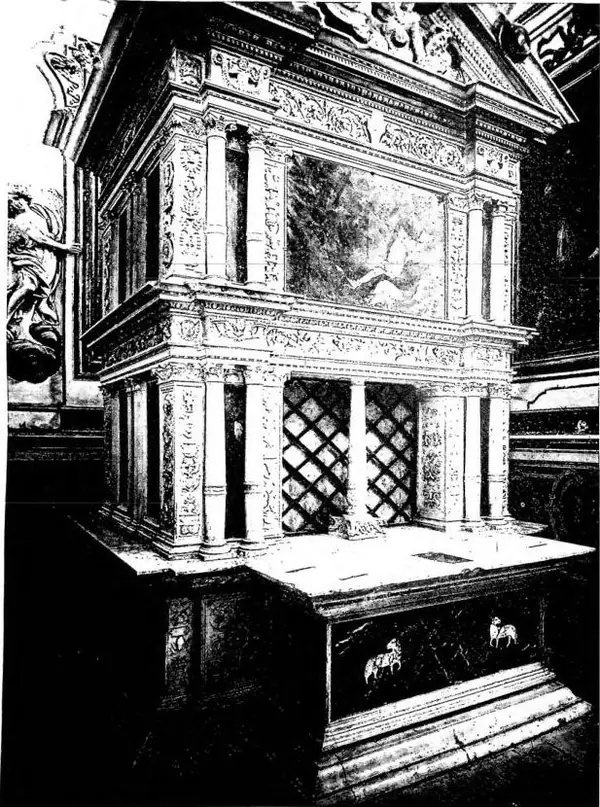
MAUSOLEUM OF CELESTINE V, work by Girolamo da Vicenza (1517) - L'Aquila, church of S. Maria di Collemaggio.
Plate LXXVI MAUSOLEUM OF CELESTINE V, work by Girolamo da Vicenza (1517) - L'Aquila, church of S. Maria di Collemaggio.(fol. Alisari)
Bibliography25 works
BIBL.: Sources: F. X. Seppelt, Monumenta Coelestiniana (Quellen und Forschungen della Società Görres, 19), Paderborn 1921; it embraces the Opus metricum of card. G. G. Stefaneschi, finished in 1319, the lives of St. C. by Pietro d'Ailly (c. 1408) and Maffeo Vegio (1445); the process of canonization (1306). The Opus metricum is also found in Acta SS. Mari, IV, Paris 1866, pp. 437-486, and in L. A. Muratori, Rev. It. Script., III, 1, pp. 613-68. The Life by P. d'Ailly was published (reworked) by D. Faber, Paris 1539; by Surius, De probatis Sanctorum historiis, III, Cologne 1572, pp. 337-55. A life owed to the Celestines, disciples of the Saint, exists in three recensions published in the Anal. Boll., 9 (1890), pp. 147-200; 10 (1891), pp. 385-92; 16 (1897), pp. 393-432, the last of which is the most genuine. A supposed autobiography was published by C. Telera, S. Petri Coelestini PP. V opuscula omnia, Naples 1640, pp. XLIX-LXVII, and in M. de la Bigne, Maxima bibliotheca veterum Patrum, XXV, Lyon 1677, pp. 765-69; but modern criticism rejects it, as it does all the opuscules. Cf. S. Pierre Celestin et ses premiers biographes, in Anal. Boll., 16 (1897), pp. 365-92. Two rhythmic liturgical offices: G. M. Dreves, Analecta Hymnica, 28 (1818), pp. 127-34. Studies: L. Marino, Vita e miracoli di s. Pietro del Morrone già C. papa V., Milan 1630 (with many texts inserted); V. Spinelli, Vita di s. Pietro del Morrone, Rome 1664; P. Arnone, Pietro del Morrone anacoreta e papa, Cosenza 1881; B. Cantera, Cenni storici-biografici riguardanti s. Pier C., Naples 1892; id., Nuovi documenti riguardanti s. P. C., ibid. 1893; C. V ed il VI centenario della sua incoronazione, L'Aquila 1894 (a series of 15 studies); G. Pansa, C. V e i solitari del monte Maiella, Teramo 1894; G. Celidonio, Vita di s. Pietro del Morrone, 4 vols. or fascicles, Sulmona 1896 (critical study); id., La non autenticità degli Opuscula Coelestina, ibid. 1896 (identical with the preceding fasc. IV, with a small addition); P. M. Baumgarten, Il regesto di C. V., Chieti 1896 (from the Abruzzo Cattolico, 4 [1896], pp. 2-14); G. Crocioni, Pel Gran rifiuto di C. V., Casalborgino 1898 (with a critical review of the question: from the Rassegna Abruzzese, 3 [1898, ibid.]); F. X. Seppelt, Studien zum Pontifikat Coelestins V. (Abhandlungen zur mittleren und neueren Geschichte, 27), Berlin-Leipzig 1911; L. Oliger, Petri Johannis Olivi De renuntiatione papae Coelestini V Quaestio et Epistola, in Arch. Franc. hist., 11 (1918), pp. 309-73; J. Hollsteiner, Die Autobiographie Coelestins V., in Römische Quartalschrift, 31 (1923), pp. 29-40; A. Mercati, Il decreto e la lettera dei cardinali per l'elezione di C. V., in Bull. dell'Istituto stor. ital., 47 (1931); F. Baethgen, Beiträge zur Geschichte Coelestins V., Halle 1934; P. Barbaini, C. V anacoreta e papa, Milan 1936 (of a popular nature); P. Laurelli, Dante e C. V., Isernia 1939; J. Leclercq, La renunciation de

Celestin V et l'opinion théologique en France du vivant de Boniface VIII, in Revue d'histoire de l'Église de France, 25 (1939), pp. 183-92; S. Garclas Palou, El beato Ramón Llull y la cuestión de la renunciabilidad de la sede romana, in Aurora Sacra Tarraconensia, 17 (1944), pp. 67-96.

Livario Oliger

About this entry

By Livario Oliger

How we know signed in print

Translated from the Enciclopedia Cattolica, vol. III (1949), coll. 1258–1261.

Printed pages Open in the page viewer
Page 735
vol. 3, coll. 1257–1258
Page 736
vol. 3, coll. 1259–1260
Page 737
vol. 3, coll. 1261–1262

More by Livario Oliger: Celestines, Order of the · Caesarius of Speyer · Castelnau, Pierre de, Blessed · Clare of Assisi, Saint · Clare of Montefalco, Saint

Cite this article

Chicago

Oliger, Livario. “Celestino V, papa, santo.” In Enciclopedia Cattolica, vol. III, coll. 1258–1261. Città del Vaticano: Ente per l’Enciclopedia Cattolica e per il Libro Cattolico, 1949. https://azioneromana.com/article/celestino-v-papa-santo.

MLA

Oliger, Livario. “Celestino V, papa, santo.” Enciclopedia Cattolica, vol. III, Ente per l’Enciclopedia Cattolica e per il Libro Cattolico, 1949, coll. 1258–1261. Azione Romana, https://azioneromana.com/article/celestino-v-papa-santo.

BibTeX

@incollection{ec3_celestino_v_papa_santo,
  author    = {Oliger, Livario},
  title     = {Celestino V, papa, santo},
  booktitle = {Enciclopedia Cattolica},
  volume    = {III},
  pages     = {1258--1261},
  note      = {Cited by column},
  publisher = {Ente per l’Enciclopedia Cattolica e per il Libro Cattolico},
  address   = {Città del Vaticano},
  year      = {1949},
  url       = {https://azioneromana.com/article/celestino-v-papa-santo}
}

One of some 20,000 entries brought back from the twelve printed volumes (1948–54). Spotted something? Help us improve it.

Save for later

Enter your email and we will send you a sign-in link. No password. What you save (articles, verses, chapters, documents) follows you to any device.