Also known as:
Easter Proclamation, Paschal Proclamation;
Latin: Praeco Paschalis, Praeconium Paschale
EXULTET. - It is the Easter praeconium, the solemn Lucernarium proper to the night of Easter; in substance it is the solemn offering of the paschal candle (v.) inserted into the proclamation and exaltation of the Mysteries of that same night, that is, of the Resurrection and of our Redemption. The elevation of form and content makes it an authentic masterpiece.
Already St. Augustine (De civit. Dei, XV, 22) speaks of a praise of the paschal candle, and St. Jerome (Epist. 18: PL 30, 182) reproaches the deacon Presidius of Piacenza for the excessive description of nature, especially of the bees, in the E. (CSEL, 6, p. 415). Ennodius of Pavia (opusc. 9 and 10) and the Gelasianum (80) have preserved its text for us. In Rome there was no use either of the blessing, or of the paschal candle, or of the E. before the 8th century (in the so-called Gregorian it is not found the formula); to the deacons of the suburban churches license was given to bless the candle from the 6th century. The present formulary of the E., sung by the deacon
(phot. Enc. Catt.)
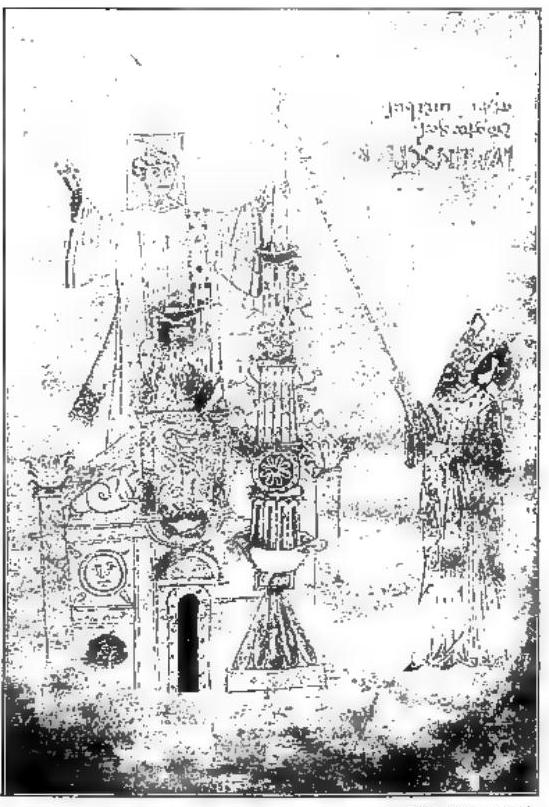
«EXULTET» - Accensione del cero. Miniatura dell'E. n. 1 (sec. XI). Mirabella Eclano, Archivio chiesa collegiato.
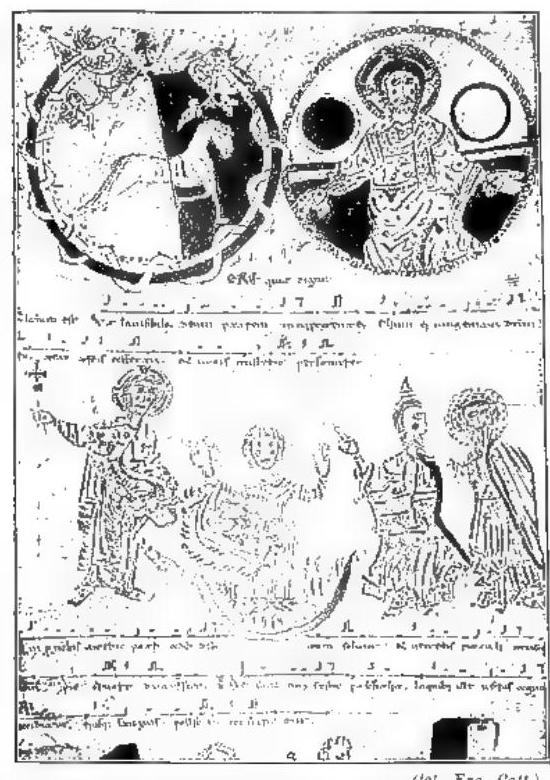
« EXULTET » - In alto : iniziale V con Alagna Dei e Cristo in aureola; sotto : Diocesà al Lambio. Minatura dell'E. n. 2 (sec. xixii) - Mirabella Eclano, Archivio chiesa collegiata.
in the ambo, it is found for the first time in the Sacramentary of Bobbio (7th century) under the title: «Benedictio cerei s. Augustini episcopi (quam) cum adhuc diaconus esset, cecinit», then in the Missale Gallicum vetus (L. Muratori, Liturgia Romana vetus, II, Venice 1748, pp. 783 and 845) and in the Missale Gothicum (ibid., 581 ff.), whence it entered the supplement of the Hadrian Sacramentary and thus the Roman liturgy (for the textual criticism cf. L. Duchesne, Origines du culte chrétien, 5th ed., Paris 1925, p. 254). To the praise it joins the prayer for the ecclesiastical and civil authorities. In ancient times the individual passages were well illustrated.
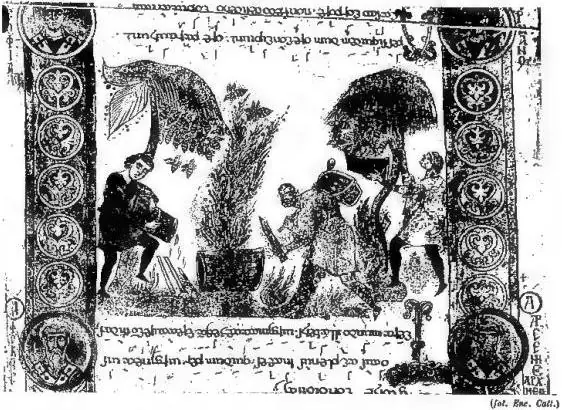
Some passages of the E. were once the object of heated discussion, such as that of the "felix culpa", of the bees as a symbol of the virginity and motherhood of Mary Most Holy, and others, and for this reason in many manuscripts they are either missing or have been erased. - See plates LXI-LXII.
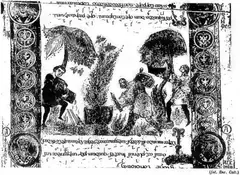
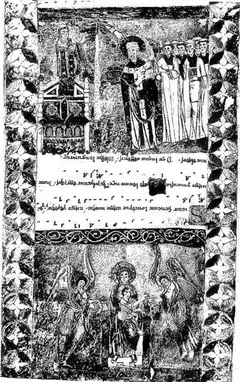
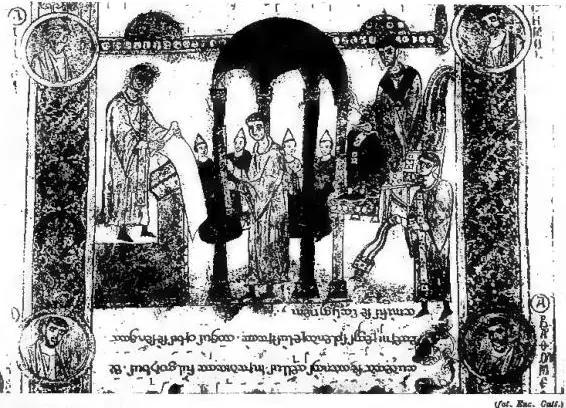
Plate LXIa) EXULTET. Miniature with scene of the bees. In the corners St. Theophylact, St. Germanus, St. Phocas, St. Arsenius of Corfu (ca. 1000) - Bari, archive of the Cathedral. b) THE DEACON PREPARES FOR THE SINGING OF THE EXULTET. In the corners: St. Andrew, St. Simon, St. James, St. Bartholomew. Exultet 1 (ca. 1000) - Bari, archive of the Cathedral.
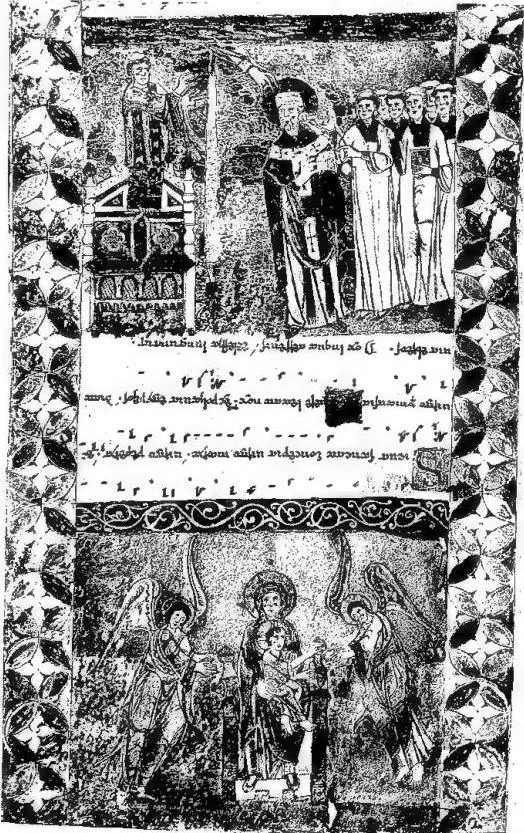
Plate LXIIEXULTET. Scroll with miniatures and relevant passage of the Exultet with musical notation (12th cent.) - Rome, Biblioteca Casanatense, cod. 724 B I, 13.(fot. Ens. Catt.)Bibliography10 worksJ. Braun, Osterpräconium und Osterhorzenweihe, in Stimmen aus Maria Laech, 36 (1899), p. 273 agg.; anon., Le miniature dei rotoli dell'E., M
BIBL.: J. Braun, Osterpräconium und Osterhorzenweihe, in Stimmen aus Maria Laech, 36 (1899), p. 273 agg.; anon., Le miniature dei rotoli dell'E., Montecassino 1899; P. Latil, De praconio paschali, in Ephenerides liturgicus, 18 (1902), p. 123 agg.; A. Mercati, Paralipomena Ambrosiana (Studi e Testi, 12), Roma 1904, pp. 24-43; F. Di Capua, Il ritmo della prosa liturgica e il Praconium Paschale in Didaskaleion, nuova serie, 5 (1925), pp. 1-13; R. Buchwald, Osterluce und E., in Theologisch-praktische Quartalschrift, 80 (1927), pp. 240-49; B. Ebel, Zum Verständnis der E., in Liturgische Zeitschrift, 3 (1930-31), pp. 165-73; O. Casal, Der äuerliche Lichtgesang der Kirche, ibid., 4 (1931-32), pp. 170-191; B. Capelle, La procession du Lumen Christi au Samedi Saint, in Revue bénédict., 44 (1932), pp. 105-19; id., L'Exultet pascal oeuvre de si Ambroise, in Miscellanea Mercati, III, Città del Vaticano 1946, pp. 219-46.
Oppenheim, Filippo. “Exultet.” In Enciclopedia Cattolica, vol. V, coll. 920–921. Città del Vaticano: Ente per l’Enciclopedia Cattolica e per il Libro Cattolico, 1950. https://azioneromana.com/article/exultet.
MLA
Oppenheim, Filippo. “Exultet.” Enciclopedia Cattolica, vol. V, Ente per l’Enciclopedia Cattolica e per il Libro Cattolico, 1950, coll. 920–921. Azione Romana, https://azioneromana.com/article/exultet.
BibTeX
@incollection{ec5_exultet,
  author    = {Oppenheim, Filippo},
  title     = {Exultet},
  booktitle = {Enciclopedia Cattolica},
  volume    = {V},
  pages     = {920--921},
  note      = {Cited by column},
  publisher = {Ente per l’Enciclopedia Cattolica e per il Libro Cattolico},
  address   = {Città del Vaticano},
  year      = {1950},
  url       = {https://azioneromana.com/article/exultet}
}
One of some 20,000 entries brought back from the twelve printed volumes (1948–54). Spotted something? Help us improve it.
Click or scroll to zoom · drag to pan · Esc to close