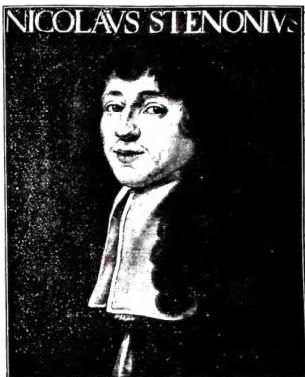
STENSEN, NIELS. — In Latin Nicolaus Stenonis, Stenonius, and erroneously also Steno; anatomist, geologist, and bishop, born, according to the Gregorian calendar, on 11 Jan. and, according to the Julian calendar, on 1 Jan. 1638 in Copenhagen, died, according to the Gregorian calendar, on 5 Dec. and, according to the Julian calendar, on 25 Nov. 1686 in Schwerin; descended from a family of preachers from Scania, a region then belonging to Denmark.
The son of the goldsmith Sten Pedersen, he studied languages, mathematics, and anatomy at the University of his native city in 1656–60, and in 1660–64 made bold anatomical discoveries (ductus Stenonianus, the glands of the head, the structure of the muscles and the heart, knowledge of ova). Awarded a doctorate in medicine by decree of the University of Leiden on 4 Dec. 1664, he published several strictly scientific writings, free of all baroque rhetoric (De glandulis oris, 1661; De glandulis oculorum, 1661; De musculis et glandulis, 1664). Between 1664 and 1665 he travelled in France, where, among the circle of the founders of the Académie des Sciences, he delivered the celebrated Discours sur l’anatomie du cerveau, partially anti-Cartesian. At the beginning of 1666 he arrived in Tuscany, where Ferdinando II and his brother Leopoldo appointed him anatomist at S. Maria Nova. As a member of the Cimento and of the Accademia della Crusca, in the milieu of learned men and men of religious feeling, such as Redi, Magalotti, Malpighi, and Viviani, he became, on the occasion of the dissection of a shark, «the promoter of modern geognosy» (cf. his ingenious Prodromus de solido intra solidum naturaliter contento, 1669). Two years earlier, on All Saints’ Day, he had decided to convert to the Catholic faith, and on 7 Nov. 1667 he was received into the Catholic Church (cf. his Epistolo de propria conversione, 1676).
From 1672 to 1674 he was «anatomicus regius» of Copenhagen, and thereafter one of the tutors of the hereditary prince Ferdinando III in Florence. In 1675 he received priestly ordination, and on Easter Sunday, 14 Apr., celebrated his first Mass before the miraculous image of the Most Holy Annunciation.
As a priest he led a life of strict poverty and renunciation. His spiritual zeal even impelled him to address his former friend Spinoza (Epistola ad novae philosophiae reformatorem, 1675). At the request of Duke Giovanni Federico of Hanover, on 19 Sept. 1677 he received episcopal consecration in the church of the Palazzo di Propaganda, together with the title of Titiopolis in part. inf. After only three years of activity in Hanover (v. Leibniz), following the death of the Catholic duke he had to abandon his mission; and at the request of Ferdinando di Fürstenberg, by papal bull of 7 Oct. 1680 he was appointed auxiliary bishop of Münster, where, because of his reforming tendencies in the spirit of the Council of Trent (cf. his Parochorum hoc age, 1684), he