
MANFREDONIA, DIOCESE OF. - City and archdiocese in the province of Foggia (Italy).
It has a population of 112,040 inhabitants, of whom 111,903 are Catholics; it has 16 parishes, 76 diocesan priests and 17 regular priests, a seminary, 4 male religious communities, 14 female (Annuario Pont., 1951, p. 262).
1. HISTORY
M. arose through the work of Manfred in 1256, after the ancient Siponto lay in ruins, destroyed by the Saracen assault and by earthquake. Once the diocese was transferred, it inherited from it, along with its splendors, all its privileges as well. The origin of the Sipontine see is lost in legend. The first prelate historically attested is a Felix, present at the Roman Council of 465. The second, Lawrence, appears in two later Lives, one of which, written by an anonymous author, contains data that are not always acceptable; and the other, heavily manipulated in the 11th century, confuses facts and episodes that are unjustified before the Byzantine domination. The episcopate of Lawrence is to be placed between the 5th and 6th centuries; he is connected with the consecration of the famous Garganic sanctuary of the archangel St. Michael, which attained such great fame in the Middle Ages. The third bishop is a Felix (one and not two as Ughelli would have it), attested between 591 and 593 (Jaffé-Wattenbach, nos. 1121, 1245, 1246, 1247, 1288). There follow: Vitalian (597-99; ibid., 1495, 1496, 1638 and 1791) and Rufinus, who took part in the Lateran Council of Martin I (649). In this time a tragic parenthesis of devastations by Slavs, Saracens and Lombards opens for Siponto, as a result of which the population is dispersed and the episcopal see entrusted to Benevento. Only in the first years after 1000 did Siponto regain its independence from Pope Benedict VIII, who raised the see to metropolitan rank with various suffragan dioceses. The first titular archbishop, Leo (1034), established his see at Monte Gargano, but he was also the only one. Divergences over religious privileges, which arose between Siponto and Monte Gargano, and consequently the continued subjection of the Sipontine see to that of Benevento, willed by Leo IX, brought about a state of uncertainty until 1066, when Alexander II definitively separated the churches, appointing as archbishop of Siponto Gerard I, a most learned German monk of the Benedictine Order. Subsequently Siponto acquired new privileges. Paschal II subjected Viesti to the Sipontine church, Eugenius III that of Monte Gargano, and in 1200 Innocent III confirmed both privileges.
It was Archbishop Roger who witnessed the decline of Siponto and the birth of M.; entering solemnly with his clergy in 1258, he confirmed the continuity of the Sipontine church and at the same time opened the series of prelates of M. The church of this city, long agitated by the ancient controversies and repeatedly disturbed by the wind of schism, has left painful episodes in the history of the episcopate. And yet M. has many times linked its name to most noble figures of princes of the Church.
II. MONUMENTS
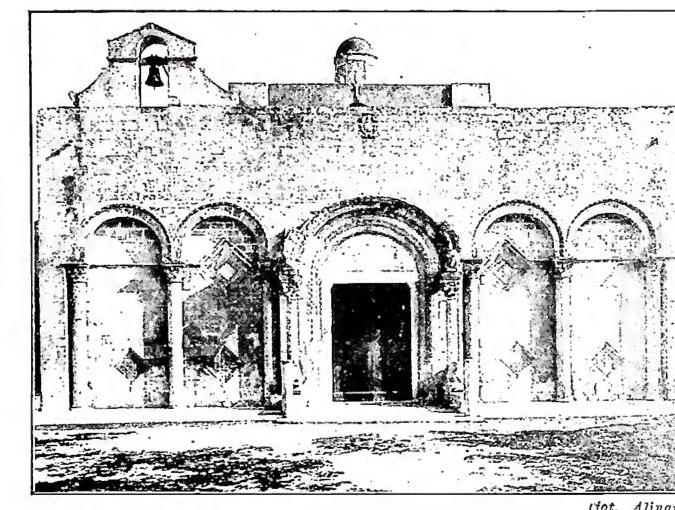
Siponto was the mother city of M.; among its remains the most important monuments are still preserved. In a deserted plain the famous church of St. Mary Major still stands, in Romanesque-Byzantine forms, with a square plan, a low dome and side apses. It is composed of two superimposed churches, which would be two distinct constructions, because the upper one, consecrated by Paschal II in 1117, was completed when the other was by then buried and ruined by the ravages of time and by earthquakes. In any case, its greatest merit lies, besides its forms, in the rich decoration that draws on Byzantine models, reshaped by that sense of classical balance which informs almost everywhere the masterpieces of Apulian medieval art. About a mile from the ruins of Siponto there still stands the church of St. Leonard, which closely recalls the Apulian cathedrals with multiple domes. Square, with strong pointed arches springing from robust clustered piers, it still preserves much of its structure, despite the abandonment and the amputations suffered from the buildings leaning against it. Of M. there is little of note to point out, except for the 13th-century Cathedral, which, moreover, has lost almost everything in its reconstruction in modern forms.
Bibliography15 works
Pasquale Testini