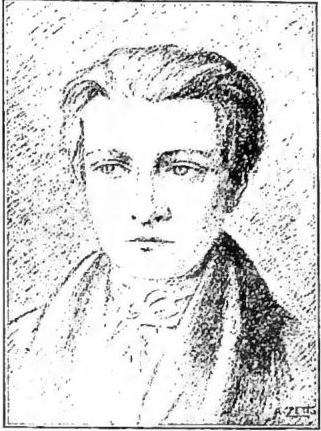
OZANAM, ANTOINE-FRÉDÉRIC. - Historian and apologist, b. in Milan on 23 April 1813 to Giovanni Antonio, a physician, and Maria Nantas of Lyon, d. in Marseille on 8 September 1853.
I. LIFE
After the family returned to France in 1816, O. completed his education at the Royal College of Lyon and there obtained his baccalaureate in letters. A brief period of doubt gave rise in him at the age of 18 to the resolve to seek the "demonstration of the truth of the Catholic religion by means of the antiquity of historical, religious and moral beliefs," a subject that remained, one might say, the stimulus and purpose of his studies. After some months of legal practice with a lawyer in Lyon, at his father's wish, he went to Paris in Nov. 1831 for legal studies and was a guest of the celebrated scientist Ampère. He obtained his doctorate on 30 Apr. 1836, and in Dec. 1839 he was entrusted with the teaching of commercial law in Lyon. He did not, however, abandon his beloved studies, to which, along with a sure knowledge of the classical languages, he added that of Hebrew and Sanskrit; he knew German, English and Spanish, but after the study of French it was that of Italian which attracted him in a particular way, and when in Jan. 1839 he took his doctorate in letters his thesis dealt with the philosophy of Dante.
Toward the end of 1840, on the advice of Cousin, he took part in the competition for the Sorbonne and, appointed substitute for Claude Fauriel in foreign literatures, he began his university teaching on the general characteristics of German literature in the Middle Ages; and on Fauriel's death, following a presentation by the academic council, on 21 Nov. 1844 he was appointed full professor. In the meantime he had also taught rhetoric at the Collège Stanislas, and in June 1841 he had married in Lyon Amalia Soulacroix, by whom he had a little daughter.
From his student years O. took part in the spiritual and scientific activity that was seething in Paris. Besides Chateaubriand and Lamennais, with whom he had occasional contacts, and Fauriel, O. found himself in the current of the best Lamennais and of the Count of Montalembert, and he had a particular friendship with the abbé, later father, Lacordaire; among the convinced assertors of freedom of the school and of the authority of the Church in the face of civil power, and of raising the prestige of religion in the face of public opinion, he was among the most convinced petitioners to the Archbishop of Paris for the Work of the Conferences at Notre-Dame, which began in 1835 with Lacordaire. A convinced and professing believer, he never belied a spirit of tolerance, both in his manner and in his writings, which caused him to incur even, among the most heated, the accusation of heterodoxy; he therefore disapproved of the narrow and violent policy of certain Catholic newspapers. In 1848 he took a lively part in the agitations of the time, siding in favor of public liberties, convinced of the possibility of a Christian democracy as the goal of political progress, convinced that God was leading the world thereto. Thus he who had collaborated with the Correspondent was active in the Ere nouvelle, anxious that demagogy should not gain the upper hand.
II. WORKS
His delicate health and the illnesses that afflicted him did not distract O. from study and teaching, which he regarded as his mission. He made his debut in his activity as a publicist as early as 1831 with the Réflexions sur la doctrine de Saint-Simon, to counter the propaganda of the Saint-Simonians; he then wrote occasionally on the goods of the Church, on Buddhism, on the origins of socialism, and left notes on commercial law. But the specific field in which O.'s scientific activity chiefly unfolded was the Middle Ages. Tempering the romantic spirit peculiar to his time with constant and meticulous work on the sources, he opposed to the facile Voltaireanism that infested the scientific milieu an inquiry stripped bare, in which the apologetic ardor that accompanied it illuminated and warmed the truth without betraying it. With a first group of writings O. illustrated the transition from the Roman age to the barbarian one with La civilisation au cinquième siècle (21 lectures at the Sorbonne published posthumously by Ampère); La civilisation chrétienne chez les Francs; Les Germains avant le christianisme. A second group of writings is dedicated to the Italian thirteenth century; Les poètes franciscains en Italie au XIIe siècle; Des sources poétiques de la Divine Comédie; Dante et la philosophie catholique au XIIIe siècle. Of lesser bulk: Un pèlerinage au pays du Cid; Les deux chanceliers d'Angleterre (a parallel between St. Thomas
Becket and Bacon of Verulam).
O. traveled a great deal and visited Italy with particular passion; in 1853 he was made a member of the Accademia della Crusca together with Cesare Balbo, especially by virtue of his Dante studies and those on Franciscanism, of which he was a pioneer.
III. THE CONFERENCES
In 1833 O. enrolled in those history and philosophy conferences that Bailly had founded the year before as a meeting for study and discussion. From those conferences, in May 1833, the Conferences of St. Vincent de Paul had their beginning through the work of O. and seven other companions, as an effective instrument of Christian propaganda, on the occasion of a heated discussion with young unbelievers, who admitted that in the past the Christian faith had acquired ample merits in charitable activity, but that at present everything was the opposite, because those who professed themselves Christians did nothing that demonstrated a living faith. The eight companions with their Charity Conference set out to visit the poor in their homes, and at their meetings, after prayer and spiritual reading, they gave an account of the visits, assigned the goods to be distributed, and ended with a modest collection. It was the best way to create contact with the poorest classes and provide for their immediate needs. Indeed each of the members had his own poor family to visit and assist. Toward the end of 1834 the members numbered about a hundred and this first single Conference had to be subdivided; others were formed throughout France and there were 415 of them in 1851; meanwhile others had been founded in Europe and even in America, always through lay initiative, with the motto constantly observed by the members "not to make themselves seen, but to let themselves be seen." O. was an indefatigable propagator of them wherever he found himself in his travels until the eve of his death, and as vice-president he was a member of the central council established to coordinate the activity and maintain its spirit. The Conferences are still very active at the head of charitable works and alongside the social initiatives that O. would have wished for.
O.'s works were collected in eight volumes in Paris in 1856, preceded by a biography by Lacordaire; another volume appeared in 1862 and contains the translation of Dante's Purgatorio with the Commentaire général des huit derniers chants; two volumes of letters followed in 1869, repeatedly reprinted. There were translations into Italian: Dante e la filosofia cattolica, by P. Ushinelli (Naples 1842) and an earlier translation of 1841; I poeti francescani by P. Fanfani (Prato 1854); La civiltà nel V sec. by A. Fabre (Turin 1891) and by A. Coiazzi (ibid. 1933); almost all the works were translated by A. Carraresi (Florence between 1857 and 1874); Lettere scelte (Treviglio 1920).
Bibliography10 works
Pio Paschini