
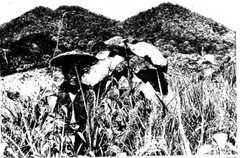
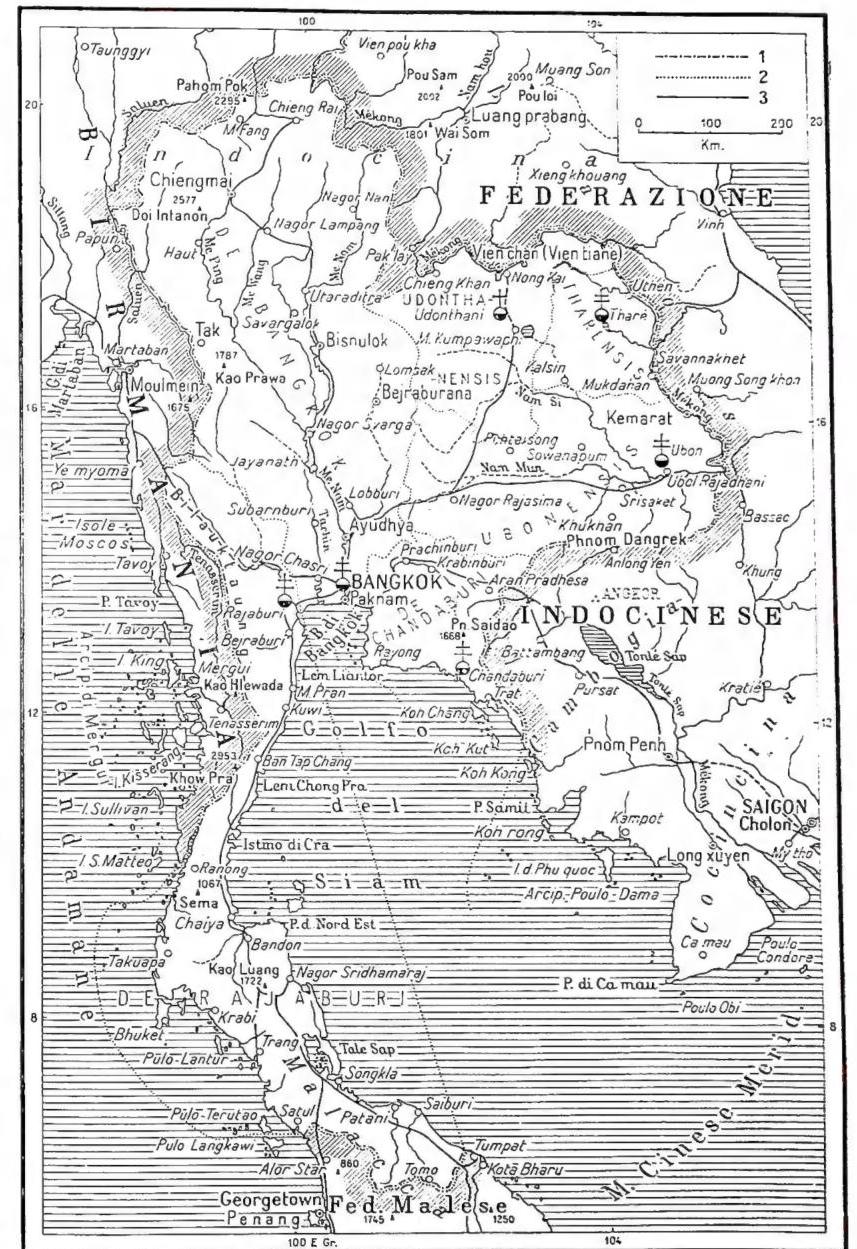
THAILAND (formerly Siam). - State of southern Asia, comprising part of Indochina and of the Malay Peninsula between Burma, the Malay Federation and French Indochina. It is 513,447 sq km in area and has no fewer than 18.5 million inhabitants (density 36 per sq km), of whom only 4.3% are foreigners, for the most part Chinese.
I. GEOGRAPHY
It is a country of rather varied structure and appearance, with a long, slender strip of mountains in the south, and in the north plateaus and mountains that surround the broad alluvial plain, traversed by the Menam, which represents its economically most developed and most populous part. Rice is the basic crop, and its huge production (97% of agricultural land) is partly destined for export. Tobacco, cotton, sugar cane, sesame, pepper, etc. also yield decent products. The forests covering the mountain slopes contain the precious teak, which is also largely exported, together with tin, which is extracted from peninsular T. (tungsten is declining; the production of lead, molybdenum and diamonds is decent). The livestock heritage is considerable, though for religious reasons it is limited to work animals.
The capital, Bangkok (or Krungthep, or "city of Angels"), on the left bank of the Menam, is a large urban agglomeration that exceeds one million inhabitants with its suburbs; all the other inhabited centers are much smaller.
T. is a constitutional monarchy, with a parliament of two chambers, one elective, the other appointed by the king.
Bibliography2 works
Giuseppe Caraci
II. HISTORY
The Menam valley, the heart of T., was originally inhabited by the Austro-Asiatic people of the Mon, who very early felt the civilizing influence of India. Politically the region remained from the 1st to the 6th century under the high dominion of the Kingdom of Fu-nan in the Mekong Valley. On the ruins of this foreign dominion there later arose the Mon kingdom of Dvāravati. In the course of the 9th and 10th centuries the Khmer became the dominant population, and in the first half of the 11th century the country became a province of the Khmer Empire of Cambodia. The Mongol conquests in China in the 13th century helped to accelerate the slow infiltration southward of the T'ai people from their seats in the mountains of Yunnan; the descent to the sea became an avalanche, which at the end of the 13th century swept away from the upper Menam the Mon dynasty and from the lower Menam the Khmer administration, and with them Hindu civilization. The T'ai of the middle Menam, organized in the kingdom of Sukhot'ai (ca. 1220-1378), gave Siam its name (Muang T'ai, T., definitively the official name since 1948) and its present-day borders; they adopted Hinayāna Buddhism with its canon in the Pāli language, introduced from Ceylon, and the new religion left its mark on the whole life of the nation. The dynasty of Sukhot'ai was soon supplanted by the kings of Ayuth'ya on the lower Menam (1347-1767), while the upper
Menam constituted the T'ai State of Xieng Mai, which in 1556 fell prey to the Burmese. The annals of Ayuth'ya are full of the centuries-long struggle against the ancient rulers, the Khmer of Cambodia, whom the Siamese gradually reduced to a very small State and who were saved only by the French protectorate (1867).
In the 16th-18th centuries the great enemy was Burma, against which T. warred sometimes with grave disasters. In these wars foreign mercenaries and adventurers played a great part (Portuguese in the early 16th century, Japanese in the early 17th century). After 1680 the government passed practically into the hands of a Greek from Cephalonia, Constantine Ierakis known as Phaulkon, with whose help French influence became supreme; it ceased, however, with the fall and death of Phaulkon in 1688. The 18th century was an era of decline, ending with the Burmese invasion of 1767; Ayuth'ya was taken and set on fire, the Kingdom passed under the Burmese yoke. But in the following months the national recovery, led by the general P'ya Taksin, of Chinese origin, met with full success; and in 1769 T. was reunited under his scepter. P'ya Taksin established the capital at Bangkok and in 1775 united to his Kingdom the region of Xieng Mai (upper basin of the Menam). His capricious cruelty, however, alienated the people from him; and in 1782 he was overthrown by the general P'ya Chakri, founder of the Rama dynasty still reigning. During the 19th century T. found itself exposed to the political pressure of Great Britain from the south and from the west, and of France from the east, but it managed to preserve its own independence precisely thanks to the equilibrium there achieved between the two European influences. The treaties of 1907 and 1909 definitively regulated the borders with the powerful neighbors, not without grave sacrifices for Siam.
Reigning at that time was King Chulalongkorn (1868-1910), who made the country take its first steps on the road to modernization. Under Vajiravudh (1910-25) T. took nominally part in the First World War as an ally of the Entente. Prajadhipok (1925-35) was the last absolute king of T.; in 1932 a bloodless military coup forced him to grant a constitution. Three years later, having fallen into disagreement with his ministry, he was forced to abdicate; his successor Ananda (1935-46) was a minor and resided in Switzerland during almost his entire reign. In 1938 Colonel (later Marshal) Luang Pibul Songgram came to power, and his government soon took on a dictatorial character. In Dec. 1940 and Jan. 1941 T. waged a brief war with France to claim the positions lost in Indochina in the previous century; and in Dec. 1941 it joined the Japanese invasion of Burma. However, the country was spared active military operations; it was therefore easy, after the collapse of Japan and the resignation of Songgram in 1945, to conclude with the Allies a peace Treaty that restored the borders of 1940. King Ananda was assassinated shortly after his return to his homeland (1946); his brother Phumiphon succeeded him. The political situation of the postwar period remained unstable. In 1947 a new Constitution was promulgated, and in 1948 Marshal Songgram again came to the government, though no longer in the capacity of dictator. On 29 Nov. 1951 a coup by the armed forces abolished the Constitution of 1947 and restored that of 1932, while keeping Songgram in power. In recent years T. demonstrated its solidarity with the Western world, sending troops to Korea and taking measures against the communists, numerous especially in the Chinese colony.
Bibliography2 works
Luciano Petech
III. EVANGELIZATION OF THAILAND
The first missionaries of whom there is record are the two Dominicans Jeronimo da Cruz and Sebastião da Canto, who, summoned by Portuguese merchants, arrived at Ayuthia in 1567 (not in 1554 or 1555). Jeronimo was killed in that same year; Sebastião likewise met his death together with two other Dominicans in 1569 during the war between Burma and T. At the end of the century Dominicans, Franciscans and secular priests are found, and at the beginning of the 17th century Jesuits as well. Missionary activity was very often interrupted by the continuous wars between T. and Burma and between T. and Cambodia. It was carried on not so much among the Siamese, to this day zealous followers of Buddha, as among the Portuguese, who had become numerous after the capture of Malacca by the Dutch in 1641, and the Cochinchinese, who had taken refuge at Ayuthia during the persecution in Cochinchina. In 1662 there were in Ayuthia about 2000 Catholics with 11 priests: 4 Jesuits, 2 Dominicans, 2 Franciscans and 3 secular priests, all under the Portuguese padroado.
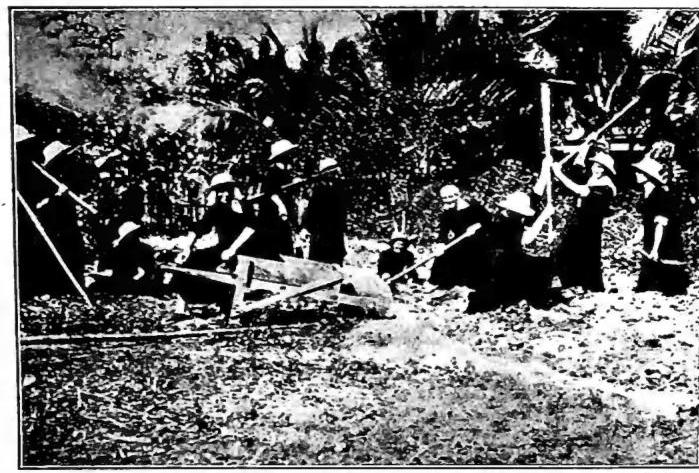
In 1662 there arrived at Ayuthia Msgr. Lambert de la Motte (v.), appointed by Propaganda as apostolic vicar of the recently erected vicariate of Cochinchina, with 2 priests of the Seminary of Paris, and he settled at Ayuthia, because he could not enter his vicariate owing to the persecution. Only in 1668 did he obtain jurisdiction also over T., which, however, was not recognized by the Portuguese priests and gave rise to unpleasant struggles. Following the good relations with France of King Phra-Narai and his minister Phaulkon and the Treaty of 10 Dec. 1685, which granted the missionaries freedom of preaching in T., the future of the mission seemed assured; but in 1688 a revolution destroyed everything and the missionaries were imprisoned. It is true that this first persecution ceased in 1691, but in the course of the 18th century periods of calm alternated with fierce persecutions, especially in the years 1730 and 1779 (expulsion of the missionaries), to which were added the destructions caused by the Burmese-Siamese wars, so that the mission grew steadily worse. Under Msgr. Arnaud-Antoine Garnault (1786-1811), who fixed his see on the Island of Penang (under English rule from 1786), the missionary work in T. was able gradually to resume and even to develop under his successors, especially after the Franco-Siamese Treaty of 15 Aug. 1856, which granted freedom to erect churches, seminaries, schools and hospices throughout the Kingdom of T. From 1881 the mission was able to extend to Siamese Laos. In 1925 the Salesians took over the missionary work in Siamese Malacca. In the educational field the Brothers of St. Gabriel (from 1901), the Sisters of St. Paul of Chartres (from 1898) and the Ursulines (from 1924) work. In 1944 an apostolic vicariate for the native clergy was erected at Chantaburi.
T. is today divided into six ecclesiastical circumscriptions: BANGKOK, in 1673 erected as apostolic vicariate of Siam, from 1924 with its present name, entrusted to the Seminary of Foreign Missions of Paris; CHANTABURI, in 1944 erected as apostolic vicariate, entrusted to the secular clergy; RAJABURI, in 1930 erected as a mission "sui iuris", in 1934 apostolic prefecture, in 1941 apostolic vicariate, entrusted to the Salesians; THARÉ, in 1899 erected as apostolic vicariate of Laos, from 1950 with its present name, entrusted to the Seminary of Paris; UBON, in 1953 erected as apostolic vicariate and entrusted to the Seminary of Paris; UDONTHANI, in 1953 erected as apostolic prefecture, entrusted to the Redemptorists.
Bibliography3 works
Giovanni Rommerskirchen
IV. SITUATION OF THE CHURCH IN THAILAND
The official religion of T. is Buddhism. The Constitution, issued in 1932 and amended in 1939, 1940 and 1952, in ch. I, sec. 25, states: "The King professes the Buddhist faith and is the head of the religion."
However, the same Constitution openly affirms religious freedom together with the other various individual freedoms: "Everyone has full freedom to profess any religion, to belong to any sect or religious creed and to practice the form of worship corresponding to his own beliefs, provided that such form is not contrary to civic duties, public order or good morals" (ch. II, sec. 25). "In the exercise of the freedom mentioned in the preceding paragraph, every person will be protected from any act of discrimination that the State may commit (an act that would be contrary to the rights of the person himself or harmful to his legitimate well-being), solely because the person professes a religion, belongs to a religious sect or doctrine or practices a form of worship different from that of others" (loc. cit., para. 2). "Within the limits provided by law, every person has full freedom of property, of speech, of writing, of the press, of education, of public assembly, of association and of forming political parties" (ch. II, sec. 26).
A special royal decree, issued on 27 Aug. 1909, regulates the situation of the Catholic Church in Siam, with the recognition of juridical personality for the missions and the regime of the related property. The Catholic Church in Siam, whatever the nationality of its missions and its priests, receives, in conformity with Siamese law, for each of its apostolic vicariates, the civil personality required to possess land, under the conditions fixed in the present decree (art. 1). An apostolic vicariate is, in the course of this decree, also called a bishopric or mission.
The apostolic vicar established by the Holy See as head of the mission and, in his absence, the Superior of the mission is the legal representative of the bishopric or mission, considered as a distinct juridical person. In each station, the missionary in charge of it acts as representative of the mission under the high authority of the bishop (art. 2). No Catholic missionary, even if a member of the mission for a long time, may, in the future, acquire landed property in his own name (art. 3). Landed properties belonging to the missions shall be governed by Siamese law and shall depend on the jurisdiction of the Siamese courts (art. 4).
In the future a mission may not possess landed property except directly, as is laid down by the present decree. It may not possess indirectly, nor may it claim a right of property or of interest in a landed good except in its own name or in the name of a station, of a branch, or of a determined religious establishment (art. 5). Landed properties belonging to a mission are divided into two classes according to their destination; the first comprises the lands of churches and other sacred buildings; the second the revenue lands (art. 6). In conformity with art. 3 of the Treaty concluded on 15 Aug. 1856 between Siam and France, missionaries have the freedom to preach and teach, to build churches, seminaries or schools, hospitals or other sacred buildings in any place of the Kingdom of Siam, always in conformity with the laws of the country (art. 7). The mission has the freedom to acquire land in any place for the founding of a new station or branch for the extent really necessary for the purpose (art. 10). - See plate I.
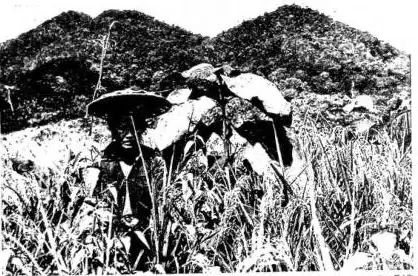
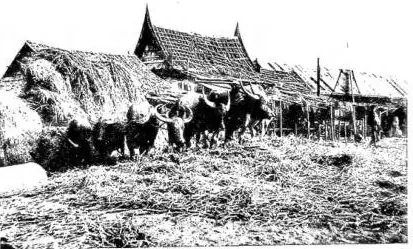
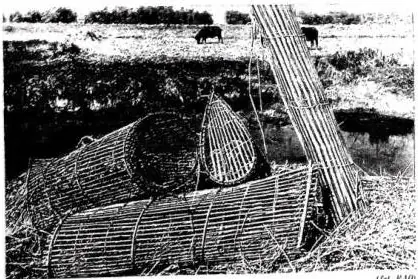
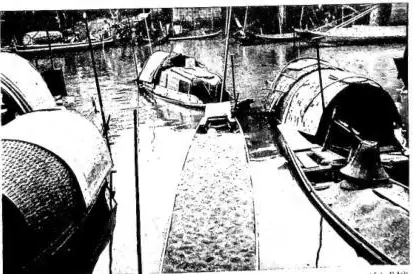
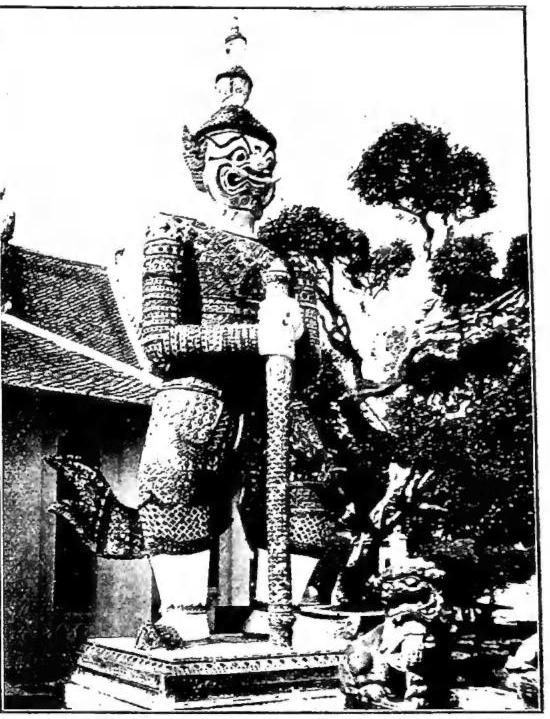
(Int. Fides)
Bibliography2 works
Edoardo Pecoraio