Machine translation of the 1948–1954 Italian original. The original text is authoritative.
TRIONFO (Triumphus), AGOSTINO. — Augustinian philosopher and theologian, b. at Ancona around the middle of the 13th century, d. at Naples on 2 April 1328.
I. LIFE
Appointed in 1300 to lecture on the Sentences at Paris, he began his lectures around 1305–1307. In the following years he took part in the political and religious events of France with treatises on the Templars and Against the Defamatory Articles against Boniface VIII, directed against Filippo il Bello. A regent master at Paris, around 1318 he moved with the same office to Padua, and from there to the neighboring convents; the Expositio in Evangelium Matthaei is dated at Venice in 1321. On 30 October 1324 he appears for the first time in the Angevin registers, as counsellor to King Roberto and Prince Carlo. He remained in Naples until his death. His biographies subsequent to 1582 are inaccurate: his birth in 1240 or 1243 is improbable, given
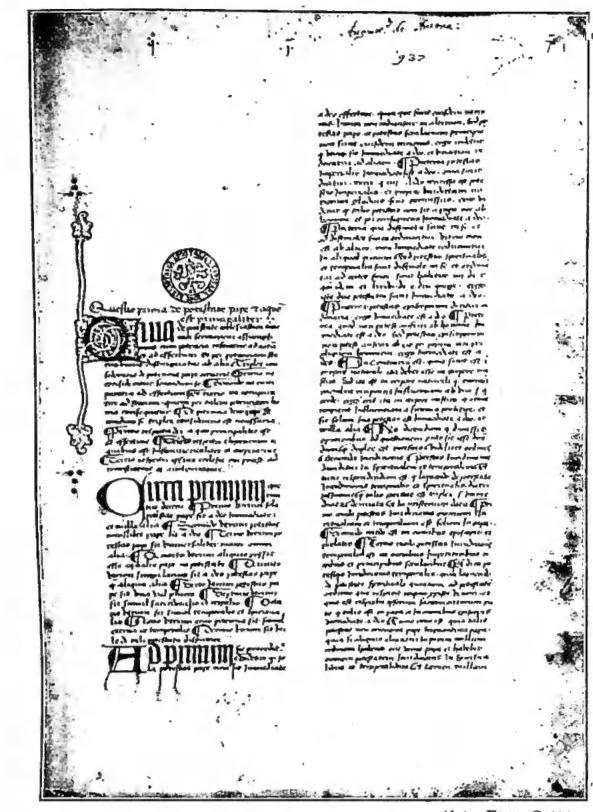
(Ist. Enc. Catt.) TRIONFO, AGOSTINO — Quaestio prima della Summa de potestate ecclesiastica — Vatican Library, cod. Vat. lat. 937, fol. 1 (15th century).who began to lecture on the Sentences in 1305; for the same reason, it is highly doubtful that he was a disciple and substitute for St. Thomas by mandate of Gregory X at the Second Council of Lyons; it is impossible that he attended St. Bonaventure’s lectures in Paris; it is false that from 1284 onward he was at the Angevin court. The title of blessed, which some authors attribute to him, has not been confirmed by the Church; the surname Trionfi, by which he is generally known, is found in no document, no author, and none of the numerous manuscripts of his works before 1382.
II. WORKS
Of the numerous works (cf. the lists of B. Ministeri, A. d'Ancona; la sua vita, le opere e la dottrina della giustificazione; of D. Perini, Bibliogr. Augustiniana, IV, Florence 1937, pp. 20–28; and of P. Glorieux, Répertoire des Maîtres en théologie, II, Paris 1933, pp. 321–27), mention may be made of the various scriptural commentaries (on s. Matteo, s. Paolo, the canonical letters, Pater, Magnificat, etc.), the sermons, the philosophical works (especially the commentaries on Aristotle, Analytici priorei, Metaphysica), and the various treatises: Summa de potestate ecclesiastica ad Johannem XXII (Augsburg 1473, with several editions), Contra divinatores et somniatores (Rome–Leipzig 1901); Tractatus contra articulos... ad diffamandum... Bonifacium Papam VIII (Münster 1902); Tractatus brevis de facto Templariorum (Stuttgart 1903). The copious dictionary of the works of s. Agostino, entitled Milleloquium veritatis, begun by T., was completed by Brother Bertolomeo di Urbino, under whose name it appears in the manuscripts and printed editions.
III. DOCTRINE
Agostino d’Ancona, in the period of high scholasticism, was one of the most distinguished masters of the Augustinian school. Basing themselves solely on the treatise De cognitione animae, Prantl, Haureau, and, more extensively, Werner asserted in the last century that his epistemological and psychological doctrine harmonized with that of Egidio Romano. Recent studies of the manuscript works confirm this judgment and extend it to other areas of philosophy and theology (cf. Grabmann, Schmaus, Ministeri, cited in the bibliography). As an exegete, he proves to be one of the finest of the scholastic period; and the Summa de ecclesiastica potestate constitutes a true monument of ecclesiology; particularly noteworthy is his treatment of the questions concerning primacy and infallibility.
BIBL.: B. Ministeri, A. d'Ancona; la sua vita, le opere e dottrina della giustificazione (critical bio-bibliographical study, forthcoming in Palermo); D. A. Perini, Bibliographia augustiniana, IV, Florence 1937, pp. 20–28. Doctrinal studies: H. Finke, Aus den Tagen Bonifaz VIII, Münster 1902, p. 250 ff.; R. Scholz, Die Publizistik zur Zeit Philipps des Schönen, Stuttgart 1903, pp. 172–89; H. Denille, Die abendländ. Schriftumleger bis Luther, Mainz 1905, pp. 161–72; J. Rivière, Le problème de l'Église et de l'État au temps de Philippe le Bel, Louvain 1926; U. Mariani, Sertitori politici agostiniani, Florence 1927; W. Mulder, De potestate collegii mortuo Papa des A. Triumphus, in Studia cath., 1928, pp. 40–60; E. van Moo, A. T. et ses théories politiques, Paris 1928, pp. 101–14; J. Santeler, Die Prädestination in den Römerbriefkomment. des 13. Jahrh., in Zeitsch. f. kath. Theol., 52 (1928), pp. 1–39, 183–201; J. Kürsinger, Zur Deutung der Johannestaufe in der mittelalt. Theol., in Beiträge zur Gesch. der Philos. des Mittelalters, suppl. III, II, Münster 1935, pp. 954–73; M. Schmaus, Die Gotteslehre des A. Triumphus nach seinem Sentenzenkomment., ibid., pp. 896–953; J. Rivière, Une première « Summe du pouvoir pontifical. Le pape chez A. d'Ancone, in Rev. d. sc. relig. (1938), pp. 149–83; M. Grabmann, Der Metaphysikhomm. der Aug. T. von A., in Scholastik, 1941, pp. 11–23.
David Gutierrez
Cite this article
“TRIONFO (TRIUMPHUS), AGOSTINO.” Enciclopedia Cattolica, vol. XII (1954), p. 355. Azione Romana digital edition, https://azioneromana.com/article/trionfo-triumphus-agostino.