
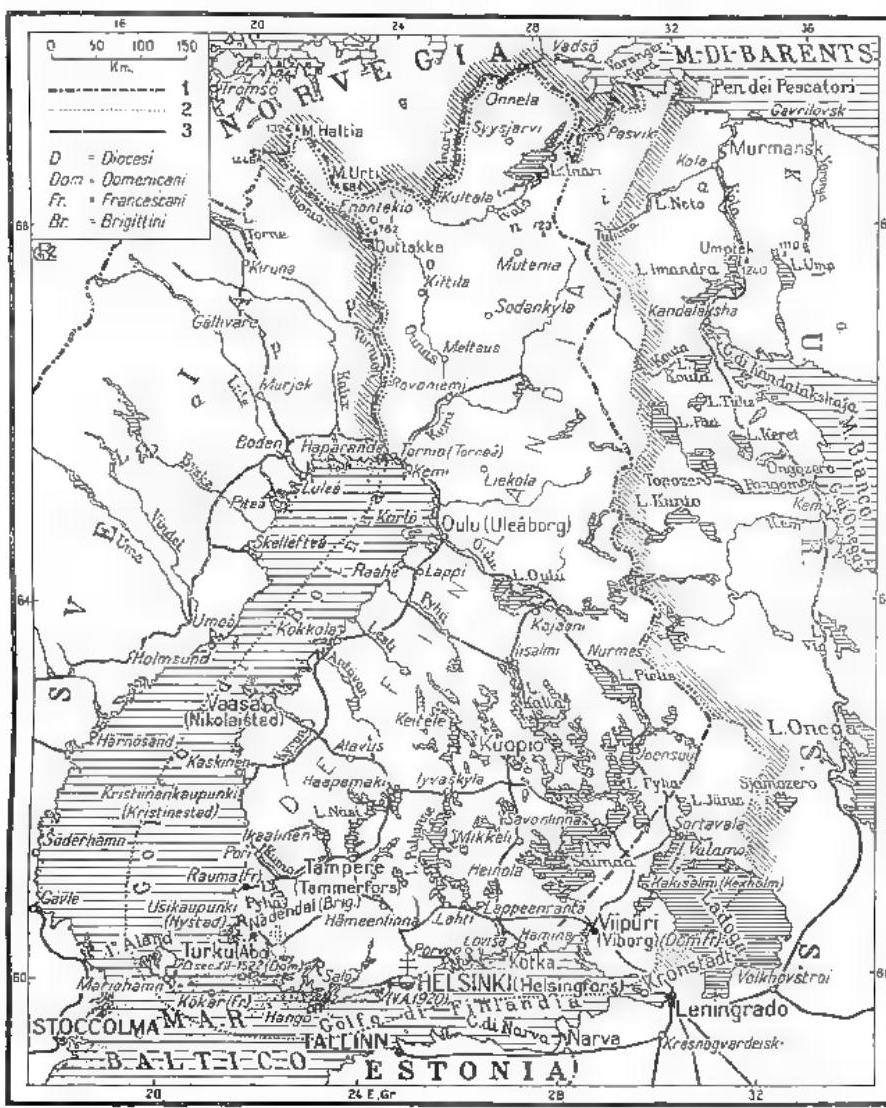
FINLAND. - I. GEOGRAPHY. - The territory of F., larger than Italy (331,759 sq. km.), has roughly the shape of a quadrilateral, enclosed between the Gulf of F. and the Arctic Ocean, the Gulf of Bothnia and the depression that runs from Ladoga to the White Sea. It is a matter of a broad platform resulting from the leveling of an ancient relief of granite rocks, on which the Quaternary glaciations left a thick blanket of sediments and determined a maze of lake basins (over 35 thousand). The surface of these basins occupies 1/8 of the country, still covered for over 2/3 by forest.
The climate has a continental character, attenuated in comparison with the neighboring Russian plain, but which grows milder in the northern regions where the tundra dominates (Lapland). Barely 7.4% of the territorial surface is represented by arable land and 1.3% by pastures; nevertheless agriculture and livestock raising constitute the prevailing occupation (60%) of the inhabitants, both practiced with intensive character and modern systems. The main crops are the cereal crops (oats, rye, barley); the cattle stock allows a large production of butter. But the richest resource of the country is silviculture, which feeds an intense and flourishing industrial activity (sawmill, carpentry, furniture factory, wood pulp, cellulose), widespread especially in the southern regions. Favored by the abundance of water power, but hampered by the lack of coal and iron, the other industries are nonetheless important for all that (metallurgical, mechanical, textile, chemical, etc.), and they too are exporters.
The population (4 million inhabitants; 11 per sq. km., much denser in southern F.) is for 9/10 made up of the Suomi, of Finnic stock, who differ from the Swedes living predominantly in the southwestern regions (fewer than 400 thousand in all), who are allowed the use of their own language.
As for confessions, Lutherans make up 66.2% of the total, while Catholics number about two thousand. Only the capital Helsinki (Helsingfors) is a large urban center (over 300 thousand inhabitants); none of the other cities (Turku, Tampere, Vaasa) reaches 100 thousand inhabitants. Subject to Sweden for over six centuries and united with Russia in 1809, F. proclaimed itself an independent democratic republic in 1917. In the last war it had to cede to the U.S.S.R. a part of its richest territories; especially grave was the loss of the so-called Karelian isthmus with the city of Viborg.
Bibliography2 works
Giuseppe Caraci
II. HISTORY
The evangelization of F. began around the middle of the 12th century. Its promoter was the king of Sweden Erik IX the Saint, who placed himself at the head of a crusade: Bishop Henry of Uppsala (v.) remained in F. The results of this undertaking, however, were not lasting. Once the bishop had been assassinated, the work of evangelization languished, as is shown by a brief of Alexander III (1171), in which the Pope urges the archbishop of Uppsala to take an interest in the spread of the word of Christ in F. Only in the first decades of the following century did Catholicism regain vigor, thanks to the tireless missionary action of Thomas, Finnorum episcopus, who, however, in 1245 resigned from his bishopric because the crusade he had led against the city of Novgorod had failed, whose army, commanded by Alexander Nevsky, had defeated the crusaders on the banks of the Neva (1240). At the same time Sweden, under the energetic guidance of the jarl Birger Magnusson, who was the highest authority of the Kingdom after the sovereign, undertook in 1249 a new crusade in F., which definitively bound western F. to the Swedish State and to the Catholic faith: to the same year also dates the foundation of the first convent, the Dominican one of Åbo. In 1286 the first bishop, Johannes I, was canonically elected, who transferred to Åbo the episcopal residence that until then had been established at Nousia and at Räntämäki. The peace of Nöteborg (1323) between Sweden and Novgorod, by which Swedish sovereignty over western Karelia was recognized, opens new prospects for the missionary action of the Finnish Church, and during the episcopate of Benedictus (1321-38) the solid foundations are laid, on which the Church of F. would rest until the introduction of the Lutheran "reformation". In this period two other figures of prelates are worthy of particular mention: Hemming (1338-66), who continued the work of organization begun by his predecessor and who strengthened the position of the Church in F., and Magnus II Tavast (1412-50), who is a personality of the greatest importance in the medieval ecclesiastical history of F.
In F., as in Sweden, the "reformation" was introduced by King Gustav I Vasa, who, as the State was struggling with grave economic difficulties, intended to procure for himself the financial means to continue the war against Denmark (which wanted to stably reassert its dominion over Sweden and F.) through the appropriation of ecclesiastical property and the confiscation of tithes. The center of diffusion of Protestant ideas in F. was the city of Viborg (Viipuri), where the greatest representative of Finnish Lutheranism, Michael Agricola, also studied. Having enrolled in 1536 at the University of Wittenberg, Agricola cola returned to his homeland after obtaining his doctorate and translated the New Testament and other sacred texts into Finnish. He also composed a book of prayers (Racouskiria Bibliasta), which can be considered a veritable manual for priests. The "reformation" finally took firm hold in F. with the acceptance of the Augsburg Confession at the Synod of Uppsala (1593). F.'s position, however, was still uncertain. After the death of King John III (1579-92), the struggle began between Charles, Duke of Södermanland, brother of the deceased king, and Sigismund III Vasa, son of John III and king of Poland, who wished to re-establish Catholicism in Sweden. F. was then governed by Klas Fleming, a person devoted to the deceased John III and to the new king, nor did the latter intend to take Charles's side. But Fleming died and Charles won the battle against Sigismund and became king of Sweden under the name Charles IX, forcing Sigismund to withdraw to Poland. This outcome of the struggle is of truly historical importance, because it definitively bound F. to the political destiny of Sweden and to the Lutheran faith. With the rise of Russian power, F. became Sweden's bulwark toward the east, a function it fulfilled for more than two centuries until the Peace of Fredrikshamn (1809), when F. became part of the Empire of the tsars in the form of an autonomous and independent grand duchy. Proud of its own freedom, F. has always kept alive the flame of its particular national sentiment. An independent republic in 1917, it defended its territorial integrity to the utmost limit during the two wars against Russia in 1939-40 and in 1941-44.
Bibliography13 works
Silvio Furlani
III. APOSTOLIC VICARIATE of F
The apostolic succession of bishops ceased when the Lutheran king of Sweden, Gustav I Vasa, placed the apostate Martin Skitte (1528-50) at the head of the diocese of Åbo. From then on the persecution began, which had only a brief truce under the reign of John III and of his son Sigismund, king of Poland and Sweden. Only in 1721 did Catholicism begin to revive through the work of the Polish soldiers in the province of Viborg who had passed to Russia. In 1781 the prohibition of Catholic worship ceased in the Swedish part, but in the Russian part all Catholic propaganda remained forbidden and the missionaries were repeatedly driven out. In 1857 the archbishop of Mohilev, who had jurisdiction over all the Catholics of Russian territory (excluding Poland), sent a chaplain to F. for the military. In 1860 another priest was requested at Helsinki, along with some German nuns who later had to withdraw (1880) for lack of resources. The Catholics then strove to find the funds necessary for their Church, but, since the legislation knew no authorized form for an association of persons professing the Catholic religion that could serve as a secure basis for settling the treatment of the clergy, they explicitly asked the civil authority for permission to found a Catholic parish in Helsinki. The request, submitted to the faculty of law of the University, received an affirmative answer in 1897; the church built in Helsinki (1860) and served by military chaplains received the rank of parish dependent on the archdiocese of Mohilev. The number of native Catholics grew slowly and in 1912 a new church could be opened for them. In 1917, F. having obtained independence, the Holy See made it an autonomous apostolic vicariate (8 June 1920), detaching it from the diocese of Mohilev.
Bibliography7 works
IV. LITERATURE
Finnish literature is
among the youngest in Europe: despite the
fact that the Swedish population represents, in F.,
only a tenth of the total population,
the belonging of F. for six centuries to the kingdom of
Sweden had as a consequence that the Swedish language and culture dominated throughout the whole country (for Swedish-language literature in F., v. SVEDESE LETTERATURA). It is characteristic that only in the second half of the nineteenth century was Finnish gradually recognized as an official language, alongside Swedish. The period of Russian domination (1809-1917) had instead little influence on the cultural life of the nation, although the general conditions continued to remain unfavorable for the Finnish people. Of a Finnish literature, in the artistic sense of the term, one can only begin to speak in the full nineteenth century. In an earlier era, one should remember above all Michael Agricola, who translated the New Testament (1548) and part of the Old. A Finnish grammar, the work of E. Petraeus, saw the light in 1649.
In the climate of Romanticism, in an environment of distinctly Swedish culture, Elias Lönnrot (1802-84) wished to draw directly on Finnish folk poetry. Thus there came to light folk songs that in a short time aroused the attention of all educated Europe and that revealed the until then ignored values of F. The Finnish national poem, the Kalevala, was in fact composed by Lönnrot from part of the folkloric material collected; a very ancient treasure of legends was selected and harmonized by the poet: the definitive edition (1849) numbers fifty songs. In an environment of ardent national feeling and incipient political freedom, Alexis Kivi (1834-72) can be considered the first notable modern writer, of a truly European horizon. Of him one remembers: The Seven Brothers, a novel permeated at once with realistic and lyrical touches and unfolding in a rough climate of wooded solitude. Among the lyric poets are to be mentioned Kaarlo Kramau (1855-95), poet of pessimism, revoker - in his ballads - of painful episodes of Finnish history, and August Ahlqvist (1856-80), better known under the name of Oksanen.
In the last decades of the nineteenth century there came to be affirmed in Finnish literature, in the footsteps of Western Europe in general and of Scandinavia in particular, a realistic and social orientation, interwoven moreover with neo-Romantic currents, which seek to emphasize national values and those more specifically poetic against the prevalence of a spreading contentism. In a few decades the very young Finnish literature shows, in short, the signs of a rapid maturation and the aptitude for assimilating the most varied aspects of European culture.
Minna Canth (1844-97) passed from Romanticism to realistic and socialistic accents: she wrote novels and stories inspired by the proletarian environment. Arvid Järnefelt (1861-1932) underwent to a notable degree the influence of Tolstoy. Juhani Åbo (1861-1921), besides being a master of style and language, is a fine psychologist. To be remembered too, alongside these, are Teuvo Pakkala, Santeri Ivalo and Kasimir Leino.
As the moment of national independence draws nearer, Finnish literature seems to free itself ever more from the obligatory tracks that often characterize the beginnings of young literatures. With Eino Leino (1878-1926) lyrical values are above all reaffirmed, but he also established himself in the theater and as a narrator; his translation of the Divine Comedy is classic. Otto Manninen (b. 1872) is characterized by his musicality and is also notable as a translator of great ancient and modern poets (from Homer to Heine and to Petőfi). Johannes Linnankoski (1869-1913) is known especially for a novel, The Song of the Red Flower, unfolding, with modern sensibility, in a primitive environment, and for a "rustic novel", The Juggiacchi. Aino Kallas (b. 1878), wife of an Estonian writer, generally drew her inspiration from the Estonian environment and also treated with finesse problems of feminine psychology. Larin Kyösti (b. 1873) is a poet rich in imagination, sometimes with a fairy-tale background; Kasimir Leino (1866-1919) has been not wrongly compared to the Parnassians. V. A. Koskenniemi (b. 1885) is a poet of classical taste, known also as a scholar of Lucretius, Goethe and Kierkegaard.
It would moreover be impossible to cite all the most salient names that have come to be affirmed in this first half of the twentieth century in Finnish literature. It suffices therefore to recall Frans Emil Sillanpää (b. 1888; Nobel Prize 1939), who, after having taken his initial inspiration from the Norwegian Hamsun, came to be affirmed as the most notable modern Finnish narrator. In his stories the most diverse social environments are mirrored, against the background of the countryside. Of him one should remember Life and Sun, Pious Misery, Watched over by Angels, The Path of a Man, Dead Young (also known under the title Sifja).
The cultural life of F. has been affected to a notable degree by the agitated events of the last 19-40 years. National independence (1917) contributed enormously to the affirmation of culture and to its emancipation from a climate strongly permeated with foreign elements. Most painful instead were the consequences of the Second World War, connected with the loss of part of the national territory and with grave destruction. Moreover the tenacious will to live of the Finnish people has known how to overcome these harsh trials: cultural activity has resumed in all fields, with surprising energy.
Bibliography7 works
Wolf Giusti
V. SCHOOL SYSTEM OF FINLAND
The Finnish constitution provides for individual and national education. Freedom of conscience and the rights of minorities are guaranteed. Attendance at elementary school is compulsory and free and lasts 7 years. It is the duty of the elementary school teacher to know the pupil's sphere of interest in order to direct him toward the right profession in life. The elementary school is therefore regarded as the foundation of Finnish life in that it reveals the pupils' aptitudes by selecting them. Instruction is informed by the pedagogical doctrines of Comenius and Pestalozzi. The influence of Comenius was already felt in 1649 and is very strong especially in the schools of the Swedish minority. The Government strives to bring elementary education to inaccessible regions.
The number of illiterates is 0.8%.
The school system comprises four types of schools: elementary, secondary known as schools of erudition, schools of social erudition, and the university.
Elementary schools are divided into elementary schools lasting 2 years, higher elementary schools lasting 4 years, and after-school programs lasting one year.
Secondary schools comprise the middle school lasting 5 years, higher schools for boys lasting 8 years, and higher schools for girls lasting 9 years. The schools of social erudition comprise the various vocational schools, 51 people's colleges and 34 work institutes also called free institutes. The universities are in Helsinki (founded in 1640 at Åbo and moved to Helsinki in 1828), the Swedish university at Åbo (founded in 1918) and the Finnish university at Åbo (founded in 1922).
Bibliography
Stumpf Miroslav