
PARALYTIC. - St. John the Evangelist (5:1-15) relates that Jesus, having come to Jerusalem, stopped at a place near the present-day church of St. Anne, where there was a pool called by the Hebrews
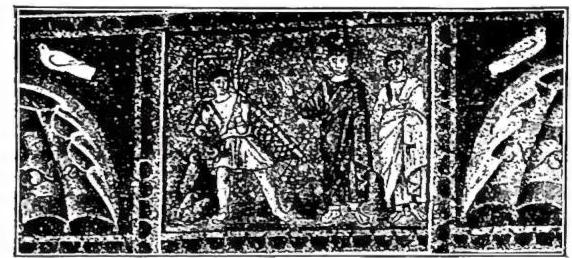
Bethsaida (Bethsada or Bethesda) with five porticoes, under which lay sick people of every kind, waiting for an angel to come down from heaven to stir the waters, and he healed the paralytic who for 39 years had been waiting for someone to lower him into the water at the opportune moment.
Christian art naturally took possession of this episode, depicting it repeatedly, though in different ways. However, painters preferred to represent the other scene of the healing of the paralytic of Capernaum (Mt. 9:6 ff.; Mk. 2:12; Lk. 5:25 ff.), in which the man healed walks away with his bed on his shoulders; and they often place this scene next to another of the Baptism (cf. the figures of the Greek Chapel of Priscilla and of crypt A of the Sacraments of St. Callixtus), thereby emphasizing the symbolic connection existing between the healing of the paralytic and regeneration from sin. The healing of the paralytic was frescoed in the 3rd century in the baptistery of Dura Europos (Enc. Catt., IV, pl. 126). Sculptors, on the other hand, exploiting the possibility of giving more scenes, sometimes superimposed, and the very nature of relief, which makes use of the background to create a reality richer in details, have left some representations in which almost all the elements of the Johannine text recur. Only a few are known, but in compensation the compositions are all alike and occupy the center of the front of the sarcophagi, which all have, in the same order, an identical series of scenes. In Gaul there are the following fragments: a) at Die (Wilpert, Sarcofagi, pl. 230, 2), almost the entire upper scene with the portico of three arches; b) in the Museum of Clermont (ibid., pl. 230, 5), the two superimposed scenes, but the portico is reduced to a single arch, according to the typology of columnar sarcophagi; c) at Arles (ibid., fig. 184), only an arch with two heads of sick people; d) in the Museum of Vienne (ibid., pl. 230, 4), almost the whole upper zone and part of the broad wavy fillet that divided the two scenes.
Two other fronts of sarcophagi, the most complete and important, are the Lateran 125 (ibid., pl. 230, 6) and that of the cathedral of Tarragona (ibid., pl. 230, 3), a faithful copy of the first. From these two fragments the traditional iconography of the composition is inferred: the lower scene represents the paralytic lying on his bed and surrounded by the sick, while Jesus approaches from the right; the upper one, divided from the one below by a wavy fillet, which is meant to signify the water contained in the probatic pool, shows again the sick, the Lord in the gesture that marks his command, and the man healed walking away with his bed on his back. All these fragments, the only ones that have come down to us, must be assigned to the 4th century, with a single exception: the fragment of Die, because of the halo sketched around the head of the Lord, must be placed in the 5th century.
Also in the National Museum at the Baths in Rome there are two fragments of sarcophagi with the paralytic (R. Paribeni, La collezione cristiana del Museo nazionale romano, in N. bull. arch. crist., 21 [1915], pl. 4, no.
2). The miracle of the paralytic was then depicted in gilded glass (R. Garrucci, Storia dell'arte cristiana, Prato 1876-81, pl. 177, nos. 3 and 4) and is found in an ivory of the Louvre Museum (J. Marquet de Vasselot, Un ivoire chrétien du Musée du Louvre, in Monuments Piot, 28 [1925-26], pp. 175-86, and pl. 14).
In the mosaic cycle of the New Testament in St. Martin in caelo aureo, today St. Apollinaris Nuovo, the scene of the paralytic is the most complete (M. van Berchem and J. Clouzot, Mosaïques chrétiennes, Geneva 1924, p. 131, fig. 156).
Bibliography7 works
Pasquale Testini