
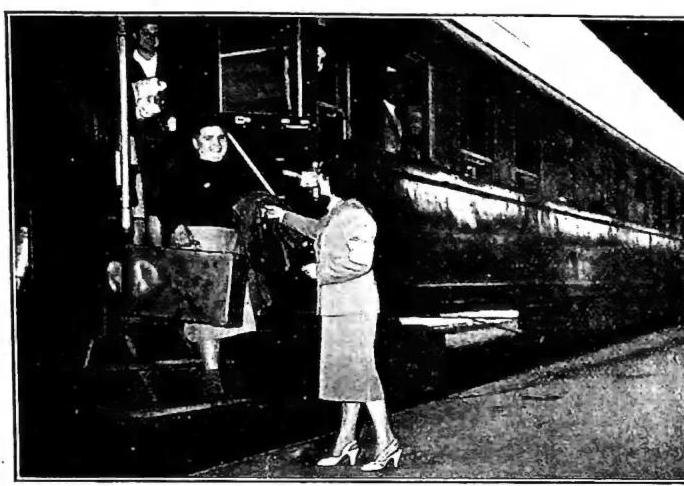
PROTECTION OF YOUNG WOMEN, INTERNATIONAL CATHOLIC ASSOCIATION OF WORKS FOR THE. — The Association carries out work not of redemption but of preservation on behalf of young women in the face of the dangers they may encounter while travelling, at work, or in their studies: it provides and arranges supervision services in railway stations, ports, airports (missions de gares), etc.; it organizes and manages lodging houses and family homes (homes), hotels, canteens, clubs, employment offices, news and information offices, places for festive and cultural gatherings, convalescent homes, and holiday homes; it is connected with a vast network of “supervised” hotels in many countries of the world; it collaborates with all Catholic youth associations, as well as with non-Catholic associations directed toward the same purpose. Through its “travel guides,” it establishes the broadest itineraries by which it can follow a young woman wherever she may go. The International Committee is based in Fribourg.
It was founded in 1896 by Louise Raynold, with the approval of Leo XIII, out of the need to defend young women from the “white slave trade.” The International Committee has a president appointed by the Holy See and, as ecclesiastical adviser, the bishop of Fribourg. Widespread across the five continents, it has highly active national committees in Europe, especially in Austria and Belgium,
France, Germany, Italy, Luxembourg, the Netherlands, Portugal, and Spain. The Association has held 11 international congresses; the most important were held in Budapest (1931), Fribourg (1935), and Rome (1948), where representatives of 23 nations gathered. The patroness of the Association throughout the world is the Blessed Virgin of Good Counsel; of the young women assisted, St. Maria Goretti. Affiliated with the International Union of Catholic Women’s Leagues, its president is an ex officio member of the World Council; it has a consultative vote in the “Vatican migration bureau” in Geneva; it takes part in the meetings of UNAC and of the non-governmental organizations at the United Nations (NGOs).
The Italian National Committee is based in Rome; it was founded in Italy in 1902 through the efforts of prof. Rodolfo Bettazzi and Countess Maria di Groppello Bray, with the first committee in Turin. Committees were subsequently established in Milan, Florence, Venice, Genoa, and Naples. Once the National Committee had been established in Turin, it was entrusted with coordinating and directing the expansion and interconnection of the P. della g. in Italy. In 1930 the national headquarters was transferred to Rome. Today the P. della g. has 51 committees and 29 secretariats; it has 3,051 parish correspondents in active service (during the war this widespread organization was completely disrupted), 29 station offices, 3 at the ports (Genoa, Naples, Venice), and 6 at the frontier crossings (Brenner, Chiasso, Domodossola, Modane, Tirano, Ventimiglia), providing uninterrupted assistance by day and night. In the principal cities and provincial capitals it has lodging houses for accommodating young women in transit and family homes for those far from their families or without families, who find themselves isolated because of work, employment, study, and so forth. In 1949 it assisted 81,200 young women, two-thirds of them minors and very young.
The Italian National Committee oversees the publication of the bimonthly bulletin, La P. della g., and the address sheet (F. I. T.), containing the names and addresses of the committees, secretariats, and correspondents, as well as information on the lodging houses and family homes, frontier crossings, and station offices; it is continually updated. All committees, secretariats, and correspondents provide assistance when notified in advance (airports, intercity services, special timetables). The Association has employment and information offices, supplemented by its extensive network of correspondents in Italy and abroad (practically throughout the world), to obtain the necessary guarantees before young women depart for their place of employment. It runs Sunday recreation centers; devises initiatives for vacations; promotes vocational training and study courses; and provides medical-legal, moral, and spiritual assistance. The individual committees respond to local needs: assisting rice weeders during their journeys and stops and at the weeding sites; families; emigrant women with procedures for emigration, employment, travel, and crossing the frontier; emigrant women through the national committees of the various countries; and female students who commute daily from outlying areas to provincial capitals, exercising above all delicate and prudent supervision in the vicinity of the station to prevent reported abuses; they operate hot-meal facilities near schools in full cooperation with the educational authorities; and assist domestic servants with placement and residential support, supervising their conduct, education, and health, checking the morality of the household that hosts them, reporting to their families, and acting in their stead.
All services of the P. della g. are free of charge. The president of the National Committee is elected by the General Assembly. Throughout the world, the women who serve at stations, frontiers, and ports, and during journeys, wear on their left arm a white-and-yellow armband; those belonging to the committees wear a badge bearing the initials A. M. (Ave Maria).