
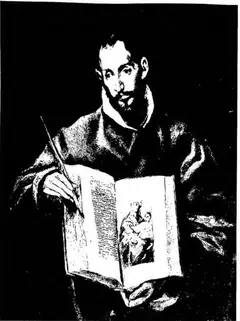
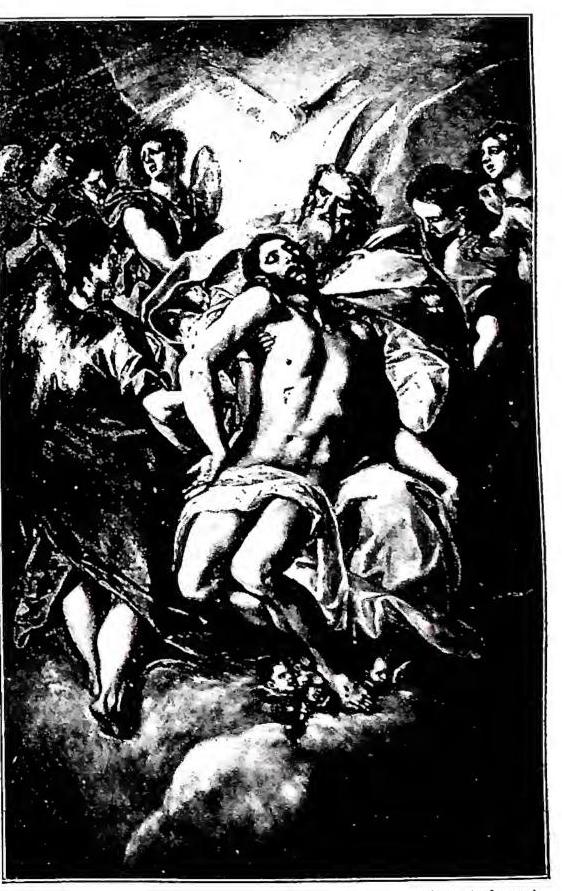
GRECO, Domenikos Theotokopoulos, called El. - Painter, b. in Candia on 1 Oct. 1541, d. in Toledo on 7 Apr. 1614. Having come to Italy, to Venice, he was perhaps a disciple of Titian, but he also knew the art of J. Bassano, of Tintoretto, of Schiavone, of Veronese and, in Parma, that of Correggio and Parmigianino.
In Rome, where he was from about 1570 to 1572, he saw the works of Michelangelo. He was also in Naples and perhaps in Malta; in 1576 he left Genoa for Spain; in 1577 he was certainly in Toledo, where he found an environment congenial to his temperament. Here, in 1577, he painted for the church of S. Domingo el Antiguo the Assumption of the Virgin, the Resurrection, the Sts. John the Evangelist and John the Baptist, the Adoration of the Shepherds, works still in their original place, except for the Assumption, now in the Art Institute of Chicago. This Assumption is one of the most Titianesque paintings of El Greco. In 1579 he was proposed to work for the Escorial, and there he painted three pictures representing St. Ildephonsus, St. Peter and St. Francis, in addition to the altarpiece with St. Maurice and the Theban Legion. Among his works of the Spanish period the most famous are the Espolio for the cathedral of Toledo (1572) and the Burial of the Count of Orgaz painted for the church of S. Tomé also in Toledo, certainly completed in 1584. Among the works of the Italian period, in which the artist was forming himself on Venetian models, are cited: the triptych with The Annunciation of the Gallery of Modena, Jesus in the House of Martha (Venice, formerly Brass collection), The Healing of the Blind Man (Dresden and Parma); the Merchants Driven from the Temple (Richmond, Cook collection); The Annunciation (Florence, Contini Collection), The Boy with the Candle (Gallery of Naples). But of his activity even earlier than these works, that is, in the midst of his first Venetian years, numerous examples have recently come to light, following the fortunate discovery of the Polyptych (signed) of the Galleria Estense in Modena. With their aid the hypothesis on the origins of El Greco is today confirmed: a broad study of the great Venetian painting - of his own El Greco brought the magic of certain Oriental chromatic secrets - and of the suggestive Parmese linearism.
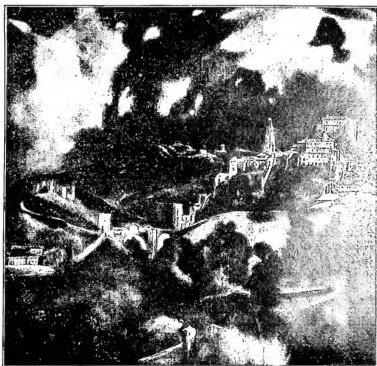
Among the works of his maturity are remembered, besides those already named, The Pentecost (Madrid, Prado, where there are numerous other canvases by him); The Apostles (Toledo, Provincial Museum); The Adoration of the Shepherds (New York, Metropolitan Museum); The View of Toledo (Toledo, Museo del Greco), and, among the portraits, that of The Inquisitor Nino de Guevara (New York, Winterthur, Reinhart collection).
If one could speak for him of mannerism, one would have to speak of a mannerism of color, which in him reaches hallucinatory effects as in the Oriental art of the Middle Ages. And the color there is commented upon by a fantastically decorative line, whereby his paintings give the sense of surprising instinctive anticipations of attitudes that in modern art derive from theoretical premises. - See pl. LXXX.
Bibliography11 works
Vincenzo Golzio