
PAUL THE DEACON. - Monk and historian. What is known of his life is derived almost exclusively from his works. Of a noble Lombard family established at Cividale del Friuli since the conquest, he had as father Warnefrit, as mother Teudelinda; he himself recalls his brother Arichi and a sister who was a nun.
He was educated at the court of Pavia, where he had as teacher a certain Flaviano, nephew of the grammarian Felix, and was part of the palatine clergy. Protected by King Rachis, he later stayed with King Desiderius, who entrusted him with the education of his daughter Adelperga and accompanied this princess to Benevento when she went as bride to Duke Arichi. To her, around 768, he offered his Historia Romana: a continuation of that of Eutropius carried down to the time of Justinian. The fall of the Lombard Kingdom reduced P.'s family to misery and forced him himself to find refuge by becoming a monk at Montecassino, which was then flourishing more and more; so many misfortunes induced P. in 782 to ask Charlemagne for mercy for himself and for his own; the latter called him to his court as a teacher alongside the other
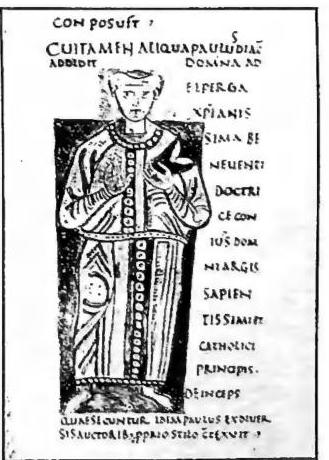
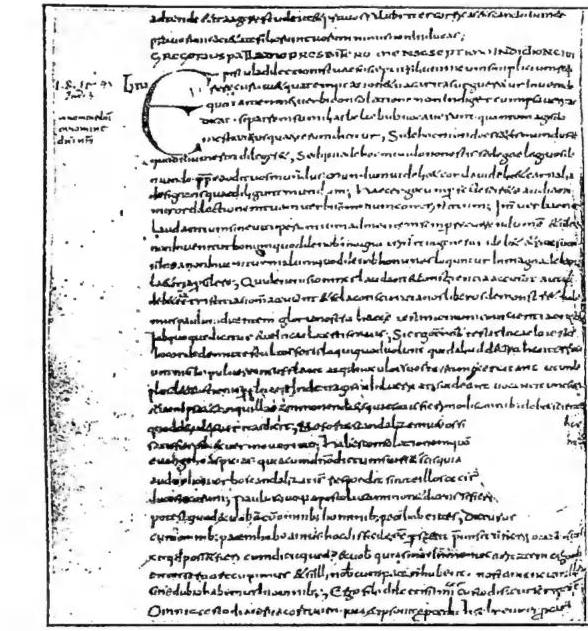
"grammarian" Peter of Pisa. Here P., besides teaching the little Greek he knew, gave free rein to his poetic inspiration and among other things, to please Angilram, bishop of Metz, composed in verse, shortly after 783, his Libellus de numero vel ordine episcoporum qui sibi ab ipso praedicationis exordio in Mettensi civitate successerunt, which later served as a model for similar compilations. Besides the extracts of Pompeius Festus, P. also compiled a collection of homilies of the Fathers for the liturgical and practical use of the Frankish bishops, which was widely used. After about four years, around 786, P. returned to the longed-for Montecassino, where he compiled a Vita of St. Gregory the Great and a selection of the letters of this Pontiff to gratify the desire of his friend Adalard, abbot of Corbie. An Expositio super Regulam sancti Benedicti, the first of its kind, is very probably a work of this last period of P.'s life, during which he also attended, according to common opinion, to writing the Historia Langobardorum, which he carries from the legendary origins down to the death of King Liutprand. To this above all the fame of P. remained bound; he is in fact the only historian of his people, and he wrote of it with filial affection, while not concealing its primordial barbarism. The documentary material was quite scanty and P. did not shrink from making use of epic legends or traditional memories, still alive in his Friulian duchy. He used a Historia of Secundus of Trent, the Editio of Rothari and the Origo gentis Langobardorum which is usually joined with it, some documents of the church of Aquileia, the biographies of the Liber Pontificalis, a catalogue of the Roman provinces, some inscriptions and the works of St. Gregory the Great. He had before his eyes the works of Jordanes, of St. Isidore of Seville, of St. Gregory of Tours and of St. Bede. Not without influence were Pliny, Virgil and Servius, his commentator, and other Latin poets and historians; so that P. also informs us about his culture, which was certainly not small for his times; a culture attested also by his verses, written for the most part with good meter and often with true poetic sensibility. With Paulinus of Aquileia, P. is a good witness of how much Lombard Italy could achieve in the field of culture in the 8th century, so as to be able to contribute to the Carolingian renaissance. P. died in fact toward the end of that century.
Bibliography14 works
Pio Paschini