
« SPIRITUS PARACLITUS ». — Encyclical of Pope Benedetto XV, published on 15 September 1920 (AAS, 12 [1920], pp. 385–422 and Denz-U, nos. 2186–2188) to commemorate the fifteenth centenary of the death of s. Girolamo (v.), of fundamental importance for Catholic biblical scholarship. It occupies Providentissimus Deus (v.), of 18 November 1893, Divino afflante Spiritu (v.), of 30 September 1943, and provides the complete solution to the biblical question.
If Providentissimus inspiration (v.) of the Sacred Scriptures, and Divino afflante Spiritu allows broad scope for methodical research concerning the hagiographers, or “instrumental authors,” of the Bible and the literary genres (v.) employed by them, S. P. gives the most vigorous affirmation of the absolute, total, indefectible truth of the Bible. It eliminates the distinction between the religious element, called primary, and the human element, called secondary, inerrancy (v.), the primary effect of inspiration, extends simply to everything that, under the assistance of the Holy Spirit, the instrumental author intended to affirm, suggest, or say. It then eliminates the equally unfortunate distinction between absolute truth and relative, or even economic, truth among the various parts of the Bible. Relative truth is that which is not truth in itself, but only in relation to the outdated ideas of those times. Consequently, S. P. condemns the theory of historical appearances, which had been the subject of lengthy discussions even among Catholics, and resolves the controversy concerning the interpretation of a passage in Providentissimus. It warns against other attempts to undermine the absolute truth of the Bible through the exaggeration of principles that are in themselves sound, such as the overly hasty and excessively broad supposition of implicit citations (v.), of historical narratives that are only apparently so (e.g., midhrdā, popular tales, novels, etc.), of literary genres incompatible with the integral truth of the Word of God, or of opinions concerning the origin of certain biblical books—especially the Fourth Gospel—that diminish their human authority and destroy their divine authority: anyone who were to say that s. Giovanni mixes the sayings and deeds of Jesus with his own personal views or with those of another Christian generation would be in error.
Having concluded the doctrinal teachings, already preceded by several decrees of the Biblical Commission, S. P. exhorts all to a great love of the word of God, speaks of the intellectual and moral virtues required for its study, recommends that the faithful read the Bible daily, and offers very useful advice for preaching: pastors must nourish the flock, amid all the vicissitudes of life, with spiritual food drawn chiefly from the literal sense of the Bible. In this way the encyclical encourages the biblical movements that arose in Austria, Brazil, Canada, France, Germany, Spain, Switzerland, and elsewhere, and that were also begun in Italy; in particular, it promotes the Pia Società di S. Girolamo (v.).
(photo Eult)
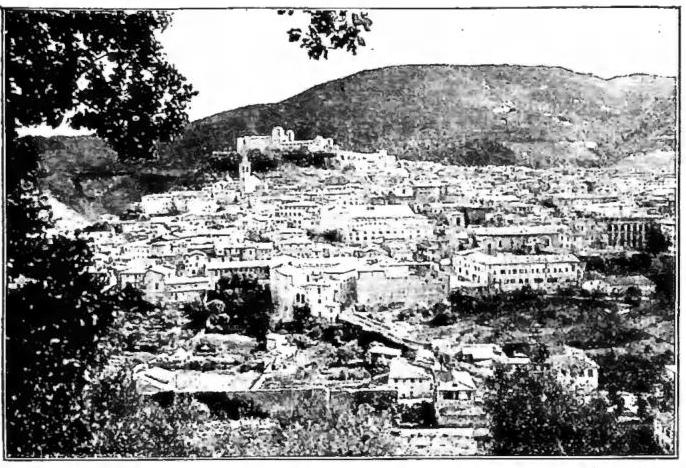
SPOLETO, ARCIDIOCESI di — View of the city, with the Rocca and the hermitages of Monteluco.