ORDER OF THE MOST HOLY TRINITY - Martin, archbishop of Toledo, with the consent of the Chapter, grants to St. John of Matha the perpetual administration of the hospital of the Blessed Virgin Mary in the parish of the French (February 1206). Madrid, National Historical Archive.
fratrum ord. Can. Reg. S. Crucis, Rome 1926; R. Haas, Die Kreuzherren in den Rheinlanden, Cologne 1932; H. Van Rooyen, Theodorus van Celles, Rotterdam 1935; H. F. Chettle, The Priors of the Holy Cross in England, in History, 47 (1949), p. 122.
Pietro Rutten
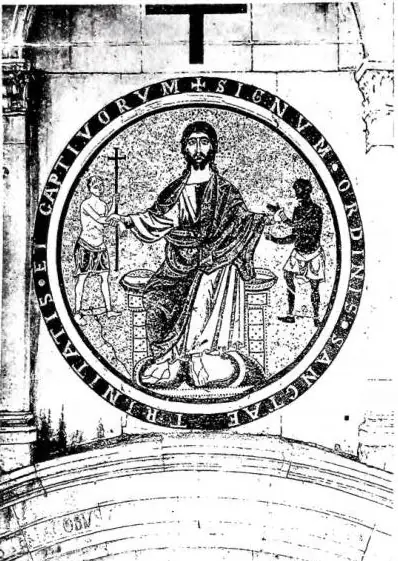
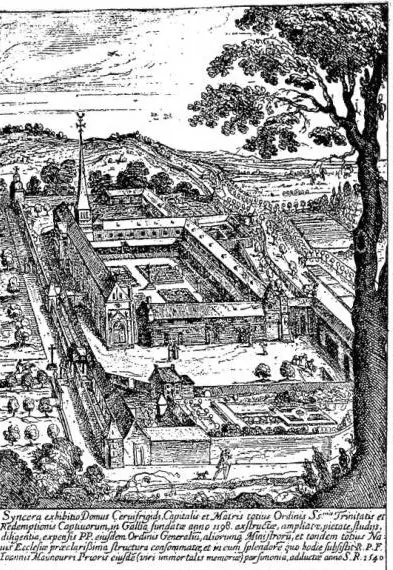
ORDER OF THE MOST HOLY TRINITY (Ordo S.mae Trinitatis redemptionis captivorum). - Founded by Sts. John of Matha (v.) and Felix of Valois (v.), it was approved by Innocent III with a bull of 17 December 1198, and is the first regular Order to arise in the Church with its own Rule distinct from that of St. Augustine.
Its purpose was the ransom of Christian slaves, imprisoned by the Saracens and exposed to the danger of losing the faith. To this end, the Order was obliged to divide its goods or revenues of whatever origin into three parts: two served for the support of the community and for the exercise of the common works of mercy, and the third was to be destined exclusively to the ransom of the aforesaid slaves. In the conventual Chapter, which was to assemble every week, the superior and the subjects gave an account of the observance of this prescription. When the occasion arose, infidel slaves were also ransomed, but with a view to exchanging them for Christian slaves. The habit of the religious was of white wool with a red and blue cross on the scapular and on the mantle. The priests wore the wide tonsure; the lay brothers let their beards grow. The Rule prescribed the common recitation of the Divine Office, special suffrages for the dead every week; numerous abstinences and fasts, great silence, and in general a notably austere regimen of life in food, clothing and bed. It also contained special norms and recommendations for the charitable and cordial assistance of the sick and of guests. The superiors were called Ministers, and were elected by common vote; if the case required it, they could be deposed by a college of superiors designated for this purpose. Each convent could receive and educate novices: a reminiscence of monastic usage. It was forbidden to demand any compensation for their admission into the Order; one could, however, accept what the postulant had given spontaneously.
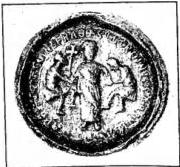
Since the new Order responded to a grave social need of the time, it received approval and support from popes, bishops, kings, princes and the faithful. Proof of this general favor were the many privileges and graces that the Holy See granted not only to the Order, but also to the Confraternities of the Most Holy Trinity established by it everywhere for the purpose of facilitating the collection of alms for the ransom of slaves. The Order spread rapidly in Europe and in Asia Minor, so much so that by 1240 it already counted more than 600 houses with about 5000 religious, a number that went on increasing in the following centuries. As a result, however, of the schisms that afflicted the Church in the 16th century and of the various suppressions of religious Orders in the 18th and 19th centuries, it was reduced to very small proportions. It began to recover at the end of the last century, and now it counts an apostolic prefecture in Madagascar and a little more than 50 houses scattered in Europe and in the Americas. There belong to the Order, besides the two holy founders, St. Michael of the Saints, the bl. G. B. della Concezione, the bl. Marco Criado, the bl. Simon de Roxas and others. The secular Third Order of the Most Holy Trinity numbers among its other illustrious members the bl. Anna Maria Taigi (d. 1837) and the ven. Elisabetta Canori (d. 1825). To the O. of the H. T. there are linked by their origin and by their spirit, although they do not juridically depend on it, certain female institutes of Trinitarian sisters, one of enclosure and the others of a hospitaller or teaching character.
The first Order has had various branches: that of the Reformed (1578) in France, which then in 1769 merged with the primitive branch, under the denomination of Regular Canons of the Most Holy Trinity, and with it became completely extinct in 1894; that of the Reformed Discalced, which had its origin in Spain in 1599, through the work of the bl. John Baptist of the Conception, and which survives today.
Once the initial purpose of the Order ceased through the evolution of the times, which for five centuries had written pages of glory in the field of Christian charity, today its members devote themselves to the various forms of priestly apostolate, both at home and in the missions; and in particular to the propagation of the cult and devotion toward the Mystery of the Most Holy Trinity, by means of the Third Order, of the Confraternity of the same name, of «Perpetual Adoration» and of publications of various kinds. - See plate XII.