
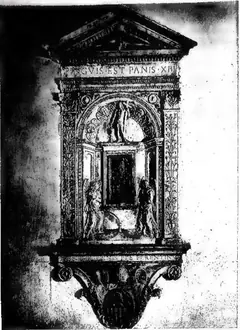
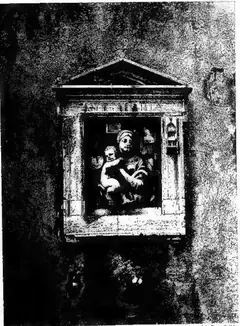
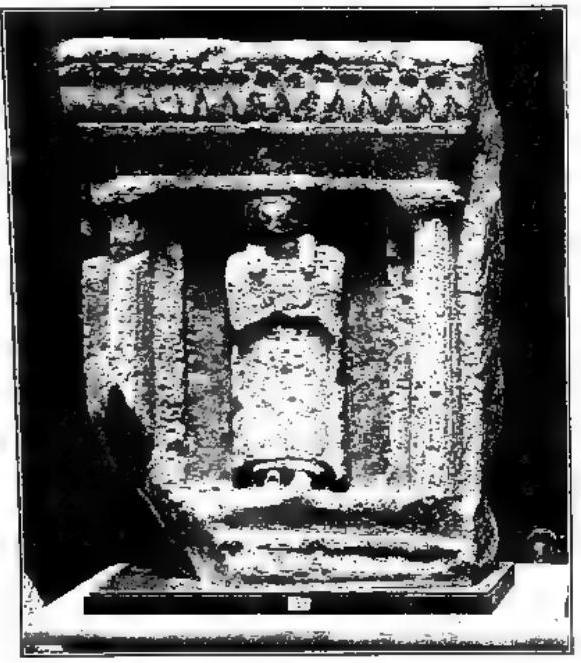
NICHE. - The word, derived from the Latin "aedicula," a diminutive of "aedes" = temple, properly means a small temple, a small chapel, mostly only as a niche in the walls of temples and houses or in the corners of buildings. As an architectural term it therefore indicates an organism in which the characteristics of the facade of a temple are present, that is, a pediment supported by columns or pilasters. A kind of aedicula is the tabernacle, whether it encloses an image or, in the form of a small temple placed on the altar, preserves the Blessed Sacrament.
More generally, any architectural composition that frames objects of particular religious significance, such as images and relics, is called an aedicula. The architectural organism can also be reduced to a simple frame: this broader meaning of the word aedicula is the one in which it is most generally used today in sacred art.
I. LITURGY AND CANON LAW
Anyone may build a sacred aedicula in his own home or outside it, on his own property, as an act of devotion or piety, without contravening any special norms of canon law, apart from the prohibition concerning the display of images (v.) not admitted to worship.
Under civil law, the building regulations must of course be observed (Italian Civil Code, arts. 871-72).
There is no special blessing for aediculae in the Roman Ritual, nor can the blessing proper to private oratories (v.) be applied to them, since aediculae are not such in themselves; only the blessing of images, which, if solemn, is reserved to the Ordinary, and if private, may be given by any priest (Rit. Rom., tit. VIII, chap. 25), or else the blessing "omnis rei seu ad omnis" (ibid., Appendix, no. 70).
An aedicula may present a particular aspect with regard to the effects of canon and liturgical law if an altar (v.) is attached to it. An altar so attached must be considered, for the purposes of the celebration of Holy Mass, as a portable altar, whether it is covered by the aedicula or stands "sub dio": the licence of the local Ordinary is therefore required (in the former case it may also be granted for his subjects by the Superior of an exempt clerical Congregation); with the usual conditions, namely: there must be a just and reasonable motive, the case must be extraordinary, the permission must be granted "per modum actus"; and the altar stone must be present (can. 822 § 4).
The place, in the case of an aedicula, is presumed to be decent, and, on equal terms, is to be preferred to any other for the celebration of Mass "sub dio". A legitimate custom, if one exists, can legitimize the celebration of the sacrifice of Holy Mass at an altar before the aedicula, even outside the aforementioned conditions; but often what is involved is not legitimate customs but abuses.
With regard to the custody of aediculae, the norms governing the custody of domestic oratories may be applied by a certain analogy: both as regards decency and as regards reservation for worship to the exclusion of other profane uses (can. 1196). In some places, such as Rome, the custody of aediculae is entrusted to pious associations, which attend to their maintenance, veneration and aesthetic aspect.
Pietro Palazzini
In canon law, the name aedicula is also given to funerary aediculae erected in cemeteries by families or private individuals for their own burial: but these are considered in canon law as private oratories (can. 1190; v. ORATORIO); in them (unlike other private oratories) the Ordinary may permit the celebration, even habitual, of several Masses (can. 1194), on condition, however, that the bodies are not located below the altar, but to the side and at a distance (measured horizontally from the projection surface of the altar) of not less than one metre (otherwise the celebration of Mass is forbidden: can. 1202 § 2).
In the event that a funerary aedicula is placed under interdict (v.), the cemetery does not thereby remain under interdict; whereas if the cemetery is placed under interdict, all the funerary aediculae existing in it are affected.
Bibliography
Pio Ciprotti
II. ARTS
In classical art, mention must be made of the aediculae inside the Pantheon, with triangular or curved pediments alternating with the niches, and of those which, as independent structures, rose in great numbers at street crossings and housed the images of the Lares. Aediculae with images of the Lares, either sculpted or painted, were also found in private houses, as can be seen at Pompeii and Ostia. In funerary art, too, aediculae in the form of small niches are quite common, with the sculpted image of the deceased either as a reduced full figure, or as a half-bust, or limited to the head alone.
In the Middle Ages, especially in the period of Romanesque and then Gothic art, aediculae came to be used on the interiors and exteriors of buildings, of which they constitute a distinctive feature. In Rome, on the facade of the church of S. Tommaso in Formis an aedicula frames a Cosmatesque mosaic depicting Jesus between two slaves; on the Romanesque bell tower of S. Croce in Gerusalemme, in the lower zone with single-light windows, a hanging aedicula shelters the patriarchal cross, formerly adorned with Cosmatesque decoration of which only a small part survives, and on the top storey another hanging aedicula can be seen, perhaps added in the 14th century; other aediculae are found on the bell towers of S. Maria Nova and of SS. Giovanni e Paolo; also on the bell tower of S. Maria in Trastevere, on the top storey, there is an aedicula that shelters a mosaic depicting the Madonna with the Child.
In the Renaissance, the Robbiana terracottas may be considered aediculae; in the form of tabernacles enclosing sacred images, they adorned the buildings in the cities of Tuscany. Thus among the aediculae may be counted the tabernacle that encloses the image of the Madonna della Febbre in the sacristy of S. Pietro in the Vatican, the one containing the Annunciation in the Florentine church of S. Croce, and the other, now in the Kaiser Friedrich Museum in Berlin, with the image of the Virgin and Child in painted stucco, all works by Donatello.
Likewise the 15th-century tombs may also be considered aediculae, formed by a relief frame enclosing a recess cut into the wall and containing the sarcophagus. Such are the tomb of Leonardo Bruni, the work of Bernardo Rossellino, and that of Carlo Marsuppini, the work of Desiderio da Settignano, in S. Croce in Florence.
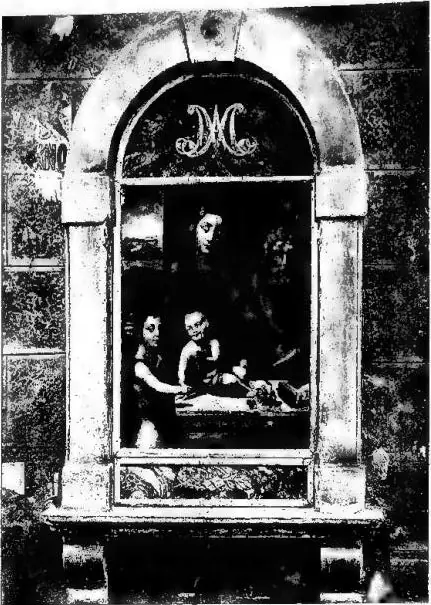
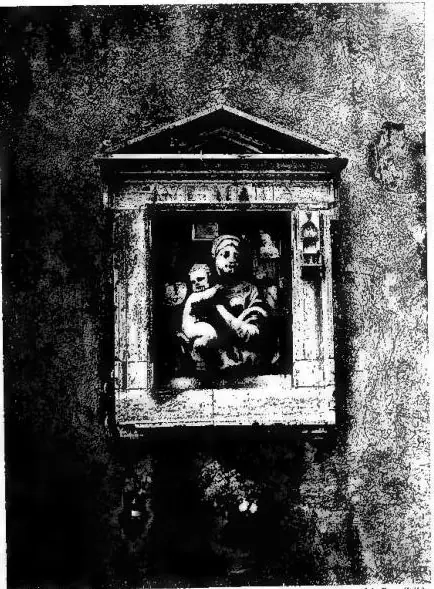
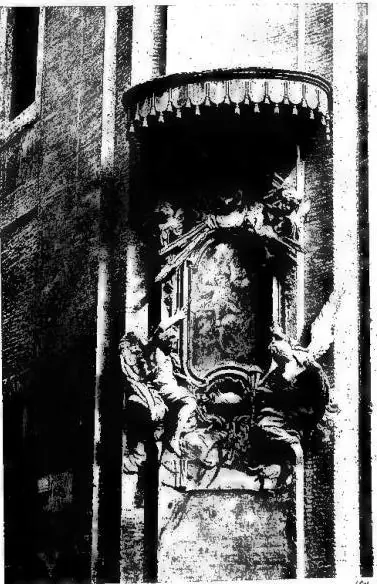
From the Renaissance down to our own day, Rome has seen a flourishing of aediculae on the facades and corners of its houses: mostly modest works, they nonetheless display the religious fervor of the people and enliven the old streets with the Baroque exuberance of their rich stucco frames adorned with angels and putti rather than with the painted images, which are often dimmed and barely visible. Many have disappeared, also as a result of demolitions, but many still remain, especially in the old districts; nor is the custom of placing images of the Virgin in public streets and squares now forgotten, for new aediculae are still being set up in the modern neighborhoods as well.
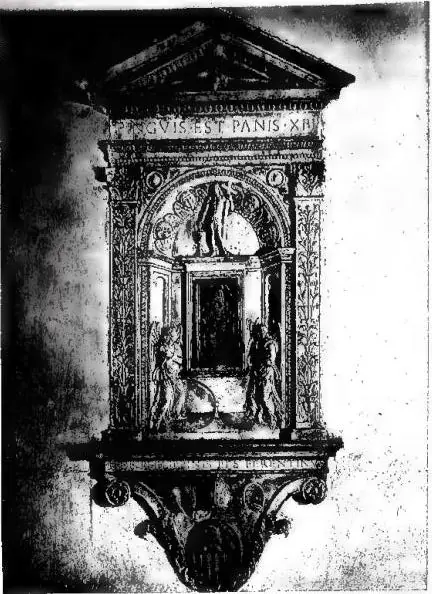
The most artistically notable of these Roman aediculae is the one containing the image of Ponte, designed by Antonio da S. Gallo, which stands on the corner of via dei Coronari with the Vicolo Domizio and encloses a painting, unfortunately damaged, by Perino del Vago, depicting the Coronation of the Virgin.
Among the Baroque aediculae, which are the majority, mention should be made of the one in Via dell'Anima at the rear of the church of S. Agnese, which contains a fragment of a fresco with a Cavallinian image, the other on the corner of Piazza dell'Orologio with Via del Governo Vecchio, those in Via del Pellegrino, in Via Mario de' Fiori, in Via di Tor Sanguigna, in Via del Plebiscito on the facade of the Palazzo Doria. - See plates IV-V.
Bibliography
Vincenzo Golzio