
COSSA (Coscia), Baldassare, Antipope. - From a noble Neapolitan family. Hostile legends circulated about his youth; it is known for certain that he was a familiar of Cardinal Pietro Tomacelli; when the latter was created pope under the name Boniface IX (1389), C. became a cubicularius, and he had no scruple about the means used to make money; and for money he would have succeeded in having himself created cardinal deacon of S. Eustachio on 27 Feb. 1402. He held the government of Bologna as legate, and on 26 June 1409 he was among the electors of Alexander V (v.), of the obedience of Pisa.
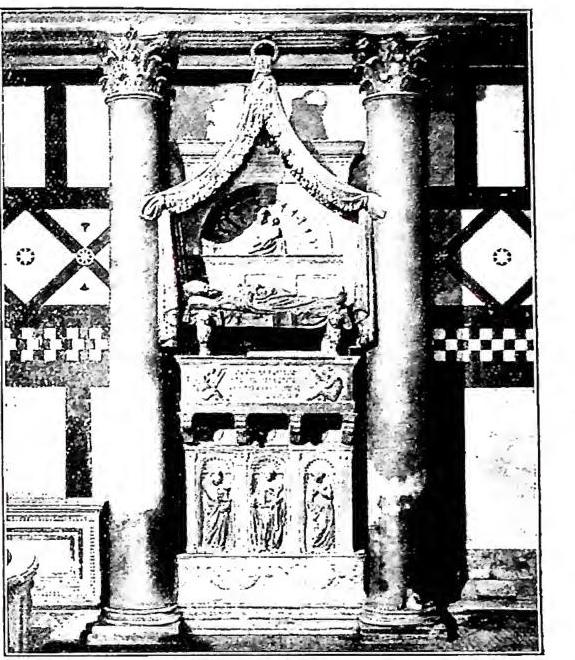
He took pains to lead the elect to Bologna, where the latter died; and on 17 May 1410 in that city C. was elected to succeed him under the name John XXIII. Having succeeded in making peace with Ladislaus, king of Naples, he was able during 1413 to assemble a council at Rome, as had been established at Pisa in 1410, and there he condemned the books of Wycliffe. But, forced to leave the city, he took refuge in northern Italy, and at the urging of Sigismund, king of Germany, he convoked on 3 Oct. the Council of Constance for 1 Nov. 1414. He was in fact there on the appointed day, hoping to gain the upper hand over his two adversaries: Gregory XII, the legitimate pope, and Benedict XIII, the pope of Avignon. Having realized that evil reports were circulating against him at Constance, taking advantage of a solemn tournament he secretly left the city on 20 March 1415 with the covert favor of Frederick, duke of Tirol. He hoped that the Council would be dissolved; but King Sigismund, who was present, succeeded in having it continue in order to provide for the ending of the schism and the reform of the Church. The Council in fact sanctioned its own authority and in May cited John to appear. He, who from Scifusa, where he had taken refuge, had gone on to Laufenburg, then to Fribourg and to Breisach, abandoned by the duke of Tirol, submitted, was imprisoned at Radolfzell; and on 29 May he was deposed, after a brief trial, «as a simoniac, a squanderer of ecclesiastical goods, an unfaithful administrator of the Church both in spiritual and in temporal matters». In that same council which he had assembled, John ratified this sentence without making any opposition. He remained a prisoner under strict guard and the surveillance of Louis of Bavaria in the castle of Hausen. He then recognized Martin V as true pope in 1418; the latter in turn named him cardinal bishop of Tusculum (1419). C. died at Florence on 22 Nov. 1419 and was buried in the baptistery of the city, where a sepulchral monument was erected to him by order of Cosimo de' Medici by Michelozzo and by Donatello.
Bibliography3 works
Pio Paschini