
POTENZA E MARSICO NUOVO, Diocese of. - P. is the capital of Basilicata: the Cathedral is under the invocation of St. Gerard, a suffragan of Acerenza and Matera.
It has a population of 87,050 inhabitants, almost all Catholics, distributed in 25 parishes, served by 67 diocesan priests and 24 regular clergy; it has a seminary, 6 male religious communities and 22 female ones (Ann. Pont., 1952, p. 327).
I. HISTORY
In the laterculus of the Hieronymian Martyrology for 27 Aug. four martyrs are mentioned: Felix, Arontius, Sabinianus and Honoratus, whose relics, according to a late legend (BHL, cols. 2297-2302), would have been transferred in the 8th century by Duke Arechis II to Benevento. The same legend, however, considers them African martyrs and not martyrs of Potenza; nor are there arguments to refute it.
Another tradition (Acta SS. Augusti, V, Paris 1868, p. 813) celebrates the martyrdom of a Carthaginian bishop named Januarius, who would have been beheaded together with his deacons Felix and Honoratus in a locality not well specified near P., on 26 Aug. Their relics - again according to the account - were found after a long time by the bishop of Marsico, Grimaldus, on the indication of a pious woman named Susanna, and placed in the little church of the religious of St. Stephen, where they were afterwards rediscovered. It was easy for Lanzoni (I, p. 326) to demolish this fantastic castle of notices drawn from several places and bound into a single plot. Much more simply, these are two martyrs cited in the Hieronymian Martyrology through a coincidence of names; nor do they lend any credence to that Januarius, confused with the famous saint of the Neapolitan church, or to that Grimaldus bishop of Marsico, recorded by Ughelli solely on the testimony of this copyist. Again in the Hieronymian Martyrology, on three different days, namely 19, 20 and 21 Aug., two names appear repeatedly: Valentinus (Valerianus, Valentinianus) and Leontius, confirmed also by the Beneventan Martyrology for 20 Aug. (cod. Vat., 5949) and by some martyrologies derived from Usuard for the 21st of the same month (Acta SS. Iunii, VI, Paris 1867, pp. 436-38; Acta SS. Augusti, IV, ibid. 1867, pp. 396-97). Their Passio (ibid., 544; Auct. seu notae ad Acta SS., 423) places the martyrdom under the diarchy of Diocletian and Maximian, and in the comune of Tito, in the province of Potenza, their feast is celebrated on 23 Aug. It therefore seems that at least these two martyrs are local and historically certain. Of Leontius, moreover, there would also exist the account of the theft of his relics, from Basilicata to Vicenza and from there to Germany, if one wishes to consider the Leontius of Sigebert of Gembloux in the Vita Deoderici episcopi Mettensis (MGH, Scriptores, VI, p. 351; IV, p. 476) as Lucanian.
The Church of Potenza therefore had its martyrs very early, together with the new religion. And the inscriptions found at P. (CIL, X, 1, 178-79), even though they date to the 6th century, testify to the existence of a religious community whose origins it is not possible to ascertain. Nevertheless, if the historical sources give the first bishop at the end of the 5th century, one must suppose that P. already during the same century, or even earlier, deserved to be elevated to an episcopal see. The first prelate known from the Regesta is an Herculentius (492-96; Jaffé-Wattenbach, 680), to whom in another letter (ibid., 653) is entrusted the task of intervening, together with two colleagues, Stephen and Justus, against the unlawful consecration of two slaves performed by Sabinus, bishop of Consilium. The successor Amandus (502) leaves one perplexed, because no indication helps to resolve the problem of whether to assign him to Potenza in Lucania or to the homonymous diocese of Picenum. To find the successor one must therefore reach Peter (552-60), to whom Pope Pelagius I gives instructions for the diocese of Marcellianum (Jaffé-Wattenbach, 1017). And from this locality one can deduce with certainty that he was Lucanian and not from Picenum. For about three centuries no one further is known, until one finds Balas, who took part in the Roman Council held in 826 by Eugenius II. After him, complete silence. A bishop, whose name is unknown, is recorded in 1080 in connection with the church of St. John the Baptist, completed by the spouses Robert and Palma; then Gerard in 1099, whose homonymous successor, from Piacenza, is the patron saint of the city and of the Cathedral (1111-1119), canonized by Callistus II. Manfred, elected bishop upon his death, left the biography of St. Gerard. After this prelate, the catalogue of the Church of Potenza becomes almost complete: accordingly, the most illustrious of those who succeeded to the see from the 13th century will be cited. Oberto (1250-56) gave vigorous impetus to the reconstruction of the now decadent city; William or Walter built at Diano in 1274 the church of St. Mary Major, elevated by Pius IX to cathedral in 1850; Fra' Guglielmo di Torri (1343) was recommended by the archbishop of Acerenza and imposed by Clement VI on the Chapter, which saw its appointment annulled; Angelo (1419), of Naples, beloved counsellor of Queen Joanna II; and Gaspare Cardoso, a Spanish Benedictine, who in 1606 celebrated the Synod and is remembered for his work in favor of the clergy. In 1818 Pius VII united to the see of Potenza that of Marsico Nuovo, declaring it a co-cathedral.
II. MONUMENTS
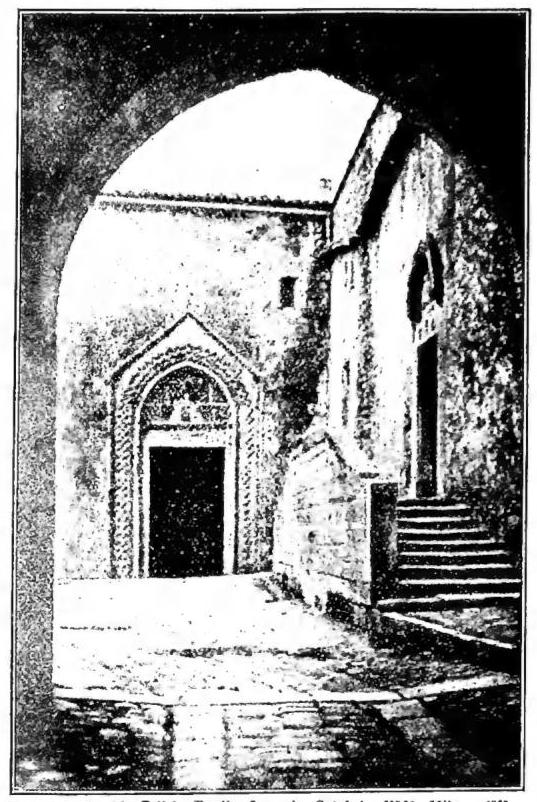
P. is short on monuments, perhaps because, having suddenly become the epicenter of the struggle between the Swabians and the Angevins, and taking the side of the unfortunate Conradin, it found itself alone facing the three of King Charles and succumbed to the violence of the vassals who razed it to the ground. And this happened when it was barely finding itself again, after the violent earthquake of 1273. The Cathedral has lost everything of its Gothic origins; the eighteenth-century remaking by Antonio Magni, a pupil of Vanvitelli, gave the church a Baroque guise which, although not without heaviness, especially because of the tall dome that weighs upon the single nave, shows a sober nobility of lines, in which a certain classical taste survives. The church of S. Francesco (late 13th century) arose on the site of an oratory erected in 1265 by the companions of the Poverello of Assisi, but was rebuilt in Baroque forms, especially in the interior, and in the last century lost in an earthquake the colonnettes of the mullioned windows of the bell tower. Nevertheless the three superb carved wooden doors remain, of which the most valuable is that of the facade (14th century) adorned with geometric inlays, symbols, putti, griffins and figures of friars. In the interior, noteworthy is the fine Renaissance tomb of the patrician Donato Grasi with the fine sarcophagus watched over by the two griffins, the recumbent statue of the deceased and the Virgin with the Child between two angels in the lunette. The church of S. Michele Arcangelo with three naves (a fourth was added later on the left, altering its line) preserves on the exterior its original thirteenth-century form. Its attribution to master Sarolo of Muro Lucano is a probable hypothesis, but is not supported by any proof. The interior is of little interest.
Bibliography12 works
Pasquale Testini