
ANCONA AND NUMANA, Archdiocese of. - The most important city of the Marches, on a bend of the Adriatic coast formed by Mount Conero, A. has about 95,000 inhabitants. It is the capital of the most populous province of the Marches (1,938 sq. km. and 380,000 inhabitants) and the seat of the archdiocese, bounded to the north and east by the sea, to the south-east by the dioceses of Osimo and Cingoli, to the west by those of Iesi and Senigallia. It has 44 parishes, 80 diocesan priests and 40 regulars, 118,000 Catholic inhabitants. The considerable harvest of Christian memories and especially their antiquity lead one to believe that the Church of A. was the first to arise in the entire Picene region. The first historically certain bishop is St. Marcellinus (5th-6th century), since there is no similar historical testimony in favor of two martyrs venerated there and held to be proto-bishops: St. Cyriacus, primary patron of the city, and St. Primianus. An illustrious bishop of Ancona was Leopard, legate of Pope Adrian II to the Bulgarians (Liber Pontificalis, ed. L. Duchesne, II, p. 185). Martin V united the ancient Church of N. (Humana), decadent and in ruins, to that of A. (19 Oct. 1422), and Benedict XIV granted the fusion under the title of both Churches. In 1907 Pius X elevated A. to an archdiocese without suffragans. The territory was part of the patrimony of the Roman Church (Liber Pontificalis, ed. L. Duchesne, I, p. 428); later, in the Constitutiones Marchiae Anconitanae of 1357, A. appears before the Civitates maiores et magis nobiles. It knew the government of various lordships and, at intervals, autonomous government, until in the 16th century it was again subjected and definitively annexed to the Papal State.
Abbeys. - Two abbeys, whose buildings partly remain, have historical value: S. Maria di Portonovo at the foot of Mount Conero, founded by Pietro Anconetano (1038), and the Camaldolese abbey of S. Pietro on the summit of the mount, in the diocese of N.
Monuments. - The oldest and most conspicuous monument of Christian A., the basilica of the protomartyr St. Stephen, mentioned by St. Augustine (Sermo 323: PL 38, 1145-46), has completely disappeared. A very interesting Christian hypogeum came to light in 1879: the cubiculum of Fl.
(phot. Anderson)
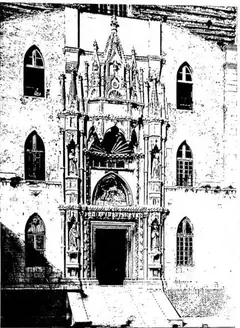
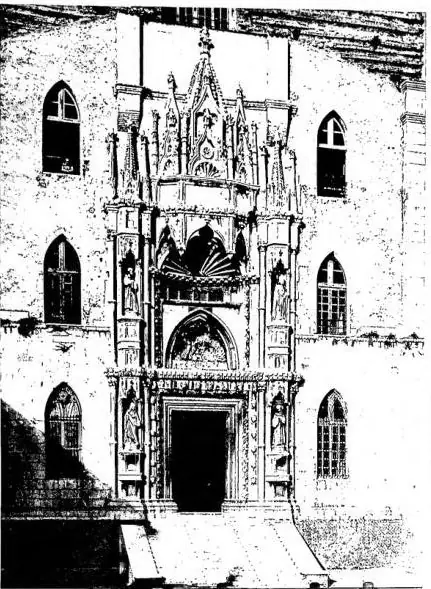
ANCONA and NUMANA - Detail of the loggia dei Mercanti by Giorgio Orsini (1451-59), in A.
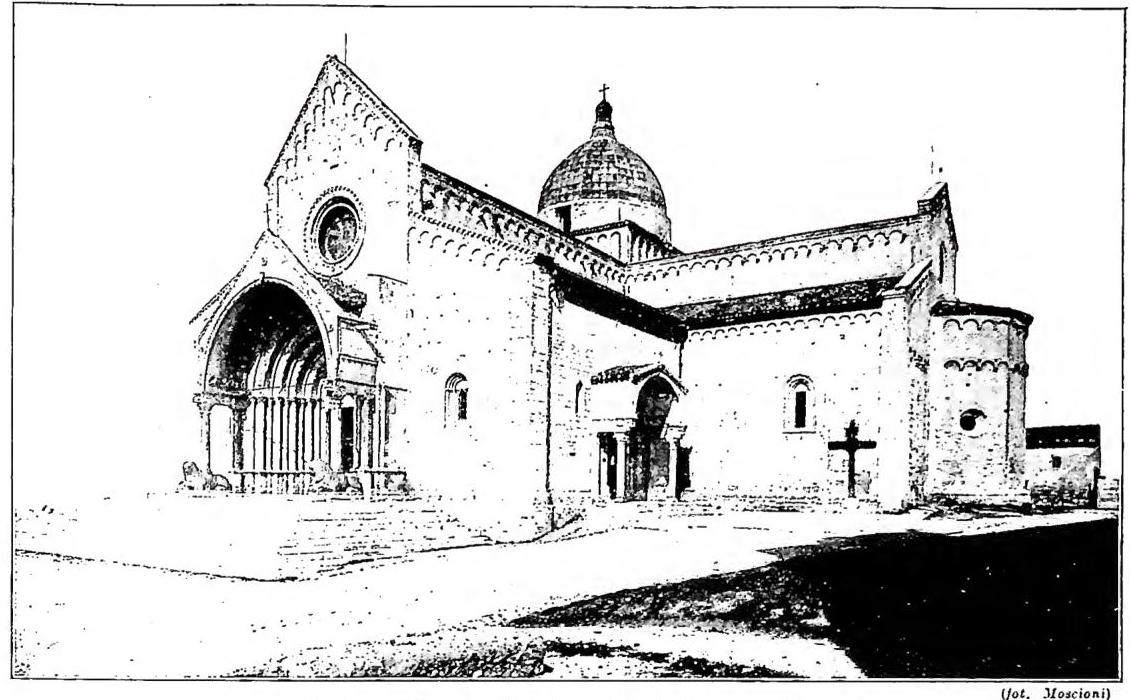
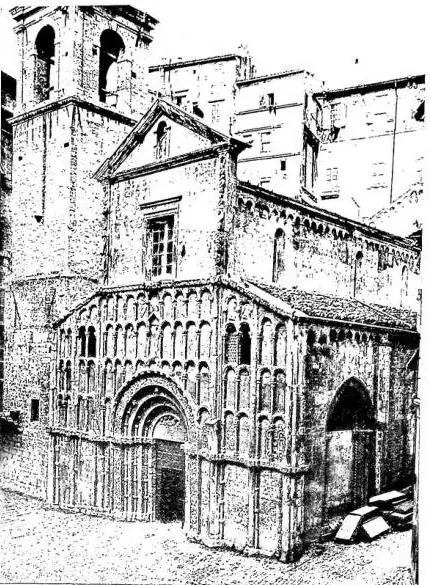
Evenzius (Bull. di Arch. Crist., 3rd series, 4 [1879], pp. 128-32). Notable remains of two early Christian churches, one from the 4th-5th century and the other from the 5th-6th century, with mosaic floors and panels bearing funerary inscriptions, are still preserved beneath the Romanesque church of S. Maria della Piazza. The most important sacred monument of the city is the cathedral of S. Ciriaco (12th century), in the form of a Greek cross, with a dome, an artistic portico and various Byzantine-Romanesque-Gothic elements. In the crypt, along with other Christian memorials, are the sarcophagus of Fl. Gorgonius and that of the martyr St. Dasius.
Archives. - The episcopal archive has been dispersed. The chapter archive preserves, among other things, a precious evangeliary (7th-8th centuries) known as that of St. Marcellinus.
Bibliography6 works
Serafino Prete
ANCONA AND NUMANA IN CONTEMPORARY HISTORY
The city of A., important for so many reasons, was, besides everything else, also the first and most active port of the Papal State, and as such was fortified by it and by others who successively occupied it with well-conceived fortifications. Ceded by the Holy See to Napoleon by virtue of the armistice of Bologna (26 June 1796) and the treaty of Tolentino (16 Feb. 1797), which followed the not entirely inglorious engagement of the Senio, it became part of the Roman Republic until, after a long siege by the Russians, Turks, Austrians and insurgents, it was on 5 July 1800 restored to Pius VII, who had landed there on the preceding 21 June. After Marengo the French returned (27 Jan. 1801), and then in July, by the concordat, the Pontiff.
Reoccupied by Napoleon in 1805, it was three years later annexed to the Kingdom of Italy, because of the Pope's refusal to adhere to the continental blockade. Between 1813 and 1815 Neapolitans, French and Austrians disputed A. with varying and alternating fortunes, until Pius VII regained it once and for all on 25 July of that year. The risings of 1831 died out in the Papal State with the entry into A. of the Austrians, who, in agreement with the government, held as null the capitulation extorted from Card. Giovanni Antonio Benvenuti by the insurgents. In 1832, to counterbalance the Austrian intervention in Romagna and at Bologna, a French corps landed by surprise at A., which soon found itself in serious difficulties because of renewed tumults by active innovators and because of pressing remonstrances from the Holy See. Gregory XVI meanwhile, having excommunicated the revolutionaries, went so far as to send there on 1 Aug., as apostolic delegate, Msgr. Gaspare Grassellini, who with prudent measures restored order and was able to put the military works of the stronghold back into efficiency.
Because of the events that followed the reforms of Pius IX and his departure for Gaeta, A. was the scene of such and so unheard-of violence as to induce the government of the Roman Republic to send there Felice Orsini to remedy it with some effectiveness. Livio Zambeccari then disputed the city with the Austrians, who besieged it by sea and land between 28 May and 18 June 1849, with the aim of restoring it to the Pontiff, and who afterwards kept a garrison there for a decade, notably improving its fortifications and striving, in union with the governmental authorities, to thwart the plots promoted there, among other things, by the Società Nazionale. Pius IX stayed there to great acclaim during his triumphal journey through the provinces (22-25 May 1857), decreeing considerable public works, such as a new circuit of city walls and further impetus to the completion of a conspicuous arsenal, besides not negligible provisions relating to the development of the free port.
Then, after the Austrians left A. on 12 June 1859 following the progress of the Franco-Sardinians in Lombardy, the pontifical government was able to maintain itself there, thanks to the composure of the apostolic delegate Msgr. Lorenzo Randi, the intuition of General Allegrini, the firmness of Major Zappi and the repressive action promoted with a good body of troops by General Schmidt, who occupied Perugia (20 June), and by General De Kalbermatten, who marched from Pesaro with several thousand men toward Fano and Senigallia and reached there on the 25th of the same month. At A., finally, General Alfonso De Lamoricière landed on 25 March 1860, called by Pius IX to reorganize the pontifical army, and he stayed there a long time during the fervent and busy months that followed, also with the intent of putting it, as far as he could, in a state of being able to resist effectively. So that, after the battle of Castelfidardo (18 Sept. 1860), followed by a few brave men, Lamoricière managed, not without skill, to shut himself up there and to hold out tenaciously, coming to terms, after an honorable defense, marked by valorous actions on both sides, only when, besides everything else, on 29 Sept. the powder magazine blew up. Thus A. was definitively united to the new kingdom. - See Plates XCVIII-XCIX.
Bibliography6 works
Paolo Dalla Torre