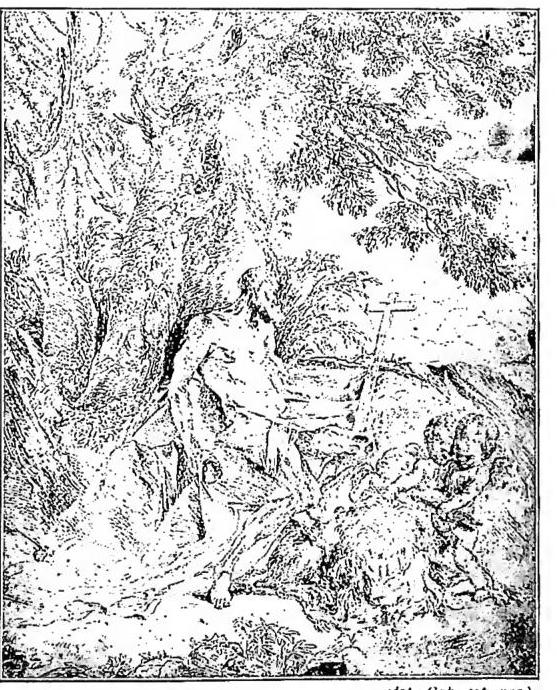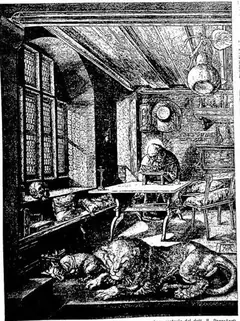
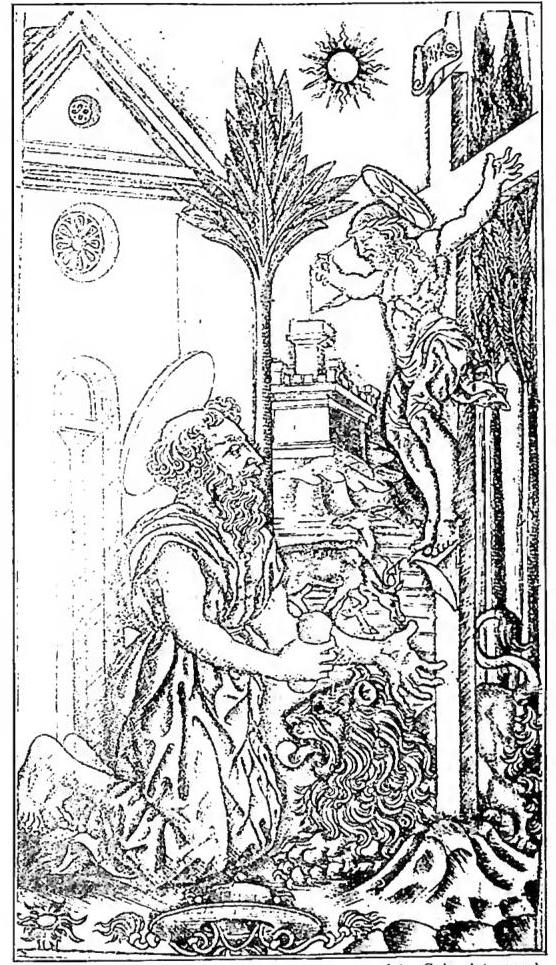
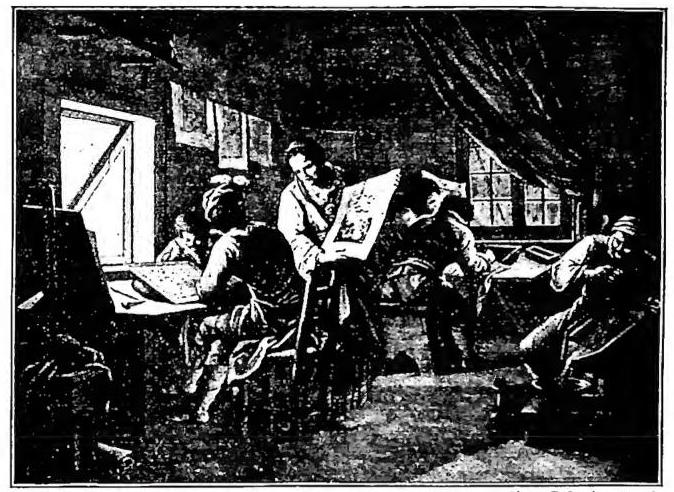
ENGRAVING. - It is properly the art of incising figures, ornaments, etc., on any surface. It can therefore be an end in itself, as in glyptics, inlay, and niello work, and in this sense it is very ancient (one need only think of the rock engravings of cave dwellers), but it can also serve to produce a matrix from which copies of the engraved images are taken; and already in times past matrices were engraved to print leather or cloth, as well as punches for striking coins. But today, when one speaks of engraving, one generally means to allude to the process that allows signs engraved on a matrix to be reproduced on paper by means of printing. In relatively recent times the process has also been exploited mechanically (v. FOTOMECCANICHE, ARTI). Here, however, we shall deal with the various kinds of engraving produced directly by the hand of the artist.
The fundamental techniques are two: engraving on wood and engraving on metal; to these one may add lithography (v.), invented at the end of the 18th century. Engraving on wood is called xylography, and its characteristic is that the design obtained in relief on the matrix, when printed on paper, shows the incised line, unlike engraving on metal (generally on copper, and therefore also called chalcography) which, being intaglio, will instead give printed copies with the line in relief, since in the press the paper is strongly compressed into the grooves of the plate (v. ACQUAPORTE). For the engraving of a composition on metal, moreover, different processes may be used. If acids are not used to incise the plate, one has engraving with the burin, drypoint, the black manner or mezzotint; if instead one makes use of acids, one has etching, aquatint, the dotted manner, and soft-ground etching.
Burin engraving is that obtained by incising the plate by means of the tool called precisely the burin (v.). Ink is made to penetrate into the grooves of the engraving, while care is taken to clean the rest of the plate. Once the plate is covered with a sheet of suitable damp paper, and this in turn with a felt, it is passed through the copperplate press, formed of two cylinders rather like an ordinary rolling mill: when the operation is complete, the ink collected in the incised lines will be printed onto the paper, while the paper will remain white in the points untouched by the engraving. Drypoint (v.) may also be connected to this type of engraving, obtained by working the metal with a point instead of the burin. In the black manner or mezzotint, on the other hand, the whole plate is prepared beforehand, graining it so that, when printed, it would give a uniformly black surface; the work of engraving, therefore, will consist in removing the graining by means of suitable scrapers, wherever lights are to appear. Indeed the plate engraved by this process was used especially in the past for reproductions of paintings with a dark background, for which it is excellently suited, even though it has the drawback of not allowing very large print runs.
From etching (v.) derive aquatint (v.) and soft-ground etching, so called because the normal etching ground is made softer by the addition of tallow, so that after biting one obtains a line characteristic of that of a grease pencil. All these processes can also be used together in engraving a single plate, and thus one has, for example, plates in etching or burin reworked in drypoint or stipple. The latter process is that of the so-called dotted manner, in which designs are executed with dots instead of lines. Besides black and white, engraving can also be in color, and in that case four matrices are generally used, one for black and one for each of the fundamental colors.
HISTORY OF XYLOGRAPHY
Xylography preceded printing on metal: playing cards, printed fabrics, and above all religious images are found in abundance already in the fourteenth century. Indeed, it is precisely these last that are the first woodcuts of any real importance, even if very little of them now remains, printed on broadsheets and destined, as objects of worship, to rapid wear. Of these figures with simple outlines, often colored by hand, without hatching and without chiaroscuro, we recall here the Journey to Calvary (ca. 1400, Albertina in Vienna) and the Madonna and Four Saints (1418, Cabinet of Brussels). Among Italian woodcuts, also very rare, and generally produced by Florentine or Venetian artists, one of the first xylographic books must be mentioned, illustrating the Passion (Print Cabinet of Berlin), in which both the text and the vignettes are printed using one woodblock for each page. This primitive printing system was widespread especially in Germany, and it does not seem rash to think that the invention of movable type found precisely in this book production its occasion and its origin. After the invention of printing, xylography was its greatest aid for the decoration and illustration of volumes: we recall the famous De re militari of F. Valturio (Verona 1472), for whose illustrations the name of Matteo dei Pasti has been put forward; the Aesop of Verona (1479) and that of Naples (1485). Also important are the Florentine publications, adorned with woodcuts reflecting the style of the best local artists, and those of Venice, very numerous, of which at least the Hypnerotomachia Poliphili (1499) by the Dominican Francesco Colonna must be remembered, whose illustrations have also led to attribution to Giambellino and Mantegna. At the beginning of the 16th century there appear the first polychrome woodcuts; they were used in Germany, among others, by L. Cranach, and in Italy by Ugo da Carpi (v.) who was also for some time considered the inventor of the new process. Followers of Ugo da Carpi were A. Fantuzzi, G. Nicolò
and A. Andreani. Among the other engravers active in this period we recall the Venetians Domenico delle Greche, N. Boldrini and G. Scolari, who worked especially on Titianesque designs. In the 17th century the woodcuts of the Coriolano family, after Tiarini and after Guido Reni, are notable. In the 18th century the decline of this art begins, which was to revive only at the end of the 19th century and in the early 20th, especially through the work of the group that arose around the journal Leonardo, of which A. Spadini and A. De Carolis were members, among others. The ranks of xylographers derived from De Carolis are numerous, and the work of many contemporary artists is also notable.
HISTORY OF CHALCOGRAPHY
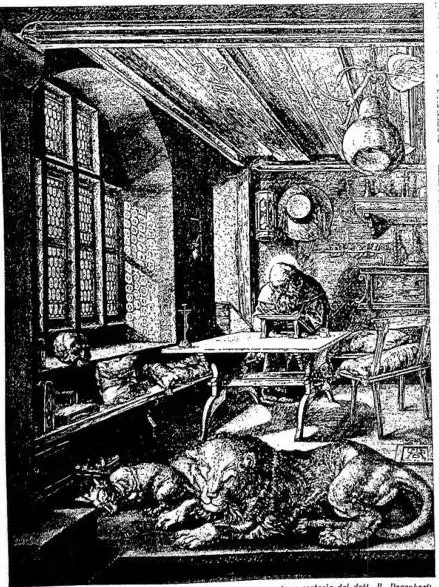
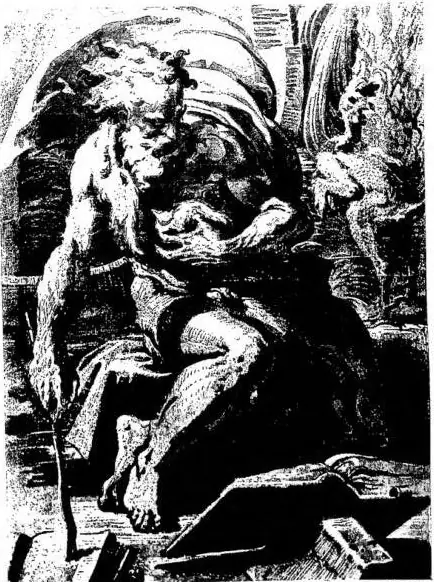
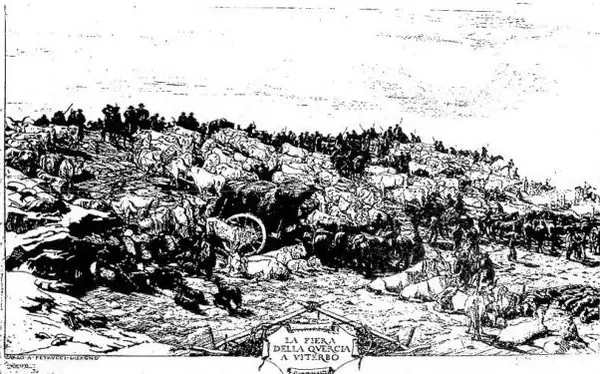
Once Vasari's thesis, which sought to trace the origin of engraving back to Maso Finiguerra and the impressions of his nielli, had been disproved (German prints predating 1460 by some years have in fact been found), the problem of the origins of engraving has not yet been completely resolved. In Vasari's account, however, one might find an indication that the workshops of the Florentine goldsmiths were among the first cradles of this new technique of illustration. The impressions of nielli are extremely rare today, and among the most precious the surviving proofs by A. Pollaiolo are remembered. Even in this field, as in that of woodcut, the earliest engravings clearly show the influences of the most famous artists of the Quattrocento: notable are those of the Master of the Great Passion, influenced by Andrea del Castagno (cf. the Penitent Jerome in the Uffizi). By A. Pollaiolo the print with the Battle of the Ten Nudes is famous, and worthy of remembrance is the great Assumption of the Virgin of Botticellian inspiration, which was, indeed, for a long time held to be by Botticelli himself. Among the interpreters of Botticelli's drawings the name of Baccio Baldini has been handed down, to whom are attributed the illustrations of the volume Il Monte Santo di Dio (Florence 1487) and those of the Divina Commedia (ibid. 1481). Among the other engravers, mention is made of C. Robetta, who engraved from drawings by Filippino, by Pollaiolo, by Ghirlandaio, with influences also from Dürer's compositions. In northern Italy many of the best-known artists, foremost among them A. Mantegna, devoted themselves to engraving: among these Nicoletto da Modena, Benedetto Montagna, Jacopo de' Barbari, Gerolamo Mocetto and Giulio Campagnola, who he produced prints of remarkable softness, employing a system of stipple engraving. Among the Lombards, Bramante made a name for himself, but in recent times a true and proper activity as an engraver on his part has been called into question. In Bologna, where F. Francia engraved nielli, M. A. Raimondi is especially notable, a personal interpreter of works by the greatest masters: at first influenced by F. Francia, whose pupil he was, he too succumbed to the influence of German prints (especially during his Venetian stay of 1506), while visible in his works are then the passages through Florence (1508) and his residence in Rome, where he came into close contact with Raphael and where he felt the spell of ancient art. Among Marc'Antonio's disciples are remembered Marco Dante da Ravenna and the Venetian Agostino de' Musis, the so-called "master B in the die." After drawings by the Mannerists Rosso Fiorentino and Perin del Vaga, as well as by Raphael, Titian and Michelangelo, G. J. Caraglio and the Parmesan Enea Vico engraved. In the orbit of Giulio Romano worked the Mantuan G. B. Scultore with his sons Adamo and Diana, while another Mantuan, Giorgio Ghisi, devoted himself to reproducing mainly Michelangelo's work in the Sistine Chapel. Among the other most famous engravers of the 16th century are remembered Parmigianino, important above all as the precursor of a more rapid and more spontaneous manner of engraving, which would see wide development in the following century; his follower A. Meldolla, called lo Schiavone, who was among the first to use drypoint, and, toward the end of the century, the Carracci. In the 17th century notable are the engravings of O. Borgianni, of Baroccio (the Annunciation, in multiple techniques, is remembered), of the Florentine A. Tempesta, who influenced especially Callot and Stefano della Bella. Among the Emilian painters engraved the Guercino, G. Reni and his best follower S. Cantarini da Pesaro; among the Neapolitans Ribera and S. Rosa; among the Genoese il Grechetto; while of the other schools it will be necessary at least to remember the Veronese G. Carpioni, the Pisan G. B. Vanni, the Lucchese P. Testa. But it is in the 18th century, above all through the work of the Venetians, that Italian engraving was to reach its highest peaks. G. B. Tiepolo (v.) and Piranesi (v.) gave rise to a most flourishing school. Among the most celebrated Venetian engravers are also remembered Carlevaris, Bellotto, Canaletto, Marco Pitteri (who engraved above all after drawings by Piazzetta) and F. Bartolozzi (engravings after M. Ricci and Zuccarelli). Toward the end of the 18th century and the early 19th, engraving was reduced almost exclusively to the reproduction of paintings, and there are cited, among the numerous engravers who devoted themselves to this practical activity, G. Volpato and R. Morghesi. The invention of photomechanical processes was decisive in restoring to engraving its original character of autonomous creation, and in the second half of the 19th century notable, in this sense, is the work of M. Fortuny, of G. Fattori, of T. Signorini, of F. Faruffini, of A. Fontanesi. And great favor is once again being enjoyed by engraving on metal, in its various techniques, in our own days, as the principal activity of very many artists. - See plates CV-CVI.