
PALATINE CHURCHES AND CHAPELS. - These are those which, because they were destined to satisfy the religious needs of the Head of a State and of his household, or merely because of the powers acquired over them by the Head of a State, stand in a relationship of very particular dependence with respect to him.
I. HISTORY
According to the assertions of Eusebius, of Sozomen and of the other writers of the life of Constantine, the origin of that private oratory, intended for the religious service of the sovereign, adjacent to the royal Palace and called sacellum, oratorium, royal or palatine chapel, seems to have to be traced back precisely to this Emperor. Among the best-known palatine churches and chapels in the West, mention is made of St. Vitalis in Ravenna, St. Caesarius on the Palatine, the Cathedral of Aachen, St. Mark's in Venice, the Palatine Chapel of Palermo, the Sainte-Chapelle in Paris, the Hofkirche of Dresden, etc., and, for the papal court, the chapel of St. Lawrence at the Lateran.
From its very rise, although presenting itself, in its fundamental characteristics, as a private oratory, the palatine chapel had characteristics of its own: it was libera et exempta ab omni ecclesiastica iurisdictione; no interdict could be placed upon it, nisi de mandato Sedis Apostolicae speciali; it was officiated by the so-called royal or Palatine Clerics, who did not depend on ecclesiastical authority and were not subject to the jurisdiction of the diocesan ordinary; but, appointed by the sovereign, they constituted a body of their own, governed, in spiritual matters, by the major chaplain and, in temporal matters, by the sovereign himself. Furthermore, while in the private oratory only certain religious practices took place, in that of the sovereign any sacred ceremony and function could be celebrated, without need of any special authorization on the part of the ecclesiastical authorities and, greatest among the privileges, the royal chapel also served as the personal parish of the sovereign, of his family and of the court.
Subsequently, alongside the palatine chapels properly so called, others came to be differentiated with a profoundly different structure. In these cases, as a consequence of successive donations on the part of the prince, the royal chapel ended up having its own patrimony completely detached from that of the sovereign, so that, having abandoned its original character of temporale officium et ministerium, it came to be transformed into an entity standing on its own, with a juridical character not dissimilar, in most cases, from that of the ecclesiastical collegiate church, having its own order and regularly erected in the canonical forms; its clergy, until then considered as salaried by the household of the sovereign, acquired a beneficiary character and, once invested by the sovereign with its prebend, the consequent canonical irremovability.
From this transformation it followed: 1) that the sovereign ceased to be the owner of the chapel and of the ecclesiastical goods, so that his right was limited to that complex of powers that constitute the right of patronage, with the sole substantial difference that, while the patron has only the right to present the candidate to the ecclesiastical authority, the sovereign proceeded by himself to the plena collatio of the benefice; 2) that the parochial character ceased to be a privilege, inasmuch as the palatine church was regularly erected into a parish.
Finally, alongside the aforementioned royal chapels or churches, mention must be made of those churches (palatine improperly so called, or ad honorem) which, having arisen as sacred places open to the worship of all the faithful, with rich donations, with ordinary care of souls and ecclesiastical jurisdiction, were later distinguished by the sovereign with the character of palatinitas, sometimes because they themselves placed themselves under his protection, but more often for political ends, when they became the center of the Ghibelline organization faithful to the prince in opposition to the cathedral, center of the Guelph party, loyal to the pontiff.
II. NATURE AND CHARACTERISTICS OF THE PALATINATE
The characteristics of palatinity correspond to the essentially political purpose of the institution, consisting in the guarantee, for the sovereign, of being able to fulfill religious duties without the threat of episcopal interdict.
These are, in principle, the following: 1) the designation of the chapel or church for the exercise of the private worship of the Head of State; 2) the function of personal parish for the Head of State and for his household; 3) the right of ownership of the Head of State over the chapel, if the latter has maintained its original character as a private oratory; the right of patronage, if it is an autonomous body; 4) the right of the sovereign to proceed with the appointment of the ecclesiastics placed in charge of the church or chapel, with the faculty, should the latter be a private oratory, of revoking them ad nutum; 5) the exemption of the church or chapel and of its clergy from episcopal jurisdiction; 6) particular liturgical and ritual privileges in ceremonies and religious functions.
III. THE CHURCHES AND CHAPELS PALATINE CHURCHES AND CHAPELS IN ITALY BEFORE THE CONCORDAT
In Italy the institution of palatinitas had real importance in the Kingdom of the Two Sicilies, where it found its regulation in the bull of Benedict XIV Conventi of 27 July 1741; it then acquired particular value with the eversive laws of 1866, since, in order to escape suppression, certain churches invoked and obtained the status of palatine, overvaluing the meaning and content of the ancient documents and royal diplomas in their favor.
Before the Concordat one could distinguish: a) churches and chapels annexed to royal palaces: they depended on the Ministry of the Royal Household, which was competent in ordinary and extraordinary administration and provided for the expenses of officiation, maintenance and repair of the building whenever the body lacked means of its own; the chaplains, appointed by the sovereign, not as a private individual but as an organ of the State, depended on the Ministry of the Royal Household and were considered royal employees; b) bodies dependent on the Ministry of Grace and Justice: of these, those lacking a patrimony of their own were charged, for expenses and stipends, to the Ministry's budget; and those with a patrimony of their own were administered by the general stewards for vacant benefices as royal delegates, under the protection and supervision of the Minister of Grace and Justice, who approved their budgets and acts exceeding ordinary administration; c) bodies dependent on the National Opera of Combatants: oratories annexed to royal villas and palaces which, by the decree-law of 3 Oct. 1919, no. 1792, had passed from the Crown to the State and were then transferred to the National Opera of Combatants, which had become their owner with the burden of providing, for those without property, for officiation and maintenance. The appointment of chaplains, also for these bodies, remained within the competence of the Ministry of Justice, which, moreover, administered the property of the chapels that, while depending on the National Opera of Combatants, possessed a patrimony of their own; d) the Apulian palatine churches: for these, while juridical personality was preserved, the administration of the patrimony was centralized in an autonomous body headed by a delegate, appointed by the king on the proposal of the Minister of Grace and Justice, with the Ministry of the Royal Household consulted; the budgets of that body and its acts exceeding ordinary administration had to be approved by the Ministry of Grace and Justice, while the clergy of the churches in question were remunerated with fixed allowances.
IV. AFTER THE CONCORDAT
With the Concordat (art. 29, letter g), the Italian State renounced the privileges of ecclesiastical jurisdictional exemption of the palatine clergy throughout Italy (except for that assigned to the churches of the Holy Shroud of Turin, of Superga, of the Sudarium of Rome and to the chapels annexed to the palaces of residence of the sovereigns and royal princes). The other churches and chapels that before the Concordat enjoyed a particular regime by virtue of their status as palatine became simple collegiate churches; accordingly, the appointments and provisions relating to them fell back under the general rules laid down in that regard for all other ecclesiastical bodies. With the Concordat it was further established that a special mixed commission would provide for the assignment to each palatine basilica or church of an adequate endowment according to the criteria indicated for the property of sanctuaries in art. 27 of the Concordat itself. Such a settlement was provided for the former palatine churches of Apulia, which, with their own endowment and their own fabriceria, were transferred to the dependence of the ecclesiastical authority; the Royal Delegation was suppressed and the autonomous body "Opere Laiche Palatine Pugliesi" was created in Bari.
By a convention between the Italian State and the Holy See, stipulated on 13 June 1939, made enforceable by law 30 Nov. 1939, no. 1887 and entered into force on 2 Feb. 1940 upon the exchange of ratifications, it was then determined which chapels, besides those expressly indicated by art. 29 of the Concordat, had still retained the characteristics of palatinità; the juridical condition was established of the churches of St. Gotthard in Milan, of St. Francis of Paola in Naples and of the chapel of St. Peter in the Royal Palace of Palermo, which, besides being annexed to the royal palaces, had a full parochial function; the procedure was specified for the appointment of the king's grand chaplain (palatine ordinary) and of the ecclesiastical officers assigned to the palatine churches or chapels; finally, the "mensa" of the grand chaplain and of his clergy was constituted.
It should be noted, however, lastly, that the republican form recently assumed by the Italian State might suggest that the very institution of palatinità could be subject to a transformation of meaning and content or, at least, of function.
V. THE CHURCH OF THE PANTHEON
Besides the transformation and the extinction of certain palatine churches, the Concordat (art. 15) provides for the creation of a new one (that of the Pantheon: St. Mary ad Martyres), with an entirely special and sui generis function, since it is destined not only for the private worship of the Head of State, but also for the ceremonies of worship of the State itself. By the said article it was further established that the archbishop ordinary military
(phot. Fides)
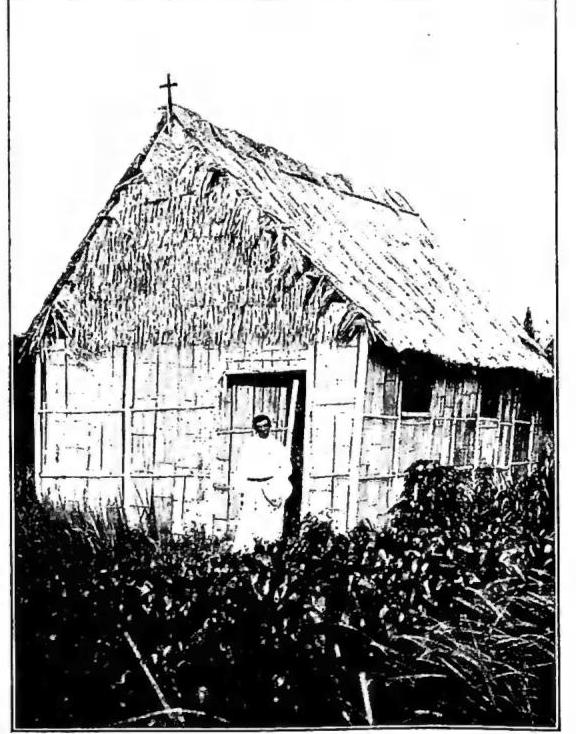
PALAWAN, APOSTOLIC PREFECTURE of - Chapel of the Mission. Palawan.
is placed at the head of the Chapter of the church of the Pantheon in Rome, forming with it the clergy that will provide for the religious service of the said Basilica and for all the functions, even outside Rome, that, in conformity with the canonical norms, may be required by the State or by the household of the Head of State. To this end the Holy See consented to confer upon all the canons who form the clergy of the Pantheon the dignity of apostolic protonotaries ad instar during munere. The appointment of each of them is made by the ecclesiastical authority (cardinal vicar of Rome) upon presentation by the Head of State (subject, however, to a confidential indication of the candidate by the ecclesiastical authority), as if the latter held the right of patronage over the church. The presentation, which takes place by decree of the Head of State, is followed by the institutio collativa, which has a concordatarily binding character.