
MATERNITÀ SPIRITUALE DI MARIA S.ma. - I. THE FACT. - That Mary Most Holy, besides being the natural mother of Christ, the God-Man, is also the spiritual mother of all Christians who are members of the mystical body of Christ, is an incontestable fact, since it is present in the preaching of the ordinary magisterium of the Church and in the conviction of all the faithful. In the words addressed by Jesus Crucified to His Mother and to St. John: "Behold thy son... Behold thy mother" (Jn 19:26), not a few exegetes, both ancient and modern, have seen the solemn promulgation of the fact of the spiritual motherhood of Mary (for example, St. Ambrose, St. John Damascene, George of Nicomedia, Eadmer, Philip of Harvengt, Rupert of Deutz, Gerhoh of Reichersberg). In two stanzas of a 15th-century Latin sequence on the compassion of the Virgin it is said: "The mother is given to the disciple, and this is a great mystery; under the name of John, every believer is included" (cf. U. Chevalier, Repertorium hymnologicum, I, Louvain 1802, p. 418, no. 6983).
The Roman pontiffs too, in official documents, have interpreted the words of the dying Christ in this sense. Benedict XIV, in the bull Gloriosae Dominae of 27 September 1748, affirmed that "the Catholic Church, under the illumination of the Holy Spirit, has always professed the most filial devotion toward the Blessed Virgin, seeing in her the most loving mother, a mother left to her by her dying Spouse with His last words" (Bullarium, II, Prato 1846, p. 428). Leo XIII, in the encyclical Adiutricem populi of 5 September 1895, taught explicitly that "according to the perennial sense of the Church ("quod perpetuo sensit Ecclesia"), Christ, in the person of John, designated the whole human race, especially those who are united to Him through faith" (A. Tondini, Encicliche Mariae, Rome 1950, p. 22). Pius VIII, Benedict XV and Pius XI declared the same.
II. NATURA
When it is asserted that Mary is our mother, it is not meant that she is so in a metaphorical sense, for example, because she loves as a mother, but in a proper sense. Nor is it meant that she is our mother in a merely juridical sense, that is, inasmuch as she has adopted us as children, but really, that is, in the sense of a direct communication of life. It is necessary, however, to bear in mind that the life communicated directly by Mary is not natural life but the supernatural life of divine Grace, incomparably superior to that of the nature communicated directly by the earthly mother.
III. IL FONDAMENTO
The fundamental reason for this supernatural motherhood is to be sought in the doctrine of the mystical body of Christ. In fact, through the Incarnation in the womb of Mary, the Word made man became the mystical head of all humanity (which is the synthesis of all creation) and humanity became his mystical body. Therefore, by naturally generating Christ, Mary also generated, supernaturally, the mystical members of Christ, that is, all humanity. The Head and its members became the fruit of the Virgin's womb, and Mary became the mother of the total Christ, head and members: naturally the mother of Christ and supernaturally the mother of all his mystical members.
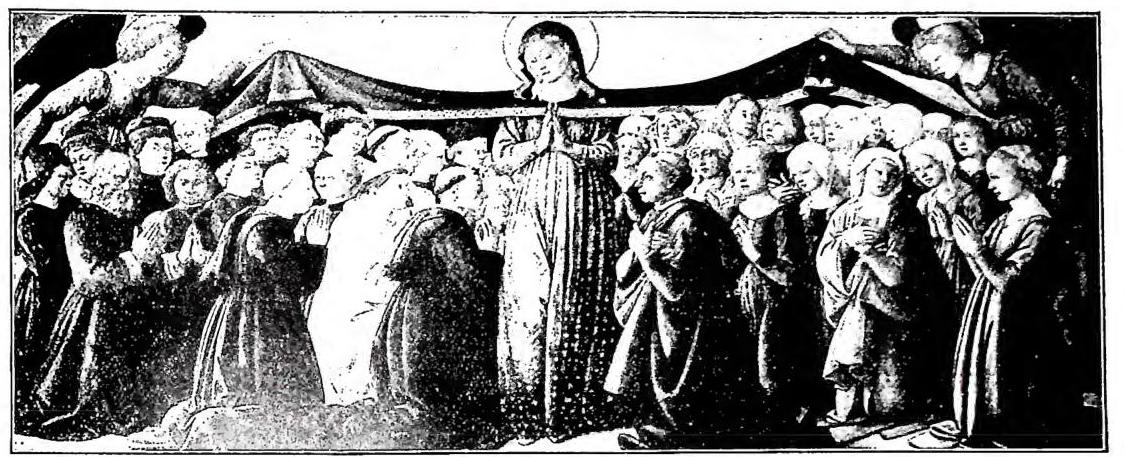
It should be noted, however, that the universal and supernatural motherhood of Mary, at the moment of the Incarnation and by virtue of it, was only in a potential state (not yet in actu), since only in an initial way was all humanity then included in Christ or, better, in the humanity assumed by him. This potential inclusion of humanity and of its individual members becomes actual and personal when individual men are incorporated into the mystical Christ, through faith and Baptism, which are indispensable for the attainment of eternal life (cf. Mk. 16:15-16; Jn. 3:5-6), since they make of Christ and of us an inseparable supernatural reality, a single mystical person. Even this actual supernatural generation of the individual to the supernatural life of divine Grace takes place only in Mary, through the operation of the Holy Spirit. In Baptism, in fact, there takes place actually for the individual what occurred potentially, for all humanity, in the Incarnation. In Baptism, the Virgin mystically actualizes her potential motherhood.
Besides directly communicating, together with Christ, the supernatural life of Grace, Mary nourishes and develops in each of her children this same life through actual graces, which all pass through her hands. This maternal action endures until man has reached in heaven the fullness of the age of Christ.
IV. L'ESTENSIONE
If the spiritual motherhood of Mary has its foundation in our incorporation into Christ, it follows that it extends as far as his quality of head of his mystical body extends in Christ. Now the quality of head, in Christ, extends to all creatures, both angels and men, since all, though in different ways, are mystical members of Christ, and therefore in all of them circulates the supernatural life of divine Grace derived from the Head.
Consequently the spiritual motherhood of Mary also extends to all creatures, angels and men, since she cooperated in uniting them, in incorporating them into Christ, as members to the head. Not all, however, are so in the same way and in the same degree. For of some Christ is head in act, of others he is head only in potency, and of others in no way. He is head in act of the faithful — sinners, the just and the blessed — but in a very different degree. Of the faithful who are sinners (deprived of Grace, but united to Christ by faith) Christ is head (and Mary is mother) only in a certain respect; of the faithful who are just Christ is head (and Mary is mother) in every respect; of the blessed, moreover, whether angels or men, Christ is head (and Mary is mother) in a more excellent way. Christ is head in potency (and the Madonna is mother in potency) of unbelievers, who perhaps one day will be united to Christ by charity or at least by faith. Christ is in no way head (and Mary is in no way mother) of those who, whether angels or men, are damned, since in no way, neither in act nor in potency, are they united to Christ, being definitively separated from him.
Bibliography8 works
Gabriele Roschini