
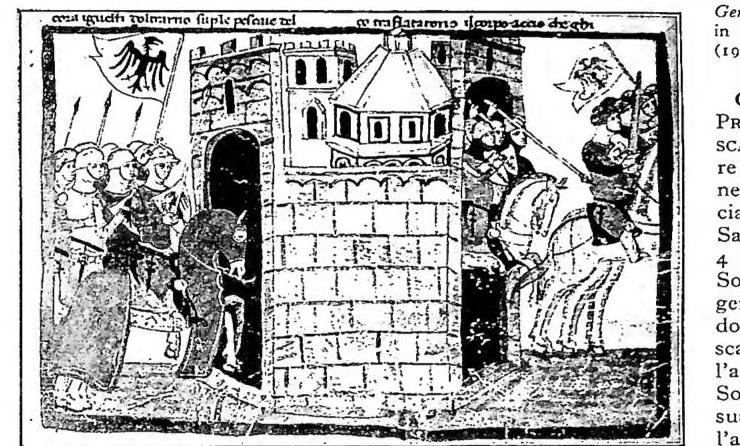
GUELPHS AND GHIBELLINES. - These are the two great parties that dominated Italian political life in the 13th-14th centuries and that still manifested a certain influence in the succeeding 15th and 16th centuries. It is commonly said that the Guelphs are the partisans of the Church and the Ghibellines the partisans of the Empire; in more recent studies an attempt has been made to gain a more precise point of view, observing that at a certain moment the two terms lost their ideological value and were reduced to indicating only the factions contending in the Italian cities for local or political or economic interests. However, the history of the two terms is a little more complex and it is not easy to pin down its stages.
The origin is German. Conrad II the Salian was called «Cuonradus de Wevelinga»; of his family it was said: «de Waiblingin oriundi» because the cradle of the lineage was probably their domain of Waiblingen on the lower Neckar, between Heidelberg and Mannheim. When the Franconian family died out with Henry V (1125), possessions and titles passed to the nephews, the Hohenstaufen dukes of Swabia, who jealously preserved the memory of their ancestors: the Chronicon Urspergense says that Frederick Barbarossa gloriabatur se de regia stirpe Waiblingensium progenitum fuisse. Their rivals were the lords of Altdorf, called the Guelphs from the use of this name, Welf, by not a few personages in the 11th and 12th centuries, before and after having received the duchy of Bavaria from Henry IV. Otto of Freising recalls the two dynasties for their importance and rivalry: Duae in Romano orbe... famosae familiae hactenus fuere: una Heinricorum de Guibellinga, alia Guelforum de Altdorfo (Gesta Federici [MGH, Scriptores, XX], II, II). The Guelphs of Bavaria with Henry the Lion held the duchy of Saxony: the rivalry with the Hohenstaufen, who had risen to the Empire, ended with their ruin; an attempt to restore the family's fortunes was made by Otto, son of Henry the Lion, who became emperor after the death of Henry VI with the support of Innocent III. Otto IV was commonly called the Guelph, just as his competitor Frederick II was called the Ghibelline; terms used not in mockery but in honor, to assert traditions, glories, patrimonial rights. Modern criticism has rejected as a late invention (15th century, first hint in the Chronicle of Andrew of Regensburg) the famous story that the two terms Guelphs and Ghibellines began to be used as war cries (Hye Welf! Hye Weiblingen!) in 1140 at the siege laid by Conrad III to the Guelph fortress of Weinsberg.
In the years 1212-18, while in Germany Otto IV and Frederick II were contending for the throne, in Italy too cities and lords divided between the two princes and thus there appeared in the peninsula as well the «party of the Guelph» and the «party of the Ghibelline». But the latter was under the protection of the Church: the Emperor, at odds with the papacy, excommunicated by Innocent III, was the Guelph. The first historical documentation for the use of the two terms is Florentine: the term Guelphs appears in 1239 (Guelfi fuerunt victi apud Castagnolum); in 1242 the two terms appear together (Guelfi fuerunt ad Gangalandi et Ghibellini ad Castagnolum): they are historical annotations of a Florentine codex written not later than 1244. From 1246 is a letter of the captains of the Florentine Guelphs (C. de Cavalcantibus et R. de Adimaribus, Capitanei Guelforum) to a Florentine at the court of the anti-king Henry Raspe. The parties were already organized; the conflict between Frederick II and the Communes explains why in 1241 the Emperor wrote to the capitanei fidelium suorum Ianuensium. In 1247 at Parma there is a pro imperatore capitaneus in Parma partis Imperii. In Florence evidently the Frederickians were called Ghibellines (= those of the Ghibelline) and the anti-Frederickians were an-

still called Guelphs. However, in these years, in the struggle between Frederick II and Innocent IV, especially after the excommunication and deposition of the Emperor, the great transformation must have taken place: Ghibellines, no longer merely partisans of Frederick II, but of the Empire; Guelphs, no longer merely enemies of Frederick, but partisans of his new enemy, the papacy. In 1248 Innocent IV writes from Lyon to Cardinal Ottaviano degli Ubaldini: abque dilectorum filiorum nobilium virorum Guelforum scandalo and in 1245 he writes at the request dilectorum filiorum capitaneorum et partis Guelforum de Florentia. Yet still in the second half of the 13th century in official Florentine documents there is a trace of the origin in expressions such as: "parte del Guelfo, parte del Ghibellino," although commonly by now the partisans of the Church were already called Guelphs and the partisans of the Empire Ghibellines. The Florentine historical tradition traces the formation of the two political factions to the family conflict between the Buondelmonti and the Amidei of 1216, on which Davidsohn succeeded in throwing ample light: the Pseudo-Brunetto, writing at the beginning of the 14th century, says that on the day Buondelmonte was killed the ruin of Florence began and the two names of the Guelph party and the Ghibelline party were born, which then became the parties of the Church and of the Empire. However, it is not clear how the two terms of political value became wedded to the two opposing Florentine family consorterie.
After 1250 the two parties were firmly organized in Florence and embraced noble families. The use of the two terms began to penetrate into some neighboring city in which Guelphs and Ghibellines had connections and found refuge when misfortune forced them to become exiles. At Arezzo there is talk of Guelphs and Ghibellines already in 1240; likewise at Città di Castello and at Borgo S. Sepolcro; at Siena in 1255, at Perugia in 1260, at Bologna in 1274. The terms also appear in the history of other cities, but always in relation to Tuscany and to Florence in particular. Often in the chronicles there is talk of military actions carried out together by the "Pars Guelfa Florentie" and by the "Pars Ecclesie" of another city, which shows how the two terms were known in Italy as the names of Florentine factions, while north of the Apennines the generic expressions "Pars Imperii" and "Pars Ecclesie" were used, or, more precisely, the names of the local factions. The two terms Guelphs and Ghibellines did not spread very rapidly. In all the Italian cities the lack of a superior power to discipline and coordinate had favored the formation of local factions as a result of family conflicts, of consorterie, of city neighborhoods: thus city life crystallized in these situations that perpetuated themselves through vendettas; the factions, however, if they do not lose their original meaning and do not forget their particular causes and aims, veil the coarseness of their content with an ideological cloak. It is difficult to specify why a particular family is called partisan of the Church or of the Empire: generally the distinctions occurred still during the reign of Frederick II: at Parma still in 1305 there is mention of the Pars antiqua que dicebatur Ecclesie while in contrast there was the Pars Imperii et Episcopi; in 1295 in a Guelph tumult at Parma against the bishop the cry had been raised moriantur latrones de parte Imperii. The terms Guelphs and Ghibellines spread after the alliance of the House of Anjou with the Church, extending or modifying their meaning. Ideological adherence to the Church or to the Empire is not, however, simple exteriority: there was, in noble families especially, a traditional and deeply felt devotion to the Church or to the Empire: by fighting for or against, ideological bonds were established with families and political groupings of other cities, spiritual currents were delineated, along with significant political-economic coalitions.
Guelphism after the battle of Benevento predominated in the peninsula, supported by the kings of Sicily; the revolution of the Vespers determined grave setbacks; at the beginning of the 14th century it was again dominant not only in Tuscany but also in the Lombard region. The expedition of Henry VII led to a lively Ghibelline reawakening: the lords of Lombardy were generally Ghibelline. Now there is a struggle between the Church and the Lords who represent ideologically the Empire, but who in reality aim at the construction of their own States. Old political programs, but new reality. In Florence Guelphism is identified with what is the Florentine political program, and Villani makes himself its interpreter by saying that the Guelph party is the foundation and a firm and stable stronghold of the liberty of Italy and contrary to all tyrannies; "so that if any Guelph becomes a tyrant, he must of necessity become a Ghibelline." Thus Lapo di Castiglionchio idealizes the Guelph party: "The Guelphs are pitiful and merciful men, peaceful and mercantile, desirous of living in liberty and in commune and in popular state and under the reverence of Holy Church. And the said others of the number of the Ghibellines have been and are fierce men, proud, full of scandals, of plots and betrayals and of support of tyrannical states, and who never wished to hold their lands, where they had peace or predominance, as a commune, nor as a popular state, cruel and obstinate in their ways and with little reverence for God and for His Vicar on earth, enemies and hateful, whence by vulgar and common saying it has come about and they are called Ghibellines Paterini."
In reality the Church favored during the 13th and 14th centuries the communal autonomies, while Ghibellinism drew from the imperial anti-papal and anti-ecclesiastical tradition weapons to fight all forms of local autonomism and first of all ecclesiastical jurisdictions, resisting energetically excommunications and interdicts.
But during the 14th century from various quarters the struggle against the persistence of political parties began. The organizing princes of territorial States wanted to eliminate this partisanship which substantially, whether in favor or in opposition, called into question their policy and their work of state-building. Typical is the decree of Filippo Maria Visconti of 1440: all citizens who have completed 18 years within two months must swear that they are neither Guelphs nor Ghibellines. Elsewhere by legislative act the parties are abolished, while in some cities they are emptied of political vitality by dividing public offices in equal parts or in determined proportions. Now the origin of the two names was no longer known, and not a few treatise writers already in the 14th century sought to explain with the most curious etymologies the origin of the terms Guelph and Ghibelline. Worth remembering is the treatise De Guelfhis et Ghibellinis of Bartolo da Sassoferrato and that of Benvenuto S. Giorgio De origine Guelforum et Ghibellinorum where the Germanic origin of the names is specified. Common is the attribution of the origin to duobus principibus inferni, Gibel et Gualef. Despite all the prohibitions, still in the 16th century there is talk in various Italian cities of Guelphs and Ghibellines, whose attention, however, now turns to the political struggles of the time and to taking sides for France or for Spain; Montaigne finds the old factions at Bologna, at Lucca; Gregorio Leti in the 17th century notes that the Guelphs wore the feather of the hat on the right as a mark of distinction; the Ghibellines on the left, and that even the women had different signs of party; at Ravenna the Guelphs did not go to the church of the other party and the artisans who served people of one party were not admitted to serve people of the other. Thus the ancient partisanship perpetuated itself in the way of wearing ribbons or cutting hair.