
TRUTH AND FALSEHOOD. — Just as the Greek ἀληθής, in the literal sense of the word, means “not hidden” or “one who conceals nothing,” so the Latin verus denotes what is genuine, as opposed to something that is a deceptive imitation. Thus, too, a person who does not pretend, and a witness who does not deceive, is called verus. In every case, the notion of conformity between what actually is and its external manifestation, or, respectively, the judgment of the knowing subject that follows from it, enters into the concept of truth. Unlike the concepts of being and reality, which do not indicate any relation of the entity, “truth” affirms a relation between reality and the intellect or knowledge.
I. HISTORICAL SURVEY
In Western philosophy, the conception of truth as conformity between thought and being has unquestionably prevailed.In ancient philosophy, it may be said that only the sophists and the skeptics opposed this conception. According to Protagoras, consistently with his principle that “man (the individual) is the measure of all things,” truth differs according to the diversity of knowing subjects; “true” is the judgment that corresponds to the different appearances of a thing, which are different for each individual subject. Socrates, Plato, and Aristotle opposed this relativism; but in Platonic and Aristotelian philosophy truth was given somewhat different emphasis. For Plato, truth is principally a quality of the object of knowledge: the clear, the distinct, the pure, and the stable are the true; hence the eternal ideas are true reality, and the truth of knowledge depends upon the truth of objects. For Aristotle, on the other hand, “the false and the true are not in things... but in the mind” (Metaph., 6, 4). True, that is, is the thought that “says of what is that it is, and of what is not that it is not”; false, instead, is the thought that “says of what is not that it is, or of what is that it is not” (ibid., 4, 7). This, however, occurs only in judgment, not in the “thought of the indivisible quiddity,” or simple concept; thus Aristotle can define judgment outright as thought “in which falsity and truth are found” (De anima, 3, 6). The Stoics and even Epicurus likewise uphold the concept of truth as conformity between thought and being, and devote themselves to the search for a “criterion” that guarantees truth so understood. The Stoa finds this criterion in “cognitive apprehension,” that is, in an apprehension that presents the real object to us so “within reach” that denial would be absurd; for Epicurus, sensory apprehension is without qualification the universal criterion of truth. According to Neoplatonism, on the other hand, the senses provide only indistinct traces of truth. The only true reality is the supersensible, transcendent world, which can be ascended to only through thought and intellectual intuition.
Without banishing the material element, as the Neoplatonists did, the Christian Revelation of the New Testament, especially s. Giovanni, specifically indicates as “true” the sphere of the otherworldly, the divine. Thus Christ is the “true light” (Io., 1, 9), or simply “the truth” (ibid., 14, 6); the Holy Spirit is called the “Spirit of truth” (ibid., 14, 17). But Christ’s revelatory word is also “the truth”; thus “the truth” in s. Giovanni and s. Paolo is simply synonymous with the Gospel, with the fullness of Christian Revelation. “Truth” in this sense does not mean merely, as certain Protestant theologians are inclined to believe under the influence of existentialist philosophy, a personal encounter between God and man, in which God presents himself to man while demanding obedience; it also means truth of knowledge, that is, a teaching about God and his ways of salvation that the intellect is invited to accept in faith. Certainly, it is not enough to recognize this truth intellectually; it must become truth in action and in life: man must “do the truth” (ibid., 3, 21).
The first speculative synthesis of Christian doctrine on truth was accomplished by s. Agostino with the instruments of Neoplatonic thought. In mathematics, metaphysics, and ethics, invariable truths are perceived, which as such cannot derive from the sensory experience of ever-changing bodies. These cognitions must certainly be attributed to God, who is truth itself and the light that illumines every human being. The ideas in the divine intellect are the true prototypes, whose perfection the things of this world can imitate without ever attaining it; consequently, the truth of things, especially that of bodies, is always mingled with illusion. Only the eternal divine Word, generated by the knowledge of the Father, is the perfect image, “in no way unlike,” of the Father; therefore, as a distinct divine person, it is also called, in a particular way, “the truth” (De vera relig., cap. 55, n. 113; De trin., XV, cap. 14).
In the first centuries of scholastic philosophy, up to s. Bonaventura, the Augustinian conception dominated speculation on truth. Alongside it, s. Anselmo’s definition of truth (“rectitudo sola mente perceptibile”) acquired a certain importance; even Alberto Magno, in his Summa Theologica, accepted this definition, which, by calling truth “rectitudo,” intends to indicate that truth is conformity with a norm, with a duty. But in the synthesis of s. Tommaso, sober Aristotelian thought also asserts itself, without abandoning the Platonic-Augustinian heritage. Truth is found first of all, for us, as truth of knowledge—later called logical truth—in the judgment of the intellect. S. Tommaso defines it by adding to the definition “conformity of thought and being” (adäquatio intellectus et rei), attributed to Isaac Israeli (845–940), the Aristotelian paraphrase: “inasmuch as the intellect says of what really is that it is” (Summa c. gent., 1, 59). The truth of human knowledge has no being except in human thought and is therefore not eternal (Sum. Thol., 1ᵃ, q. 16 a. 7); its object is not an “eternal truth,” but the being of things (ibid., q. 16 a. 1 ad 3). Certainly, things too, for their part, are “true”; this truth of being—later called ontological truth—means that reality is not an obscure, “irrational” force, but that, as the actualization of divine ideas, it is formed by the spirit and is therefore also intelligible to spiritual knowledge. In God, finally, who is truth itself, the truth of knowledge and the truth of being interpenetrate, since in him being and intellectual knowledge are identical. Therefore, “every being is true,” although the truth of each thing corresponds to the degree of fullness of its being; this is expressed in the proposition “ens et verum convertuntur,” that is, “every being is true,” and conversely, “every true thing is a being.” Truth thus belongs, together with unity and goodness, to the transcendental properties of being—that is, those properties that belong to every being.
In contrast to s. Alberto and s. Tommaso, Latin Averroism also upholds doctrines of Aristotle and his Arab commentators that contradict the Christian faith. To avoid a clash with ecclesiastical authority, some sought to deny this contradiction through the doctrine of the “twofold truth”: the philosophical truth of a doctrine does not exclude the truth of its contrary in the theological sense. Even in the 16th century Pietro Pomponazzi (d. 1524) defended this conception. Against him, the Fifth Lateran Council defined: “Since one truth cannot contradict another, we declare wholly false every assertion that contradicts the truth of the enlightened faith” (Denz-U, n. 738).
Modern philosophers, from Descartes to Wolff, generally adhered to the conception of truth as conformity between thought and being. The doctrine of the truth of being, however, was increasingly emptied of its metaphysical content, so that Kant could regard the proposition “quodlibet ens est unum, verum, bonum” as a mere tautology, retained only honoris causa (Kritik der reinen Vernunft, B 113). In English empiricism, the truth of knowledge became increasingly confined to propositions of experience and to mere tautologies, whereas rationalism posited an intuition of “eternal truths,” independent of all experience and based on “innate ideas.”
The rationalist separation of knowledge of essences from reality, originally given only in experience, consequently had to compromise the real value of a priori essential structures and hence the realistic concept of truth itself. Kant’s criticism in fact reverses the concept of truth upheld in a purely dogmatic manner by rationalism. For it, truth is no longer conformity of thought with real being, but conformity with the laws of reason (Kritik der reinen Vernunft, B 350); this, then, is the concept of truth held by critical idealism.
If in absolute idealism thought and being, and likewise the laws of thought and the laws of being, are identified, then necessarily the concept of truth must also change. For Hegel, truth means that the object is congruent with the concept from which it proceeds (cf. Naturphilosophie, Einleitung A; Jubil.-Ausg. edited by H. Glockner, IX, Stuttgart 1927, p. 48). At the same time Hegel states: “The true is the whole” (Phänomenologie, Vorrede, II, 24). This means: if partial truths are posited in isolation and made absolute, as though they were the whole, they become false; they are true only when they are elevated (aufgehoben) as “moments” within the totality designated by the idea. Although this conception is founded primarily on Hegel’s dialectical idealism, it nevertheless points to a real danger—namely, that by one-sidedly accentuating partial truths, truth itself may be falsified. In our century constructive idealism was renewed in modified form by B. Croce and G. Gentile. Since, according to Gentile, every reality is posited in the act of thought, it no longer depends on a being transcendent to thought, but is a free creation of thought itself.
The gigantic attempt by idealism to derive every reality and truth from a single principle could not succeed. In four respects, idealist systems had to prove to be unjustified simplifications of reality: the undeniable transcendence of truth is suppressed; the proper significance of matter is not recognized; in the face of the necessary and universal orders of essence, the purely real, the concrete, the singular, and the variable in history are diminished, despite the concern for a “concrete concept”; finally, idealism exhibits a certain intellectualism, which seems to lack a sense for “life,” for the emotional dimension of man, and for his personal free decision. It is therefore not surprising that in the nineteenth and twentieth centuries currents opposed to idealism succeeded in prevailing, in turn exaggerating those aspects of reality and truth neglected by idealism. Thus logical transcendentalism, by admitting certain “truths in themselves,” exaggerates the transcendence of truth and at the same time neglects its ontological value, conferring upon propositions—especially those belonging to the essential order—an “ideal in-itself” outside not only knowledge but also real things. Thus B. Bolzano speaks of “propositions in themselves”; E. Husserl, in the Logische Untersuchungen (3rd ed., I, Halle 1924, p. 228), of “truths in themselves”; and the neo-Kantian H. Rickert of the “transcendent meaning,” which, as truth subsisting in itself, is the proper object of knowledge. These curious constructions arise because not only the object of judgment is posited, but at the same time also its logical structure (subject-copula-predicate), as transcendent with respect to thought.
materialism (v.) against idealism. Whereas idealism denied the subsistence of matter, reducing it to a content of the spirit, materialism in turn denies the subsistence of the spirit, reducing spiritual knowledge to a simple function of matter. Moreover, it upholds the realistic conception of the truth of knowledge, at least insofar as knowledge of the material world is concerned; metaphysical, moral, juridical, and religious doctrines, on the other hand, according to dialectical materialism, have only the relative value of “ideologies,” which change according to the mode of production and the corresponding social order. This relativism, needless to say, was not extended to communism itself, as a conception of the world and of life in the “classless society.” Materialism is unable to explain the possibility of logical truth, because it denies every ontological truth, understood as the formation of reality through ideas. From this point of view, N. Hartmann’s doctrine of the “trans-intelligible,” beyond every “knowability” (Grundzüge einer Metaph. der Erkenntnis, 3rd ed., Berlin 1941, p. 232), and completely alien to the spirit, has an evident affinity with materialism.
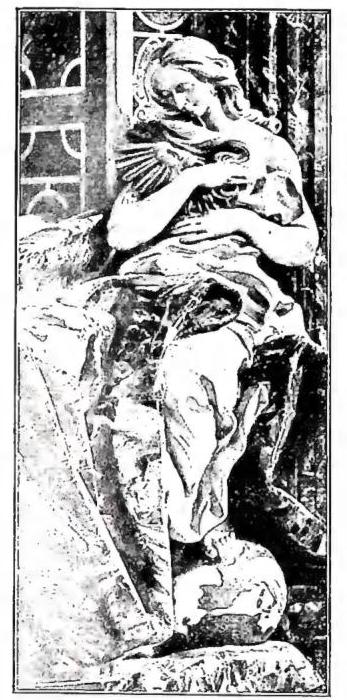
(Anderson photograph)
TRUTH AND FALSEHOOD — Truth, a late work by G. L. Bernini. Detail of the funerary monument of Alessandro VII — Basilica of St Peter.
of truth (no. 6), since it often binds truth so closely to the individual existing person and to his free decision that the objectivity of truth is thereby endangered.
“Truth is subjectivity,” S. Kierkegaard had already said (Philosophische Brocken, in Werke, VI, Jena 1910, p. 605). With this audacious statement he certainly did not intend to deny the objective value of truth; but the personal appropriation of truth, the inwardness and passion involved in grasping it, are at times so greatly exaggerated by existentialism that, by comparison, objective and universal truth seems outright falsehood.
II. NOTES ON CERTAIN SYSTEMATIC PROBLEMS
The many forms of conceiving the “v.” of modern philosophy, which have been indicated in a necessarily somewhat simplified manner, show what tasks are entrusted today to Christian philosophy with regard to the problem of V. The divergent conceptions of modern philosophers, which often contradict one another, certainly do not succeed in overturning the fundamental theses of perennial philosophy. They do, however, accentuate problems that today require more careful examination than in the past. Starting from the irremovable fact that v., as Aristotle and s. Thomas precisely repeat, is given only in our specifically human knowledge, one asks: how can its ontological value be reconciled with the cognitive conditions within the subject itself, antecedent (a priori) to every experience; its universal value and absoluteness with the variable psychological particularity of the individual; its independence from time with the historicity of man; and, finally, its rigorous objectivity with its vitality and individual importance, and with its special stimulus for each individual?J. Maréchal, through his penetrating examination of Kant’s criticism and constructive idealism, endeavoured to show that the a priori cognitive conditions of the human intellect need not at all falsify real being, but rather, being precisely adapted to constitute it as the object of our knowledge, [present it] as it is in itself. This interpretation may perhaps not be entirely satisfactory; it may especially be objected that he placed too little emphasis on the receptive moment of “seeing,” proper to our knowledge, including intellectual knowledge, in favour of the moment of tendency and active “positing.” Nevertheless, he showed that the a-priori of the intellect need not necessarily be understood in an idealistic sense, but is rather indispensable if real being is to encounter the intellect. As regards the individual psychological particularity and the further concrete conditions of knowledge, which vary from one person to another, their strong influence on the actual thought of individuals is certainly incontestable. Not every V. person; indeed, under similar influences, certain errors are more or less imminent for this or that individual. It does not follow, however, that they should be designated as “relative v.” subordinated to the individual. In the face, in fact, of the variable psychological influences of habits, feelings, tendencies, etc., the spirit remains free to follow its law, that is, to concentrate on the evidence of reality and allow itself to be determined by II. This follows already from the simple fact that, in reflection, it can become aware of the various influences pressing upon II. Insofar as it can judge the influences subordinate to its sphere, the spirit does not succumb to them but rises above them. Thus, speaking in somewhat forceful terms, the very fact that a relativistic theory of knowledge could have been conceived is already proof that it is false.
The same applies to the historical conditionality of knowledge of V. Logical V. has no being except in the exercise of knowledge, and among human beings this is always conditioned also by the historical situation. In this sense alone is there “eternal v.” in the Divine Spirit, and the fiction of “V. in itself” must be rejected. This does not mean that the value of V. too is subject to historical change. Every genuine V. has universal value, for all peoples and all times, however variable its object may be. Whoever, at any time, judges the same object, possessing a given quality at a given time, must also affirm or, respectively, deny the same thing, if he does not wish to judge falsely. In this sense the value of V. time. This is even more true when the object of the judgment is absolutely necessary and immutable; in this case the proposition is valid without any specification of time: twice two does not make four only now, but simply makes four. It does not follow from this that this V. Spirit. Nor does it follow that every V. age. In this sense one may rightly speak of the historicity of V.
The historicity of V. emerges even more clearly when one considers that V. thought, but that, in correspondence with its vital importance, the whole person must inwardly appropriate II. This personal appropriation of V. philosophy. It is not enough merely to hand down old V. in formulas; they must always be acquired personally. Thus, if different people learn the same v., it may nevertheless be “embraced with differing breadth, depth, and vividness. The response of feeling to known V. varies even more in strength and impetus, richness and depth. And it is precisely the volitional surrender to v., and its actualization in life, that marks different degrees of intensity” (Joh. B. Lotz). Yet, for subjective possession to be truly fruitful for the individual and for society, the object must constitute a genuine V. There is therefore no real opposition between “objective” and “subjective” v., provided both aspects are properly understood.
des scholast. Satzes: Quodlibet ens est unum, verum, bonum..., in Kants Kritik der reinen Vernunft, in Kantstudien, 20 (1915), p. 403 sgg.; Ch. Boyer, L'idée de vérité dans la philosophie de St Augustin, Parigi 1921; M. Cordovani, Il concetto di V. secondo il neoclassico ital. e la filosofia di s. Tommaso, in Acta I Congressus Thomistici, Roma 1925, pp. 223-30; G. Busnelli, Il farsi della V. secondo il prof. Gentile, in Civ. Catt., 1925, III, pp. 299-310; G. Schngen, Die Synthese im thomist. Wahrheitsbegriff, in Synthesen (Festgabe Dyroff), Bonn 1926, pp. 126-43; M. Cordovani, Concetto di V. s. Tommaso, in Cattolicismo e idealismo, Milano 1928, pp. 93-113; A. Levi, La teoria stoica della V. e dell'errore, in Rev. hist. de la phil., 1928, p. 113 sgg.; M. Grabmann, Der lateinische Averroismus im XIII. Jahrhundert, Monaco 1931; Th. Haecker, Der Begriff der Wahrheit bei S. Kierkegaard, Innsbruck 1932; C. Mazzantini, Il problema delle V. necessarie e la sintesi a priori di Kant, Torino 1935; A. Wilmsen, Zur Kritik des logischen Transzendentalismus, Paderborn 1935; P. Wilpert, Zum aristotel. Wahrheitsbegriff, in Phil. Jahrbuch, 53 (1940), pp. 3-16; A. Hufnagel, Die Wahrheit als philosophisch-theologisches Problem bei Albert dem Deutschen, Bonn 1940; S. C. Brac, Il concetto di V. S. Tommaso d'A., Verona 1943; M. Heidegger, Platons Lehre von der Wahrheit, Berna 1947; R. Cefal, Il problema de la verdad en Heidegger, in Sapientia, 5 (1950), pp. 19-40. - Monografie sistematiche: G. Schngen, Sein und Gegenstand, Münster 1930; M. Müller, Sein und Geist, Tubinga 1940; J. K. Ryan, The Problem of Truth, in Essays in Thomism, Nuova York 1942, pp. 63-80; H. U. V. BALDASSARRE, Wahrheit, I, Einsiedeln 1947; J. Pieper, Wahrheit der Dinge, Monaco 1947; J. B. Lotz, Existentialismus, in A. Hartmann, Bindung und Freiheit des katholischen Denkens, Francoforte 1952; id., Von der Geschichtlichkeit der Wahrheit, in Scholastik, 27 (1952), pp. 481-503. Giuseppe de Vries
FALSITÀ. — In common usage, the adjective falso is often used as a synonym for bugiardo, and thus falsità is understood as the contrary of sincerity or truthfulness; the verb falsare, on the other hand, is used almost exclusively in the sense of falsificare, thereby giving falso (v.). Alongside these meanings, common language also contains a speculative sense of falsità more directly connected with philosophy; thus, for example, one speaks of wishing to distinguish genuine coin from counterfeit, and of wishing to ascertain the V. or falsità of an assertion or of an entire theory. This manner of expression is founded upon the common conviction that every judgment is either true or false, insofar as it either conforms to its object or differs from II. In this sense, V. reality, and falsità as its contrary, that is, nonconformity.
In philosophical reflection, too, the theory of falsità develops dependently upon the theory of v., following the same vicissitudes both historically and speculatively. Historically, two opposed currents of thought may be distinguished: one that leads to the common meaning of V. and falsità, systematically interpreted; the other that gradually evolves toward a conception of V. and falsità that is quite different. The first conception, objectivistic in character, distinguishes the mode of knowing from that which is known. With regard to the mode of knowing, V. depends upon the conditions of the knower; with regard, however, to the object, the V. of the knower depends upon reality: for it is impossible to speak of the V. or falsità of a judgment except in relation to an objective term, presupposed as a point of comparison for evaluating the judgment and for distinguishing, between two contradictory assertions, the true one from the false.
The second conception, subjectivistic in character, makes no distinction between the mode of knowing and that which is actually known, and regards the object as a construction of the knowing subject itself; it therefore concludes that the V. or falsità of the judging act is determined by the knowing activity itself, which consequently is, in the last instance, the true source and measure of the falsità and V. of its own act.
Whatever exact sense is to be assigned to Protagoras’ saying that «man is the measure of all things», insofar as «to each person, what appears to him is so» (Plato, Theaetetus, VIII, 152a, XVI 162c), and whatever historically determinable significance today belongs to Gorgia’s antieletic thesis that «being does not exist; and even if it existed, we could not know it; and even if we knew it, we could not communicate it to others», the fact remains that in antiquity, just as the subjectivist-relativistic theory of V. was concentrated around the name of Protagoras—that in the flux of our cognitions there is no distinction between true and false because everything is true—so the relativistic denial of the opposition between true and false was concentrated around the name of Gorgia, because everything is false (cf. Sextus Empiricus, Against the Mathematicians, VII, 65). The Academics and the skeptics adopted this conception, denied the contrary opposition between V. and falsità, and concluded that man cannot determine which of two contradictory assertions is true or false. Thus, in antiquity and the Middle Ages (Commentarii in Aristotelem), the empirical subjectivist conception of V. and falsità became synonymous with skepticism and the denial of the possibility of philosophizing.
In modern philosophy, Kant, in opposition to Hume’s «most lamentable skepticism», introduced the a priori forms of the transcendental ego, thinking thereby to preserve the stability of science from the contingent mutability of experience; but, by denying in this way the metaphysics of being and opening the possibility only of a metaphysics of knowing, he also effected the transition from the traditional objective conception of V. (adaequatio intellectus et rei) to the transcendental subjectivist conception, according to which the subject is the measure of the object, and V. is therefore the coherence of knowing with itself (adaequatio intellectus et intellectus), just as falsità is incoherence (difformitas intellectus et intellectus). Post-Kantian idealism, and Hegelianism in particular, devoted itself to systematizing this conception. In the development of reason, which is essentially triadic, every positivity intrinsically contains, within its own negation, the principle of the movement that leads it to transcend itself and preserve itself as a higher determination. In this sense, V. and falsità become dialectical, and their contrariety is resolved into relation. Hence the recent idealist theories of error, according to which a falsità is always intrinsic to every v., as the negative element in the becoming of spirit. Croce, considering the definition of error as «the nonconformity of thought to its object» still too realistic, admits a certain positivity of error, subsequently attempting to reduce it to a merely practical, indeed economic, fact. Gentile, on the other hand, insists upon the dialectical negativity of error: «error is that which can no longer be thought after having been thought». Thus idealist coherence remains intact, but the logical conclusion of actual idealism is that «what we think, in the act of thinking it, is always true», though true with a V. false, and therefore always capable of further dialectical development.
This extreme conclusion, however, also reveals the impossibility of a subjective conception of the V. of falsità. Indeed, Kant, by distinguishing the immutability of the transcendental from the contingency of the empirical, could claim to have preserved the common stability of science, but had to profess agnosticism with regard to reality. Idealism, in order to make Kant consistent with himself, conceived the empirical as the very realization of the transcendental. In this way, however, it transferred the contingency of the empirical into the very heart of the transcendental, and thus relativism became essential to the dialectic of philosophical knowledge. For if everything is not capable of dialectical development, idealism empties its own claim and adopts a realistic position; if everything is capable of dialectical development, then even the idealist V. of the present must be recognized as capable of dialectical development, that is, as capable of being rendered true through its further negation in a historicism without term or end.
Contemporary reactions to the subjective conception of reality and V. also represent a return to the human and traditional conception of objective V. Less intellectualist in existentialism, more intellectualist in spiritualism. But it is clear from what has been indicated that the objective conception of V. and falsità is linked to the very same‑
The need and possibility of philosophizing. If it were not possible to distinguish between the truth and falsity of two contradictory assertions, and if truth and falsity were therefore not two contrary and mutually exclusive predicates in the same act of judgment, philosophical inquiry would cease to have meaning, and the philosopher would have no profession left other than that of fundamental relativism. Christian philosophy has given an by now classical theory of objective truth and falsity, which is summarized here in the terms and arguments that concern the human intellect. Sensible reality grounds the objectivity of sensations; sensations ground the objectivity of concepts; and the objectivity of concepts grounds the subsequent certain and evident judgment. The latter, being the conscious synthesis of two objective concepts, simultaneously knows the reality of the object and the correspondence of its own act with that same object. Truth, therefore, strictly speaking, is a perfection of judgment (v. logica); but, by analogy and subordination, the name of truth is also commonly extended to concepts, sensations, and things. Things are true (ontological truth) insofar as they correspond to the true judgment that originates from them; sensations are true insofar as they are objective and provide the foundation of concepts; and these, in turn, are true insofar as they are objective representations of sensed things and the proximate foundation of judgment. Not all judgments, however, are true and evident, since obscure and false judgments also occur. Accordingly, it must likewise be said that falsity properly belongs in fact to judgment (logical falsity) and that, by analogy and in subordination to false judgment, the name of falsity may be extended to the concept, sensation, and things. Things are said to be false (ontological falsity) insofar as they do not correspond to the judgment occasioned by them in some way; sensations are false when, not being objective, they become the occasion of false conceptions; concepts are false when they are derivative and inadequate elaborations that may give rise to a false judgment. In this sense, it must be concluded, the theory of error (v.) and the theory of the possibility of error completes the theory of the possibility of falsity in the various orders of knowledge.