
CANT'ARI. – Narrative poems, whose abundant production flourished, especially in Tuscany, from the thirteenth to the sixteenth century. As a rule, they were composed by popular poets and singers, or canterini or cantampanca, who sang them in the public square (in Florence, the little square of S. Martino al Vescovo), accompanying themselves on the viol, on appointed days and at appointed hours, before an audience composed chiefly of common people. The custom of the street singers was so well received by our plebeian classes that in certain cities, such as Florence, Perugia, and Aquila, they were paid by the municipality. The names of the authors of the c. have rarely come down to us, but Antonio Pucci (1310–88), the “bell-ringer and town crier” of the Municipality of Florence, has remained famous. The metre used was generally the octave, although the name c. was sometimes also applied to narrative poems in the metre of the sirventes or the ballad. The c. (often also called istoria) consisted of about fifty octaves, a length that allowed the story to be developed sufficiently without tiring the audience; at times, however, the subjects treated required longer compositions, comprising a considerable number of c. The material was drawn from everything that made up the imaginary and spiritual world of the audience to whom they were addressed.
According to their principal subjects, the c. have been divided into various groups, listed below, with the most important c. indicated for each: 1) legendary and fairy-tale C. (Bel Gherardino, Lionbruno, Donna del Vergiù, Reina d'Oriente); 2) chivalric C., developing the themes of the Carolingian and Breton cycles (Rotta di Roncisvalle, Rinaldo da Montalbano, Storia di Milone e Berta, Vanto dei Paladini, c. di Tristano, di Lancillotto, di Carduino); 3) historical C., inspired by events and figures from Italian history of the fourteenth to the sixteenth centuries (Guerra di Pisa, Guerra aquilana di Braccio, Sacco di Volterra, Istoria del Duca Valentino); 4) classical C., recounting episodes from the ancient Greek and Roman world (Guerra di Troia, Fatti di Cesare, Piramo e Tisbe); 5) sacred C., about which some particular information will be given. In terms of subject matter, these include: a) hagiographical legends; b) legends inspired by the Bible and the Gospels; c) moralizing legends. The first group, which is also the most important, includes c. concerning the saints Alberto, Antonio abate, Bernardino da Siena, Caterina martire, Cristina, Cristoforo, Feliciano, Giacomo, Giovanni Crisostomo, Giorgio, Giuliano di Buon Albergo, Lorenzo, Lucia, Orsola, Sebastiano, Stefano, Teodora, and several others. Among those in the second group we may mention the c. of Adamo ed Eva, s. Giovanni Battista, s. Maria Maddalena, Resurrezione, Vendetta del Salvatore, Giudizio Universale, vita, lamento e transito della Madonna. Two fourteenth-century narrative poems may also be included in this group: although composed in a tone of greater literary elevation, they do not fundamentally depart from the style of the c.; namely, the Fanciullezza di Gesù, by fra' Felice da Massa, and the Passione di Cristo, by Niccolò di Mino Cicerchia (1364), both authors being followers of s. Caterina da Siena. Among the principal moralizing legends, the following should be noted: Il castellano, Leonzio, La cortigiana, Il giocatore disperato, “the very beautiful story of Senso, who sought never to die.”
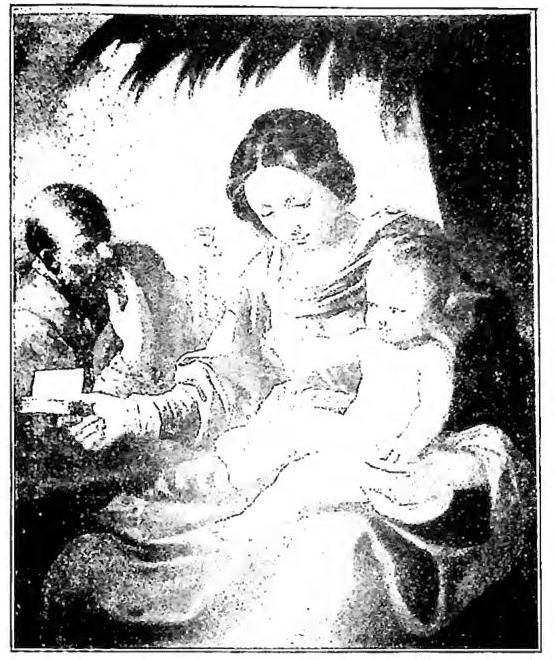
(phot. Anderson)
CANTARINI, SIMONE - Holy Family - Rome, Colonna Gallery.
and used as occasion required, to facilitate the rapid composition of the short poem.
In short, there is discernible in them a kind of “aedistic style,” by which it is impossible to distinguish the individuality of the various authors of the cantari, or to bring out their differing scope even from the standpoint of aesthetic value: these are compositions that all bear the same family resemblance, even when distant in time or originating in different regions. Compared with fairy-tale or chivalric cantari, sacred cantari generally prove to be of mediocre workmanship and scant poetic quality. None can stand comparison with the fluent ottave of the cantare of Liombruno or with the epic quality, albeit episodic, of the cantari on the Aquilan war. Nevertheless, in the better examples, such as the cantari of s. Alessio, s. Caterina, s. Giorgio, and s. Giovanni Evangelista, the qualities proper to these compositions—narrative ease, vividness, spontaneity—pervade the short poems and make them pleasant reading. On the other hand, the two aforementioned short poems, the Fanciullezza di Gesù and the Passione di Cristo, stand out for their absolute poetic value. In these, intense religious feeling finds accents among the deepest and loftiest in all Italian sacred poetry: stanzas 41c-13 of the Fanciullezza (on the silence of Gesù in the desert), and the episode of the meeting between Maria and Gesù in the Passione by Niccolò di Mino Cicerchia, deserve to enter the essential poetic heritage of every cultivated person.
The great majority of sacred cantari are still unpublished, scattered among manuscripts, incunabula, and popular prints in various libraries (the Casanatense and Corsiniana in Rome, the Nazionale in Florence, the Marciana in Venice, the library of Wolfenbüttel in Bavaria, etc.). Some have gradually been published in journals of philology or literary history, but there is as yet no critically edited collection such as that which Levi has provided for legendary cantari. The situation in this respect
is set forth in the essay by Cianciolo cited below. Important is the fact that several of these sacred cantari were reproduced in popular booklets, in crude prints for various centuries down to our own day, and that some also passed into the oral tradition of the people: certain proof of their vitality.